

Blog
Future Finance Skills Every CA & CMA Student Should Learn

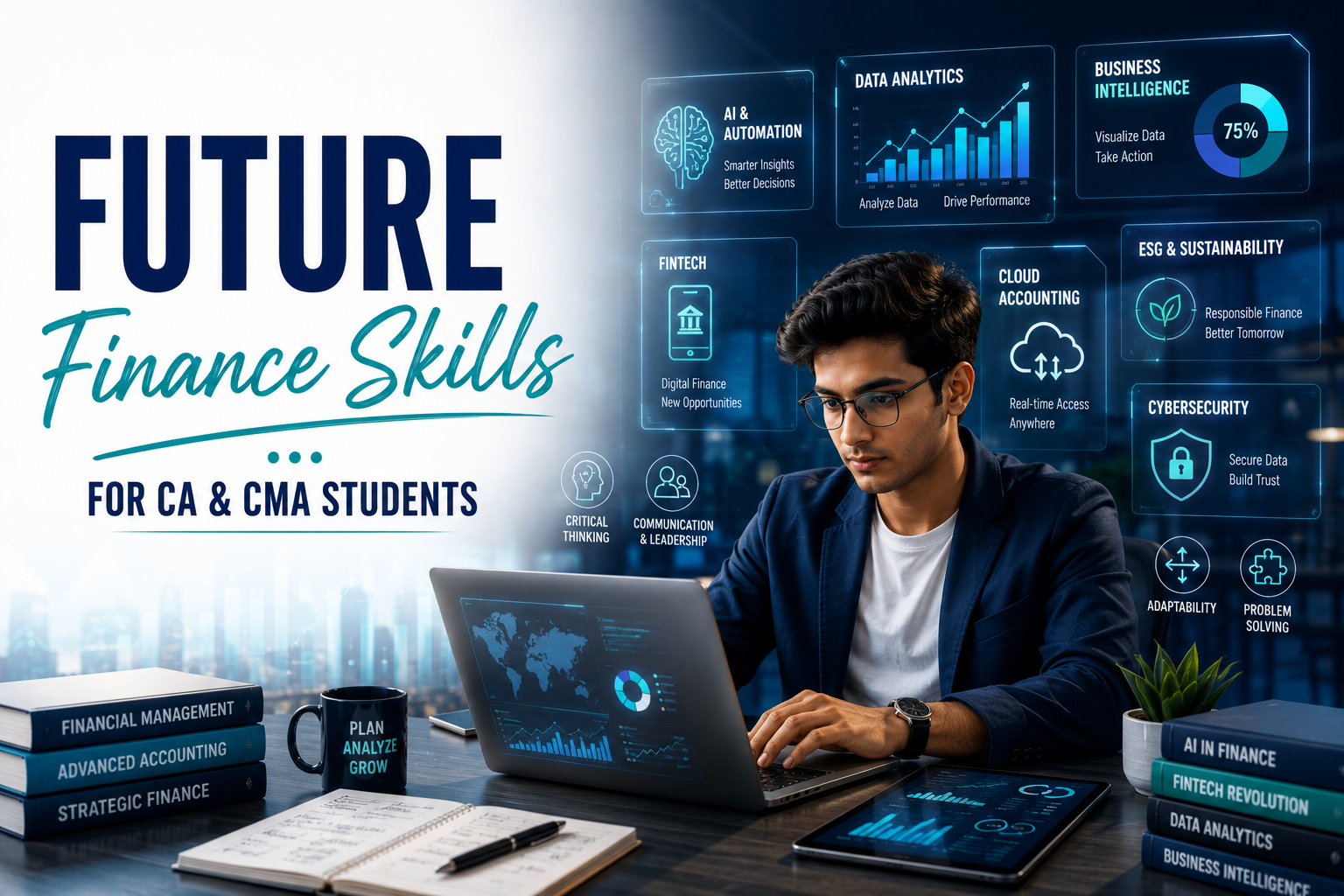
The finance industry is changing faster than ever.
Ten years ago, mastering accounting standards, taxation, auditing, and financial management was enough to build a successful career.
Today, the expectations are different.
Employers still value technical knowledge. But they also look for professionals who understand technology, data, automation, communication, and business strategy.
Think about it.
Artificial Intelligence can generate financial reports in seconds.
Business Intelligence dashboards update automatically.
Digital payments happen instantly.
Cloud accounting has become the norm for many businesses.
Yet organizations continue hiring finance professionals.
Why?
Because technology supports decision-making.
People still make the decisions.
That’s why developing the right future finance skills has become essential for every CA and CMA student.
The question is no longer, “Will finance jobs exist?”
The better question is, “What skills will finance professionals need to succeed?”
Why Future Finance Skills Matter
The finance profession has never been static.
From manual bookkeeping to accounting software.
From paper ledgers to cloud accounting.
From traditional banking to fintech.
Every decade brings new tools.
The professionals who adapt continue to grow.
Those who don’t often struggle to stay relevant.
Future-ready professionals combine technical expertise with digital skills, analytical thinking, and strong communication.
The Finance Industry Is Becoming Technology-Driven
Modern finance departments no longer work in isolation.
Today’s professionals collaborate with:
- Technology teams
- Business leaders
- Data analysts
- Compliance experts
- Product managers
- Consultants
This means finance careers increasingly require broader business knowledge.
The good news?
CA and CMA students already have a strong technical foundation.
Building additional skills becomes much easier.
1. Data Analytics
Every financial decision begins with data.
Businesses analyze:
- Revenue
- Expenses
- Customer behavior
- Market trends
- Cash flow
- Profitability
Professionals who can interpret this information become valuable assets.
Learning basic analytics and data interpretation should be a priority.
2. Artificial Intelligence (AI)
AI is transforming finance—not replacing it.
Today’s finance teams use AI for:
- Report generation
- Fraud detection
- Forecasting
- Risk assessment
- Financial planning
- Automation
Students don’t need to become AI engineers.
Understanding how AI supports finance is enough to create a competitive advantage.
3. Business Intelligence
Numbers alone don’t drive decisions.
Insights do.
Business Intelligence tools such as:
- Microsoft Power BI
- Tableau
- Google Looker Studio
help finance professionals convert raw data into interactive dashboards and visual reports.
Employers increasingly value professionals who can explain data, not just prepare it.
4. Financial Storytelling
One of the most underrated finance skills is communication.
Imagine explaining financial performance to:
- A startup founder
- A CEO
- An investor
- A marketing manager
Not everyone understands accounting terminology.
Financial storytelling helps professionals explain:
- What happened
- Why it happened
- What should happen next
That’s a skill technology cannot easily replace.
5. FinTech Awareness
Financial technology is reshaping banking and financial services.
Commerce students should understand concepts like:
- Digital Payments
- UPI
- Embedded Finance
- Open Banking
- Digital Lending
- Payment Gateways
You don’t need to build these systems.
You should understand how they work.
6. ESG and Sustainable Finance
Businesses are increasingly evaluated beyond profits.
Investors now consider:
- Environmental impact
- Social responsibility
- Corporate governance
Finance professionals are helping organizations measure and report these factors.
Sustainable finance is becoming an important career field.
7. Cloud Accounting
Businesses are moving away from traditional desktop software.
Cloud-based platforms offer:
- Real-time collaboration
- Automated backups
- Remote access
- Faster reporting
Understanding cloud accounting systems prepares students for modern workplaces.
8. Cybersecurity Awareness
Finance professionals manage sensitive financial information.
That makes cybersecurity everyone’s responsibility.
Basic knowledge of:
- Data protection
- Digital fraud
- Secure transactions
- Financial privacy
is becoming increasingly important.
9. Digital Communication
Finance professionals spend significant time explaining financial information.
Strong communication skills improve:
- Client meetings
- Presentations
- Team collaboration
- Leadership opportunities
Technical expertise creates credibility.
Communication creates influence.
10. Critical Thinking
Technology provides information.
Humans provide judgment.
Successful finance professionals ask questions like:
- Why did revenue decline?
- Which costs increased?
- What risks should management monitor?
- Which opportunities deserve investment?
Critical thinking transforms information into decisions.
11. Problem-Solving
Organizations don’t hire professionals simply to prepare reports.
They hire people who solve problems.
Examples include:
- Reducing costs
- Improving profitability
- Managing risks
- Increasing efficiency
Strong problem-solvers often become future leaders.
12. Adaptability
Perhaps the most important future finance skill is the ability to learn continuously.
Technology will continue evolving.
Regulations will change.
Business models will change.
Learning should never stop.
Professionals who remain curious rarely become obsolete.
Traditional Skills vs Future Finance Skills
| Traditional Finance Skills | Future Finance Skills |
|---|---|
| Accounting | Data Analytics |
| Taxation | Artificial Intelligence Awareness |
| Auditing | Business Intelligence |
| Costing | Financial Storytelling |
| Financial Reporting | Dashboard Visualization |
| Financial Management | FinTech Knowledge |
| Compliance | Cybersecurity Awareness |
| Excel | Power BI & Data Visualization |
| Communication | Strategic Business Thinking |
The future isn’t about replacing traditional finance skills.
It’s about expanding them.
A Learning Roadmap for CA & CMA Students
You don’t need to learn everything at once.
Here’s a practical roadmap:
First
Master your CA or CMA syllabus.
Next
Strengthen Excel skills.
Then
Learn Power BI or Tableau.
Explore
Artificial Intelligence applications in finance.
Stay Updated
Read finance and fintech news regularly.
Practice
Improve communication by explaining financial concepts in simple language.
Small, consistent improvements lead to long-term career growth.
The Future Belongs to Hybrid Professionals
The most successful finance professionals of the next decade will not be defined only by technical expertise.
They’ll combine finance with technology.
Analysis with communication.
Automation with human judgment.
Accounting with business strategy.
That’s the direction the profession is moving.
The good news?
CA and CMA students already possess one of the strongest foundations in business and finance.
Adding future-ready skills simply makes that foundation even stronger.
FAQs
What are future finance skills?
Future finance skills include data analytics, AI awareness, business intelligence, fintech knowledge, financial storytelling, cloud accounting, cybersecurity awareness, communication, and critical thinking.
Why should CA and CMA students learn future finance skills?
These skills improve employability, support career growth, and prepare students for modern finance roles where technology and business strategy work together.
Is AI replacing finance jobs?
AI is automating routine tasks, but it is also creating new opportunities in financial analysis, advisory services, risk management, data analytics, and strategic decision-making.
Which software should commerce students learn?
Students should become comfortable with Excel, Microsoft Power BI, Tableau, Google Looker Studio, and cloud accounting platforms.
Which future finance skill is the most important?
There isn’t a single answer. A combination of technical finance knowledge, data analytics, communication, business intelligence, and adaptability creates the strongest long-term career advantage.
