

Blog
Small Daily Habits That Help CA & CMA Students Succeed

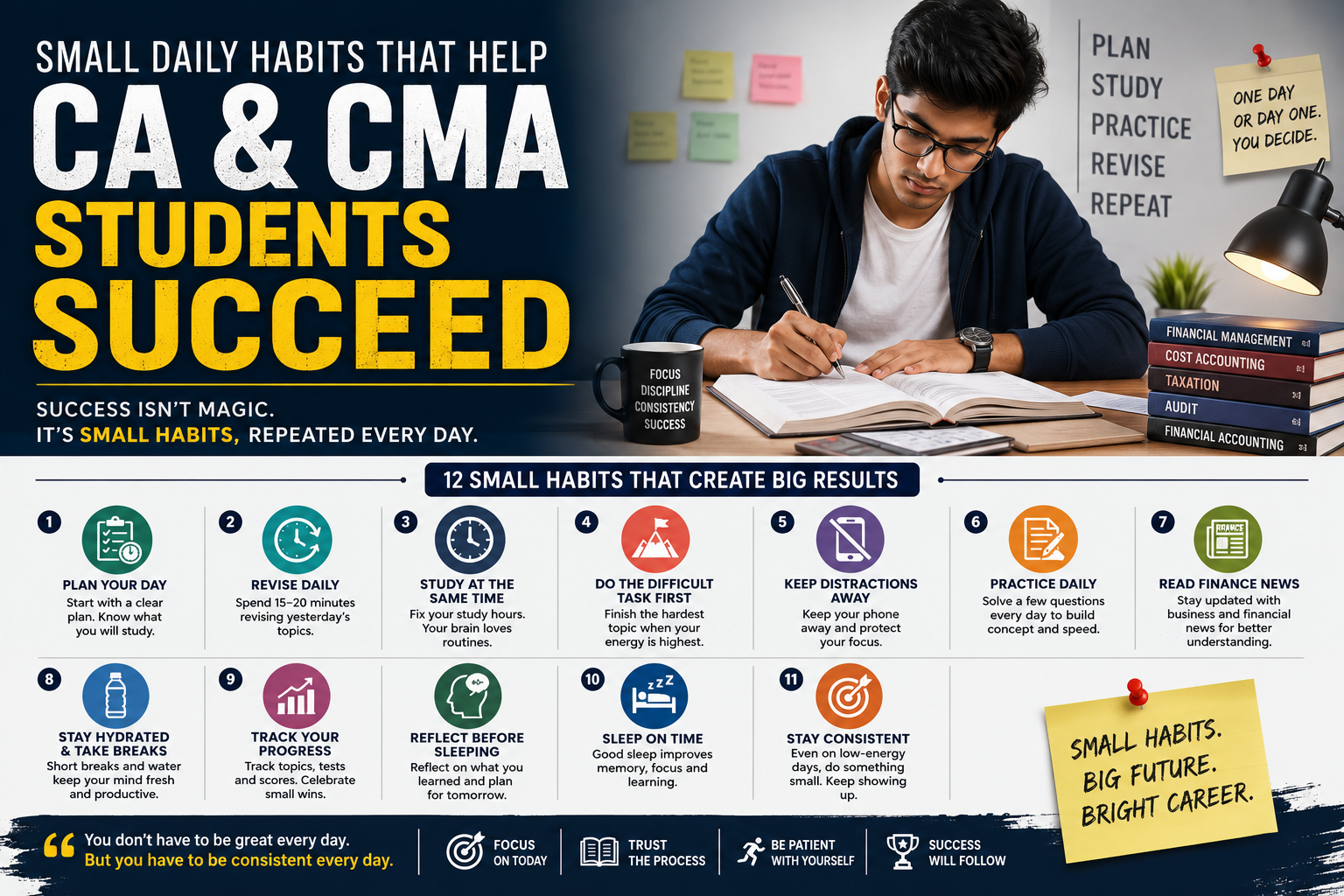
Every CA or CMA student dreams of clearing exams in the first attempt.
Most imagine success comes from extraordinary intelligence or studying for 14 hours every day.
The truth is often much simpler.
Successful students usually don’t rely on dramatic changes. They rely on small daily habits that compound over time.
Think about brushing your teeth.
It takes only a few minutes each day, but over the years, it protects your dental health.
Study habits work in much the same way.
Reading one chapter.
Revising yesterday’s notes.
Solving five practice questions.
Planning tomorrow’s schedule.
Individually, these actions seem small.
Repeated consistently, they create remarkable results.
If you’re preparing for CA or CMA, building the right success habits for students can make your journey smoother, more productive, and far less stressful.
Why Daily Habits Matter More Than Occasional Effort?
Many students believe they need to study only when exams are near.
That approach often leads to:
- Last-minute panic
- Incomplete revision
- Poor retention
- High stress
- Burnout
Small daily habits prevent these problems.
Instead of depending on motivation, they create consistency.
And consistency is what professional courses reward.
The Science Behind Small Habits
Psychologists often describe habits as automatic behaviors repeated over time.
Every time you perform a small positive action, your brain gradually requires less effort to repeat it.
Eventually, studying becomes part of your routine rather than something you constantly force yourself to do.
That’s why successful students often say,
“I don’t wait until I feel motivated. I simply follow my routine.”
12 Small Daily Habits That Lead to Big Results
1. Start Your Day with a Study Plan
Before opening your books, spend five minutes deciding:
- What will I study today?
- Which subject needs priority?
- What is today’s most important task?
A written plan reduces decision fatigue.
2. Revise Yesterday’s Topics
Many students keep moving forward without looking back.
That creates gaps.
Spend 15–20 minutes reviewing what you studied the previous day.
It strengthens long-term memory.
3. Study at the Same Time Every Day
Your brain loves routines.
When you consistently study at similar hours, concentration improves naturally.
It becomes easier to begin.
4. Complete One Difficult Task First
Every student has a subject they postpone.
Maybe it’s Costing.
Maybe Direct Tax.
Maybe Financial Management.
Start with the hardest topic while your energy is highest.
Everything else feels easier afterward.
5. Keep Your Phone Away
This habit sounds obvious.
It’s surprisingly difficult.
Even a quick notification can interrupt deep concentration.
Try placing your phone in another room during focused study sessions.
6. Solve a Few Practice Questions Daily
Reading builds understanding.
Practice builds confidence.
Even solving five questions every day improves speed and accuracy over time.
7. Read Business or Finance News
Spend 10 minutes reading reliable financial news.
This habit improves:
- Business awareness
- Analytical thinking
- Communication skills
- Interview preparation
It also helps you connect theoretical concepts with the real world.
8. Drink Water and Take Short Breaks
Productivity isn’t only about studying.
Physical well-being matters too.
Stay hydrated.
Stretch occasionally.
A refreshed mind learns faster.
9. Track Your Progress
Maintain a simple checklist.
Mark completed chapters.
Record mock test scores.
Celebrate small milestones.
Visible progress builds momentum.
10. Reflect Before Sleeping
Ask yourself:
- What did I learn today?
- What distracted me?
- What can I improve tomorrow?
Reflection turns ordinary study sessions into continuous improvement.
11. Sleep on Time
Late-night studying often feels productive.
But research consistently shows that quality sleep improves:
- Memory
- Concentration
- Problem-solving
- Decision-making
Protect your sleep.
It’s part of your preparation.
12. Stay Consistent—Even on Low-Energy Days
Some days won’t go as planned.
That’s okay.
Instead of skipping studying completely, do something small.
Read for 20 minutes.
Revise one topic.
Solve a few MCQs.
Small efforts maintain momentum.
Small Habits vs Big Last-Minute Efforts
| Small Daily Habits | Last-Minute Preparation |
|---|---|
| Consistent learning | Stressful cramming |
| Better retention | Easy to forget |
| Lower anxiety | High pressure |
| Steady confidence | Panic before exams |
| Sustainable routine | Burnout risk |
Professional courses reward consistency—not occasional intensity.
Common Habits That Reduce Productivity
Some habits quietly slow progress.
Watch out for:
- Constant phone checking
- Studying without a plan
- Skipping revision
- Comparing yourself with others
- Ignoring weak subjects
- Studying only when motivated
Replacing just one negative habit can create noticeable improvement.
How Long Does It Take to Build a Habit?
There’s no magic number.
Some habits develop within weeks.
Others take longer.
The important thing isn’t perfection.
It’s repetition.
Missing one day won’t ruin your progress.
Giving up altogether might.
A Simple Daily Routine for CA & CMA Students
| Time | Activity |
| Morning | Plan the day’s study goals |
| Study Session 1 | Difficult subject first |
| Short Break | Hydrate and stretch |
| Study Session 2 | Practice questions |
| Evening | Revise yesterday’s topics |
| Night | Reflect and prepare tomorrow’s plan |
This isn’t the only routine that works.
It’s simply an example of how small habits fit together.
Success Is Built One Day at a Time
Many students look for secret strategies.
There usually aren’t any.
Success in CA and CMA preparation comes from ordinary actions repeated consistently.
Read one chapter.
Revise one concept.
Solve one problem.
Improve by one percent each day.
Those tiny improvements become extraordinary over months.
Professional qualifications are rarely won through a single breakthrough.
They’re earned through hundreds of small decisions made every day.
Practical Tips to Stay Consistent
- Keep your study space clean.
- Prepare tomorrow’s books before sleeping.
- Study before checking social media.
- Focus on progress rather than perfection.
- Reward yourself after completing study goals.
- Avoid comparing your pace with others.
Remember:
The goal isn’t to study perfectly every day.
The goal is to keep showing up.
Final Thoughts
The difference between successful and unsuccessful students isn’t always intelligence.
Often, it’s habits.
Small habits.
Repeated consistently.
Every revision session.
Every practice question.
Every focused hour.
Every planned day.
Over time, those seemingly ordinary actions become the foundation of extraordinary success.
If you build the right habits today, your future self will thank you when exam results arrive.
Frequently Asked Questions (FAQs)
What are the best success habits for students?
Some of the best habits include planning your day, revising regularly, solving practice questions, staying consistent, reading finance news, and maintaining healthy sleep.
Why are daily habits important for CA and CMA students?
Professional courses require long-term preparation. Daily habits improve consistency, reduce stress, strengthen memory, and make revision more effective.
How can students become more consistent?
Following a fixed study schedule, tracking progress, reducing distractions, and setting realistic daily goals all help students remain consistent.
Is studying for long hours necessary?
Not always. Focused, consistent study sessions are often more effective than occasional marathon study days.
How long does it take to build productive habits?
Habit formation varies from person to person. The key is repetition, patience, and continuing even when motivation is low.
