

Blog
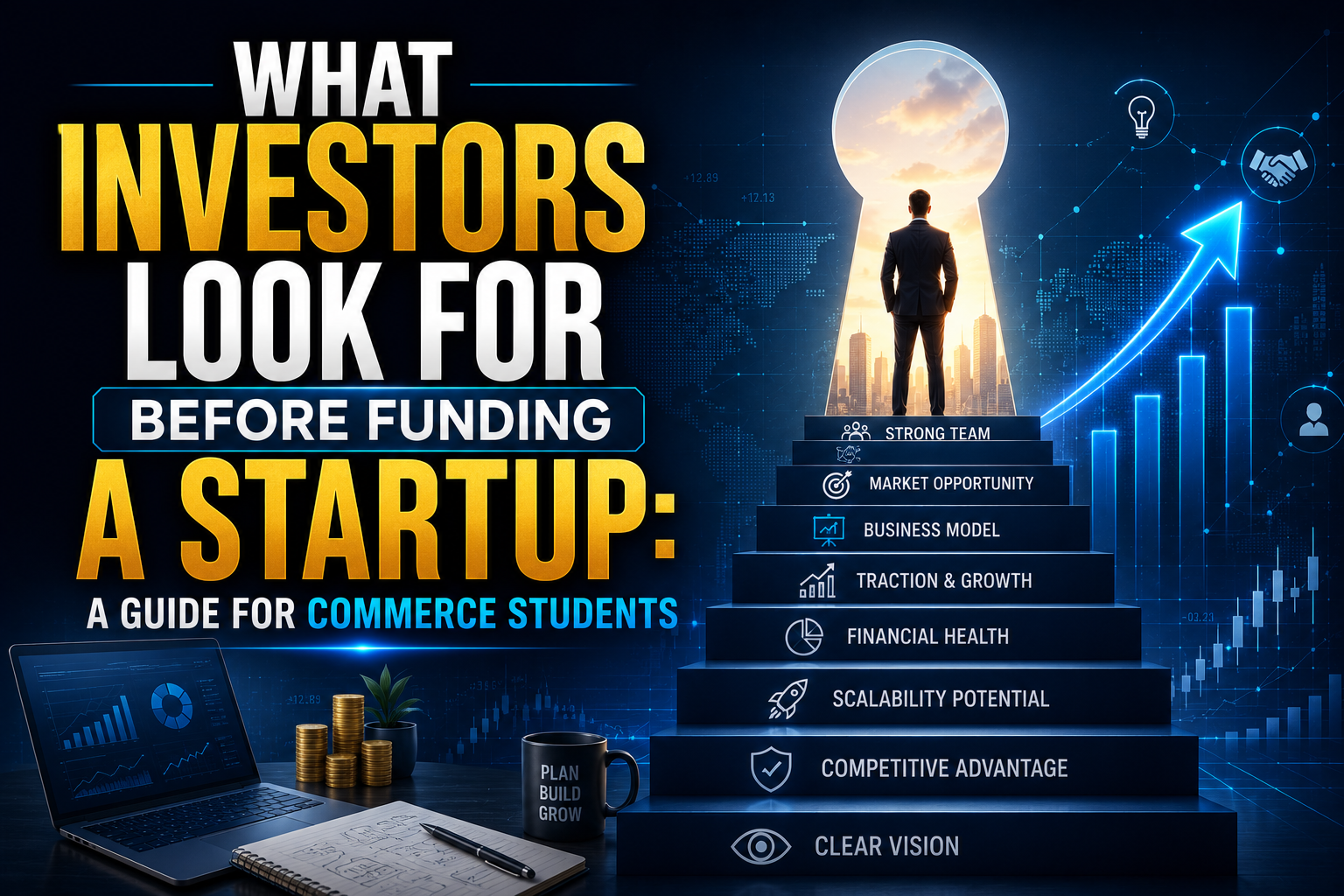
What Investors Look for Before Funding a Startup? A Guide for Commerce Students

Raising investment is one of the biggest milestones for any startup.
News headlines often celebrate funding rounds:
“Startup Raises ₹100 Crore.”
“FinTech Startup Secures Series A Investment.”
“Young Founder Raises Millions from Investors.”
But behind every funding announcement is a much longer story.
Weeks of meetings.
Months of preparation.
Countless questions.
Detailed financial analysis.
Investor negotiations.
Contrary to popular belief, investors don’t simply fund good ideas.
They invest in businesses they believe can generate long-term value.
That’s why understanding startup funding basics is valuable—not only for entrepreneurs but also for commerce students planning careers in finance, investment banking, venture capital, FP&A, consulting or corporate finance.
If you understand how investors evaluate businesses, you’ll begin looking at companies through a completely different lens.
Why Investors Don’t Invest in Ideas Alone
Every day, investors hear hundreds of business ideas.
Most sound interesting.
Only a small percentage receive funding.
Why?
Because an idea has no value until it can become a sustainable business.
Imagine two founders.
Founder A says:
“I have a great app idea.”
Founder B says:
“We have 25,000 active users, growing revenue, positive customer feedback and a clear expansion plan.”
Which startup is more likely to receive investor attention?
Usually the second.
Investors look for evidence.
Not excitement.
What Is Startup Funding?
Startup funding refers to raising money from external sources to build or grow a business.
Common funding sources include:
- Personal savings (Bootstrapping)
- Friends and family
- Bank loans
- Angel investors
- Venture Capital (VC)
- Corporate investors
- Government startup schemes
- Crowdfunding
Different businesses require different funding approaches.
Not every startup needs venture capital.
Understanding when and why businesses raise funds is one of the first lessons in startup finance.
Why Commerce Students Should Learn Startup Funding
Even if you never become a founder, funding knowledge is useful.
Many finance careers involve evaluating businesses.
Examples include:
- Investment Banking
- Equity Research
- Venture Capital
- Private Equity
- Financial Advisory
- Corporate Finance
- Business Consulting
- Startup Finance
Understanding investor thinking helps you analyse businesses more effectively.
10 Things Investors Look for Before Funding a Startup
1. A Real Problem Worth Solving
Investors first ask:
Does this business solve an important problem?
Many startups build impressive technology.
But technology alone isn’t enough.
Successful startups solve meaningful customer problems.
For example:
- Slow business payments
- Complex accounting
- Expensive financial software
- Inefficient logistics
- Limited access to education
The bigger and more frequent the problem, the greater the business opportunity may be.
2. Market Size
Even an excellent business struggles if the market is too small.
Investors often ask:
- How many customers exist?
- Is demand growing?
- Can the business expand internationally?
- Is the market large enough to support long-term growth?
Large opportunities attract more investment.
A startup solving a problem for millions of customers naturally has greater growth potential than one serving only a few hundred.
3. Strong Founding Team
Many investors say:
“We invest in founders as much as businesses.”
Why?
Because startups constantly face uncertainty.
Markets change.
Products evolve.
Competition increases.
A capable founding team adapts.
Investors evaluate qualities such as:
- Leadership
- Industry knowledge
- Commitment
- Integrity
- Problem-solving ability
- Learning mindset
A great team can improve an average idea.
The opposite is much harder.
4. Business Model
One important question every investor asks is:
How will this company make money?
The answer should be clear.
Examples include:
- Product sales
- Subscription fees
- Software licensing
- Advertising
- Transaction fees
- Consulting services
If the revenue model is confusing, investors become cautious.
5. Traction
Traction is evidence that customers actually want the product.
Examples include:
- Paying customers
- Revenue growth
- User growth
- Customer retention
- Repeat purchases
- Partnerships
Traction reduces uncertainty.
Instead of predicting future demand, investors can observe real customer behaviour.
6. Financial Numbers
Investors don’t expect every startup to be profitable immediately.
But they do expect founders to understand their numbers.
Important metrics often include:
| Financial Metric | Why It Matters |
|---|---|
| Revenue | Growth potential |
| Gross Margin | Profitability |
| Cash Burn | Spending speed |
| Runway | Survival period |
| Customer Acquisition Cost (CAC) | Marketing efficiency |
| Customer Lifetime Value (LTV) | Long-term customer value |
| Monthly Recurring Revenue (MRR) | Predictable income |
| Break-even Estimate | Financial planning |
Commerce students already study many of these concepts.
Understanding how investors use them creates practical knowledge.
7. Competitive Advantage
Investors rarely fund businesses with no competitive edge.
Ask yourself:
Why should customers choose this company?
Competitive advantages may include:
- Better technology
- Lower costs
- Strong brand
- Better customer experience
- Proprietary data
- Faster delivery
- Network effects
If competitors can easily copy the business, sustaining long-term growth becomes more difficult.
8. Scalability
Some businesses grow one customer at a time.
Others can expand rapidly.
Investors often prefer scalable business models.
Examples include:
- SaaS platforms
- FinTech
- Marketplaces
- Digital products
- Online education
Scalable businesses may serve thousands—or even millions—of customers without increasing costs proportionally.
9. Financial Discipline
Investors want founders who respect capital.
They often examine:
- Budgeting
- Cash flow management
- Spending decisions
- Financial reporting
- Working capital
A startup that burns cash without discipline creates concern.
Founders don’t need to be accountants.
They do need financial awareness.
10. Vision and Execution
Ideas inspire.
Execution creates businesses.
Investors want founders with a clear long-term vision.
But they also want evidence that the team can deliver.
Can they:
- Launch products?
- Attract customers?
- Solve problems?
- Learn quickly?
- Adapt to feedback?
Execution consistently matters more than presentations.
What Investors Usually Ask Founders
During meetings, founders often answer questions like:
- Who is your target customer?
- Why does this problem matter?
- How do you make money?
- Who are your competitors?
- What makes your solution different?
- How fast are you growing?
- How much funding do you need?
- How will the investment be used?
- When do you expect profitability?
Notice something?
Most questions involve understanding the business—not just the product.
Common Reasons Investors Reject Startups
Funding rejection doesn’t always mean the idea is poor.
Sometimes investors see risks such as:
- No market demand
- Weak business model
- Limited market size
- Poor financial planning
- Unclear pricing strategy
- Inexperienced team
- Unrealistic projections
- Weak customer traction
Understanding these reasons helps founders prepare better.
Funding Stages Explained
Commerce students should understand the common funding journey.
| Stage | Typical Purpose |
|---|---|
| Bootstrapping | Founder invests personal funds |
| Friends & Family | Early support |
| Angel Investment | Product development and validation |
| Seed Funding | Initial business growth |
| Series A | Scaling operations |
| Series B & Beyond | Expansion and market leadership |
Not every startup follows every stage.
Many successful businesses grow without venture capital.
Why Financial Projections Matter
Investors know projections won’t be perfectly accurate.
They’re looking for logical thinking.
Good financial projections usually include:
- Revenue estimates
- Expense assumptions
- Cash flow forecasts
- Hiring plans
- Break-even analysis
- Funding requirements
Unrealistic projections reduce credibility.
Reasonable assumptions build confidence.
The Importance of Unit Economics
Investors don’t simply ask:
“Are sales growing?”
They ask:
“Is every customer creating value?”
Example:
| Metric | Example |
|---|---|
| Customer Acquisition Cost | ₹2,000 |
| Customer Lifetime Value | ₹12,000 |
| Gross Margin | 70% |
If acquiring customers consistently costs more than they generate, scaling may increase losses.
Healthy unit economics indicate a stronger business model.
What Commerce Students Can Learn from Investors
You don’t need to become an investor to think like one.
Whenever you study a business, ask:
- What problem does it solve?
- Who pays?
- Is demand growing?
- Is the business profitable?
- What risks exist?
- Can it scale?
- Would I invest my own money?
These questions improve analytical thinking.
Skills That Help in Startup Finance
Commerce students interested in startup finance should gradually build skills in:
- Financial Analysis
- Business Valuation
- Excel
- Financial Modeling
- Budgeting
- Cash Flow Analysis
- Market Research
- Business Strategy
- Communication
- Presentation Skills
These skills are valuable across multiple finance careers.
A Practical Exercise
Choose a startup you admire.
Now evaluate it like an investor.
Complete this table:
| Evaluation Area | Your Observation |
|---|---|
| Problem Solved | |
| Target Market | |
| Revenue Model | |
| Competitors | |
| Growth Potential | |
| Biggest Risk | |
| Why Would You Invest? |
This simple exercise develops commercial thinking far beyond classroom learning.
Frequently Asked Questions (FAQs)
What do investors look for before funding a startup?
Investors typically evaluate the problem being solved, market size, founding team, business model, customer traction, financial performance, scalability and competitive advantage.
What is startup funding?
Startup funding is the process of raising capital from investors, lenders or other sources to build and grow a business.
Why should commerce students learn startup funding?
Understanding startup funding improves financial analysis, business evaluation and career readiness for roles in finance, consulting, investment banking and entrepreneurship.
What is traction in a startup?
Traction refers to measurable evidence that customers value the product, such as revenue growth, paying customers, user growth or repeat purchases.
What is scalability?
Scalability is the ability of a business to grow significantly without increasing costs at the same rate.
Do startups need to be profitable before raising investment?
Not necessarily. Many early-stage startups raise investment before profitability, but investors usually expect a credible business model, customer traction and a clear path toward sustainable growth.
