

Blog
CFO Career Path: How to Become a Chief Financial Officer?

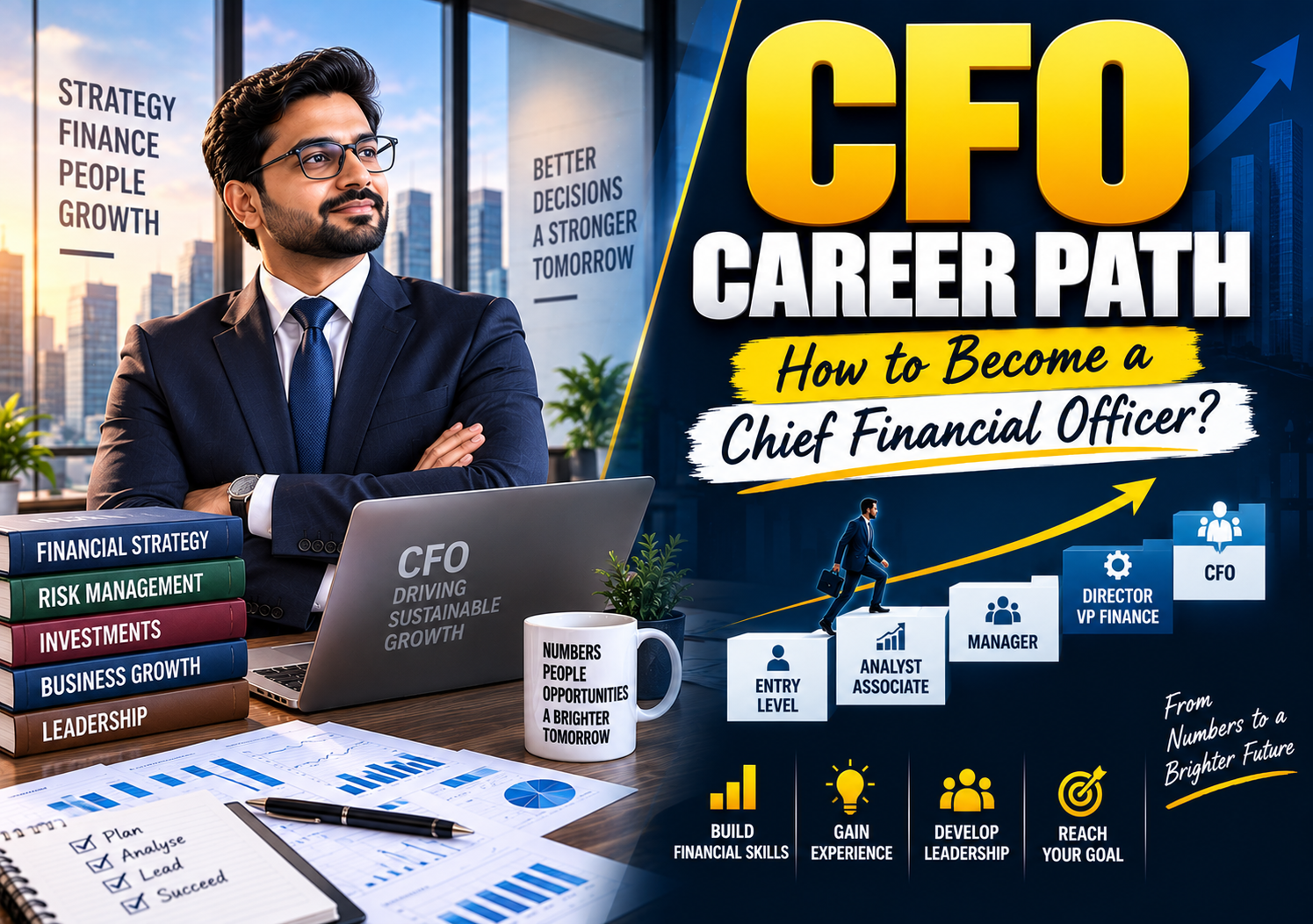
Becoming a Chief Financial Officer (CFO) is not usually a straight climb from accountant to executive. It is a gradual shift from working with numbers to making business decisions.
A CFO is responsible for much more than financial reporting. The role can involve budgeting, forecasting, cash flow, financial strategy, funding decisions, risk management and working closely with the CEO and other business leaders.
For commerce students, CA and CMA professionals, and finance graduates, the CFO career path can be a long-term goal worth planning for early.
The good news? You don’t need to know every step on day one.
What Does a CFO Do?
A CFO is the senior finance leader of an organisation.
The exact responsibilities depend on the size and type of company, but a CFO typically oversees areas such as:
- Financial reporting
- Budgeting and forecasting
- Cash flow management
- Financial planning
- Risk management
- Capital allocation
- Business performance analysis
- Investor and lender relationships
- Finance team leadership
- Long-term financial strategy
The role becomes more strategic as you move up.
A junior finance professional may ask:
“Are these numbers correct?”
A CFO is more likely to ask:
“What do these numbers mean for the business, and what should we do next?”
That change in perspective is at the heart of the CFO career path.
CFO Career Path: The Typical Journey
There isn’t one mandatory route to becoming a CFO. But a common progression looks like:
Commerce/Finance Education → Entry-Level Finance Role → Senior Finance Role → Finance Manager → Financial Controller/FP&A Leader → Finance Director/VP Finance → CFO
Not everyone follows this exact sequence.
Some professionals move through accounting and controllership. Others build careers in FP&A, corporate finance, audit, consulting or investment banking before moving into senior corporate finance positions.
Experience matters heavily at the senior level.
Step 1: Build a Strong Finance Foundation
Your starting qualification can vary.
Commerce students may begin with:
- B.Com
- B.Com (Hons.)
- M.Com
- CA
- CMA
- Other finance or business qualifications
CA and CMA can be particularly useful for developing strong accounting and financial management knowledge.
But qualifications alone don’t make a future CFO.
You also need to understand how businesses operate.
Learn the basics of:
- Financial statements
- Accounting
- Corporate finance
- Cost management
- Tax
- Budgeting
- Working capital
- Financial analysis
Step 2: Start in a Finance Role
Your first job doesn’t need to have “CFO” anywhere near the title.
Good starting roles include:
- Financial Analyst
- Accountant
- Audit Associate
- FP&A Analyst
- Finance Analyst
- Management Accountant
- Corporate Finance Analyst
At this stage, focus on learning how finance works inside a real organisation.
For example, don’t just prepare a monthly report. Try to understand why revenue changed, why costs increased and what management is likely to do about it.
That business curiosity becomes valuable later.
Step 3: Move Beyond Accounting
Accounting is an important foundation, but CFOs need a broader view.
As your career develops, gain exposure to:
FP&A
Learn how companies:
- Prepare budgets
- Forecast performance
- Analyse variances
- Track KPIs
- Support management decisions
Corporate finance
Understand:
- Capital structure
- Debt
- Equity
- Cash management
- Investment decisions
Business strategy
Learn how financial decisions connect with:
- Revenue growth
- Profitability
- Expansion
- Pricing
- Cost control
This is where a finance professional starts becoming a business partner, rather than only a numbers specialist.
Step 4: Develop Technology and Data Skills
Modern finance teams rely heavily on technology.
Excel remains essential, but it shouldn’t be the end of your learning.
Consider developing skills in:
- Advanced Excel
- Power BI
- Financial modelling
- ERP systems
- Data analysis
- Automation tools
- AI-enabled finance workflows
The goal isn’t to become a programmer.
It is to become a finance professional who can use technology to analyse information faster and make better decisions.
Step 5: Develop Leadership Skills
This is one of the biggest changes as you move toward the CFO level.
Early in your career, you may mainly manage tasks.
Later, you need to manage:
- People
- Budgets
- Projects
- Stakeholders
- Business expectations
You also need to communicate financial information to people who may not have a finance background.
A CFO might have to explain a complex cash-flow problem to a CEO in a few minutes.
Being technically correct isn’t enough.
You have to make the information understandable and useful.
Strong communication, analytical thinking, teamwork and relationship-building are widely recognised as important skills across finance careers.
Skills You Need to Become a CFO
Think of the skills in four layers.
| Career Stage | Skills to Build |
|---|---|
| Early career | Accounting, Excel, financial analysis |
| Mid-career | FP&A, budgeting, forecasting, business analysis |
| Senior management | Strategy, risk, leadership, stakeholder management |
| CFO level | Capital allocation, business strategy, leadership, communication |
The mistake is trying to learn only technical finance.
A future CFO needs both financial expertise and business judgment.
CA vs CMA vs MBA for a CFO Career
There is no single qualification that guarantees a CFO position.
Different backgrounds can lead to the role.
| Qualification | Potential Strength |
|---|---|
| CA | Accounting, audit, taxation, financial reporting |
| CMA | Cost management, management accounting, performance analysis |
| MBA Finance | Business management, strategy and finance |
| B.Com + Experience | Strong foundation when combined with relevant career growth |
A CA may begin in audit or financial reporting and later move into corporate finance.
A CMA may build a career through management accounting, FP&A or business finance.
An MBA Finance graduate may enter financial analysis, corporate finance or management roles.
The qualification opens the door.
Your experience determines how far you can go.
How Long Does It Take to Become a CFO?
There is no fixed timeline.
CFO is a senior leadership position, so it generally requires substantial finance and business experience.
Your timeline can depend on:
- Company size
- Industry
- Professional qualification
- Type of finance experience
- Leadership responsibilities
- Career progression
- Business knowledge
Someone who spends years doing only one narrow finance activity may have a different path from someone who gains experience across FP&A, controllership, treasury, strategy and business finance.
Don’t rush the title.
Build the experience that makes you capable of handling the responsibility.
What Makes a Strong Future CFO?
Here’s an important distinction.
A good finance manager can tell you what happened.
A strong CFO should be able to explain:
- What happened
- Why it happened
- What could happen next
- What the company should do
- What financial risks are involved
For example, suppose a company’s revenue rises by 20%, but cash flow falls.
A basic analysis might celebrate the revenue growth.
A CFO would want to know why cash isn’t following revenue.
Maybe receivables have increased. Maybe inventory is tying up cash. Maybe customers are taking longer to pay.
That is the difference between reporting numbers and using numbers to run a business.
Common Mistakes on the CFO Career Path
Focusing only on accounting
Accounting is essential, but CFOs need a wider understanding of business.
Chasing titles too early
A senior title without meaningful responsibility doesn’t necessarily build a strong career.
Ignoring communication
Finance leaders constantly communicate with non-finance teams.
Avoiding technology
Finance is becoming increasingly data-driven.
Staying in one narrow area
Broader experience can become increasingly valuable as you move toward senior leadership.
Thinking qualification is enough
CA, CMA, MBA or another qualification can strengthen your foundation. It cannot replace years of decision-making and leadership experience.
A Simple CFO Career Roadmap
If becoming a CFO is your long-term goal, think about your career in stages:
Stage 1 — Learn
Build accounting, finance and analytical fundamentals.
Stage 2 — Apply
Get experience in a real finance role.
Stage 3 — Broaden
Move into FP&A, corporate finance, controllership, treasury, strategy or related areas.
Stage 4 — Lead
Take responsibility for teams, budgets, projects and business decisions.
Stage 5 — Think Like an Executive
Understand the company’s entire business, not just the finance department.
Stage 6 — CFO
Lead the finance function and contribute to major business decisions.
Frequently Asked Questions
Can a B.Com graduate become a CFO?
Yes. A B.Com can provide the foundation for a finance career, but reaching CFO level requires significant professional experience, broader finance exposure and leadership development.
Can a CA become a CFO?
Yes. CA is a strong foundation for careers involving accounting, financial reporting, audit and corporate finance. With broader business and leadership experience, a CA can progress toward senior finance leadership.
Can a CMA become a CFO?
Yes. CMA’s focus on management accounting, costing and performance analysis can be useful for a corporate finance career. Additional experience in FP&A, strategy and leadership can strengthen the path.
Is an MBA necessary to become a CFO?
No. An MBA can be useful, but it isn’t the only route. Professional qualifications and relevant finance experience can also lead to senior finance leadership positions.
What is the most important skill for a future CFO?
There isn’t one. A strong CFO combines financial knowledge, analytical thinking, business understanding, communication and leadership.
Should I start with accounting or FP&A?
Either can work. Accounting provides a strong financial foundation, while FP&A offers early exposure to budgeting, forecasting and business decision-making. Your long-term career can also move between these areas.
Is CFO a good career goal for commerce students?
Yes, if you enjoy finance, business decisions and leadership. But treat CFO as a long-term career direction rather than a job you need to target immediately after graduation.
