

Blog
Cash Flow Statement vs Fund Flow Statement: Key Differences

A company may report a healthy profit but still struggle to pay its suppliers, employees or lenders. Another business may have sufficient cash today but face financial pressure because too much money is tied up in inventory and receivables.
These situations explain why financial analysis involves more than simply looking at profit.
Understanding cash flow vs fund flow statement helps students distinguish between a company’s actual cash movements and changes in its working capital and broader financial resources.
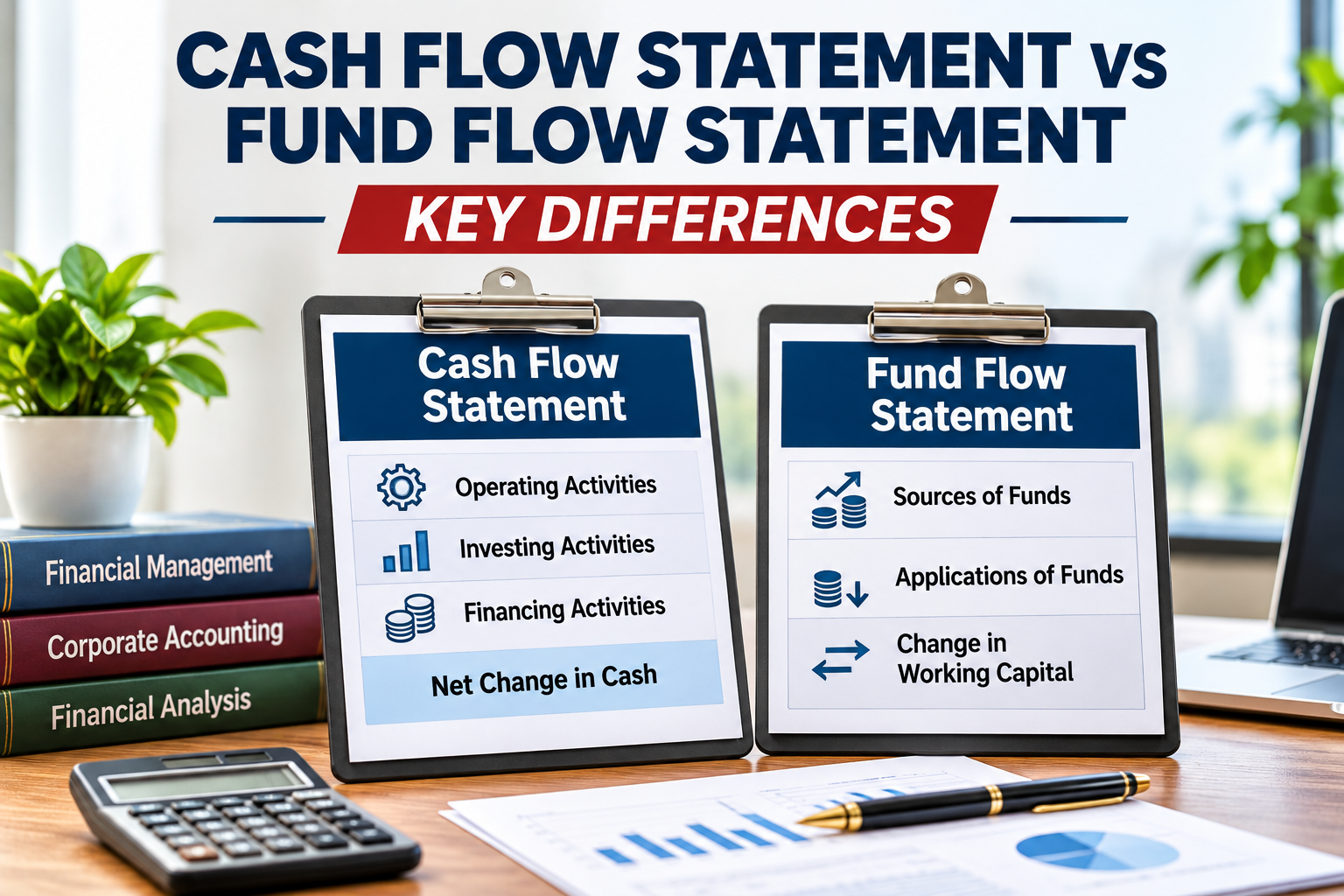
A cash flow statement explains where cash came from and how it was used during an accounting period. A traditional fund flow statement explains the sources and applications of funds, generally using working capital as the basis.
Both provide useful financial information, but they answer different questions.
What Is a Cash Flow Statement?
A cash flow statement is a financial statement that reports cash and cash equivalent inflows and outflows during a particular accounting period.
It helps explain why a company’s cash balance increased or decreased.
Cash flows are generally classified into three categories:
- Operating activities: Cash generated or used in the company’s principal revenue-producing activities.
- Investing activities: Cash used to acquire or received from disposing of long-term assets and certain investments.
- Financing activities: Cash received from or paid to providers of capital, including relevant borrowings and equity transactions.
For example, a company may receive ₹10 lakh from customers, pay ₹6 lakh to suppliers and employees, and spend ₹2 lakh purchasing equipment.
These transactions affect the company’s cash position and are reflected in the relevant sections of its cash flow statement.
In India, cash flow reporting requirements depend on the applicable accounting framework and statutory provisions. AS 3 and Ind AS 7 are important standards governing cash flow statements for entities to which they apply.
What Is a Fund Flow Statement?
A fund flow statement is a financial analysis statement that explains the sources and applications of funds between two balance sheet dates.
In traditional fund flow analysis, the term funds generally refers to working capital.
Working Capital = Current Assets − Current Liabilities
The statement helps explain how financial resources were obtained and where they were applied.
For example, a company may raise a long-term loan to purchase machinery. This represents a source of funds and an application of funds.
A fund flow statement is particularly useful for understanding long-term financing decisions and changes in working capital.
Unlike the cash flow statement, the traditional fund flow statement is generally used as a management accounting and analytical tool rather than a mandatory primary financial statement under current Indian corporate reporting frameworks.
Cash Flow vs Fund Flow Statement: Main Differences
The following table explains the key differences between cash flow and fund flow statements.
| Basis | Cash Flow Statement | Fund Flow Statement |
|---|---|---|
| Meaning | Reports cash and cash equivalent movements | Explains sources and applications of funds |
| Main focus | Cash and liquidity | Working capital and financial resource movements |
| Basis | Cash and cash equivalents | Generally working capital |
| Purpose | Explains cash receipts and payments | Explains how funds were generated and utilised |
| Classification | Operating, investing and financing activities | Sources and applications of funds |
| Time period | Prepared for an accounting period | Compares movements between two balance sheet dates |
| Working capital | Reflects relevant cash effects of working capital changes | Examines the overall movement in working capital |
| Non-cash transactions | Excluded from cash flows, with relevant separate disclosures | Certain non-cash transactions may appear in fund flow analysis |
| Reporting status | Required for entities covered by applicable standards and exemptions | Generally an internal analytical statement |
| Main usefulness | Short-term liquidity and cash management | Financing decisions and working capital analysis |
The simplest distinction is that a cash flow statement tracks movements in cash, while a traditional fund flow statement explains changes in working capital and the sources and uses of longer-term funds.
Cash Flow Statement Example
Consider ABC Manufacturing Ltd., a fictional company.
During the financial year, the company records the following cash transactions:
| Particulars | Amount |
|---|---|
| Cash received from customers | ₹20,00,000 |
| Cash paid to suppliers and employees | ₹12,00,000 |
| Cash paid for income taxes | ₹2,00,000 |
| Purchase of machinery | ₹5,00,000 |
| Long-term loan received | ₹4,00,000 |
| Loan principal repaid | ₹1,00,000 |
For simplicity, assume there are no other cash transactions and that the company applies the classifications shown below.
Simplified Cash Flow Statement
| Particulars | Amount |
|---|---|
| Cash Flow from Operating Activities | |
| Cash received from customers | ₹20,00,000 |
| Less: Payments to suppliers and employees | (₹12,00,000) |
| Less: Income taxes paid | (₹2,00,000) |
| Net Cash from Operating Activities | ₹6,00,000 |
| Cash Flow from Investing Activities | |
| Purchase of machinery | (₹5,00,000) |
| Net Cash Used in Investing Activities | (₹5,00,000) |
| Cash Flow from Financing Activities | |
| Long-term loan received | ₹4,00,000 |
| Loan principal repaid | (₹1,00,000) |
| Net Cash from Financing Activities | ₹3,00,000 |
| Net Increase in Cash | ₹4,00,000 |
The company generated ₹6 lakh from operating activities, spent ₹5 lakh on machinery and received net financing cash of ₹3 lakh.
Its cash balance therefore increased by ₹4 lakh.
If the opening cash and cash equivalents balance was ₹3 lakh, the closing balance would be:
₹3,00,000 + ₹4,00,000 = ₹7,00,000
This statement tells us how the company’s cash position changed during the year.
It does not, by itself, tell us whether the company earned ₹4 lakh in accounting profit.
Fund Flow Statement Example
Now consider a separate fictional business, XYZ Traders.
The company has the following working capital position:
| Particulars | Previous Year | Current Year |
|---|---|---|
| Current assets | ₹15,00,000 | ₹20,00,000 |
| Current liabilities | ₹8,00,000 | ₹10,00,000 |
| Working Capital | ₹7,00,000 | ₹10,00,000 |
Working capital increased from ₹7 lakh to ₹10 lakh.
Increase in Working Capital = ₹10,00,000 − ₹7,00,000 = ₹3,00,000
In traditional fund flow analysis, an increase in working capital is treated as an application of funds.
Why?
Because additional net resources have been committed to current assets after considering current liabilities.
Simplified Fund Flow Statement
Assume XYZ Traders has the following sources and applications of funds during the year:
| Sources of Funds | Amount |
|---|---|
| Funds from operations | ₹6,00,000 |
| Long-term borrowing raised | ₹4,00,000 |
| Total Sources | ₹10,00,000 |
| Applications of Funds | Amount |
|---|---|
| Purchase of fixed assets | ₹5,00,000 |
| Repayment of long-term borrowing | ₹2,00,000 |
| Increase in working capital | ₹3,00,000 |
| Total Applications | ₹10,00,000 |
The statement shows that the company generated ₹6 lakh from operations and raised ₹4 lakh through borrowing.
These funds were used to purchase fixed assets, repay existing borrowings and increase working capital.
This example demonstrates how a fund flow statement helps explain the financing and deployment of business resources.
These are illustrative figures. In an actual fund flow statement, funds from operations and working capital movements must be derived and reconciled from the relevant accounting records.
Why Cash Flow and Fund Flow Can Show Different Results
Cash and working capital are related, but they are not identical.
Consider a business that purchases inventory worth ₹2 lakh on credit.
The transaction increases inventory by ₹2 lakh and trade payables by ₹2 lakh.
At the time of purchase:
- Cash remains unchanged.
- Current assets increase by ₹2 lakh.
- Current liabilities increase by ₹2 lakh.
- Net working capital remains unchanged.
Therefore, the transaction does not create an immediate cash outflow or a net change in working capital.
Now suppose the company purchases machinery worth ₹5 lakh by paying cash.
Cash decreases by ₹5 lakh, and non-current assets increase by the same amount.
The cash flow statement records the ₹5 lakh investing cash outflow.
In traditional fund flow analysis, this purchase is an application of funds, with the corresponding reduction in working capital reflected through the working capital reconciliation.
These examples show why the two statements should not be interpreted as interchangeable.
What Are Funds from Operations?
Funds from operations is an important concept in traditional fund flow analysis.
It represents funds generated through business operations after making appropriate adjustments to accounting profit.
A simplified approach starts with profit and adjusts items that do not represent a flow of working capital.
For example, suppose a company reports profit of ₹5 lakh after charging depreciation of ₹1 lakh.
Assuming there are no other relevant adjustments:
Funds from Operations = ₹5,00,000 + ₹1,00,000 = ₹6,00,000
Depreciation is added back because it reduces accounting profit without directly representing an application of working capital.
However, funds from operations should not automatically be treated as cash generated from operating activities.
The two measures are prepared using different concepts and adjustments.
How Working Capital Affects Financial Analysis
Working capital represents the difference between current assets and current liabilities.
It is an important measure of a company’s short-term financial position.
A business may have positive working capital but still face cash shortages.
For example, imagine a retailer with:
- Inventory worth ₹15 lakh.
- Trade receivables worth ₹10 lakh.
- Cash of ₹2 lakh.
- Current liabilities of ₹12 lakh.
Its working capital is:
₹27 lakh − ₹12 lakh = ₹15 lakh
Although the business has positive working capital, only ₹2 lakh is immediately available as cash.
If customers delay payments or inventory takes longer to sell, the company may struggle to meet upcoming obligations.
This is why liquidity analysis requires more than simply calculating working capital.
For a broader understanding of the concept, read Working Capital Management Explained for Commerce Students.
Which Statement Is More Useful for Business Decisions?
The answer depends on the question being asked.
When to Use a Cash Flow Statement
A cash flow statement is particularly useful when evaluating:
- Whether a company generates cash from its operations.
- Its ability to meet upcoming payments.
- Cash spent on capital expenditure.
- Dependence on external financing.
- Changes in cash and cash equivalents.
For example, a lender may examine operating cash flows to assess whether a borrower can support future repayments.
When to Use a Fund Flow Statement
A traditional fund flow statement is useful when analysing:
- Sources of long-term finance.
- Applications of financial resources.
- Changes in working capital.
- Funding of fixed asset purchases.
- Broad financing decisions between accounting periods.
For example, management may use fund flow analysis to understand whether business expansion was financed through internal operations or additional borrowing.
Both perspectives can support financial decisions, although the cash flow statement has a more formal role in modern financial reporting.
Common Mistakes Students Make When Comparing Cash Flow and Fund Flow
Assuming Funds Always Mean Cash
In traditional fund flow statements, funds generally refer to working capital, not simply cash in hand or bank balances.
Treating Profit as Cash Flow
A profitable business may have low cash balances because customers have not paid or because money has been invested in inventory.
Profit and cash flow must be analysed separately.
Confusing Working Capital with Total Current Assets
Working capital is calculated after deducting current liabilities from current assets.
A rise in inventory does not necessarily produce an equal rise in working capital.
Assuming Every Non-Cash Transaction Is a Fund Flow
Some transactions affect neither cash nor net working capital.
For example, purchasing inventory on credit generally increases current assets and current liabilities equally.
Other non-cash transactions may require separate treatment in financial analysis.
Ignoring the Purpose of Each Statement
The cash flow statement is designed to explain cash movements.
Traditional fund flow analysis focuses on sources and applications of funds and changes in working capital.
Understanding their purposes is more useful than memorising a comparison table alone.
Why CA and CMA Students Should Understand Both Statements
For CA students, cash flow statements are an important part of financial reporting and financial statement analysis.
They help explain how operating performance translates into cash and how investing and financing decisions affect liquidity.
During practical accounting or audit work, understanding cash flow classifications can also help students examine financial transactions more carefully.
For CMA students, fund flow analysis supports the study of financial management, working capital and business financing decisions.
It helps connect operational requirements with the funds needed to support business activities.
Commerce students should also understand how these statements relate to the balance sheet and profit and loss account.
A company’s profit, cash balance and working capital can move in different directions during the same year.
Recognising those differences is an important step towards interpreting financial statements rather than simply preparing them.
Understand Financial Statements Better with Master Minds India
Learning the difference between cash flow and fund flow statements helps students understand how businesses generate cash, manage working capital and finance their operations.
For aspiring CA and CMA professionals, these concepts provide a foundation for financial reporting, accounting analysis and financial management.
Master Minds India offers educational resources for students pursuing commerce and professional accounting studies. Explore the available Master Minds courses to learn more about the educational programmes.
