

Blog
Absorption Costing vs Marginal Costing: A Practical Comparison

A manufacturing company produces 1,000 units but sells only 800 during the month. When calculating profit, should the company charge all fixed factory overheads to the current month or include part of those costs in the value of unsold inventory?
The answer depends on the costing method used.
Understanding absorption costing vs marginal costing is important for CA, CMA and commerce students because both methods calculate product costs and business profits differently.
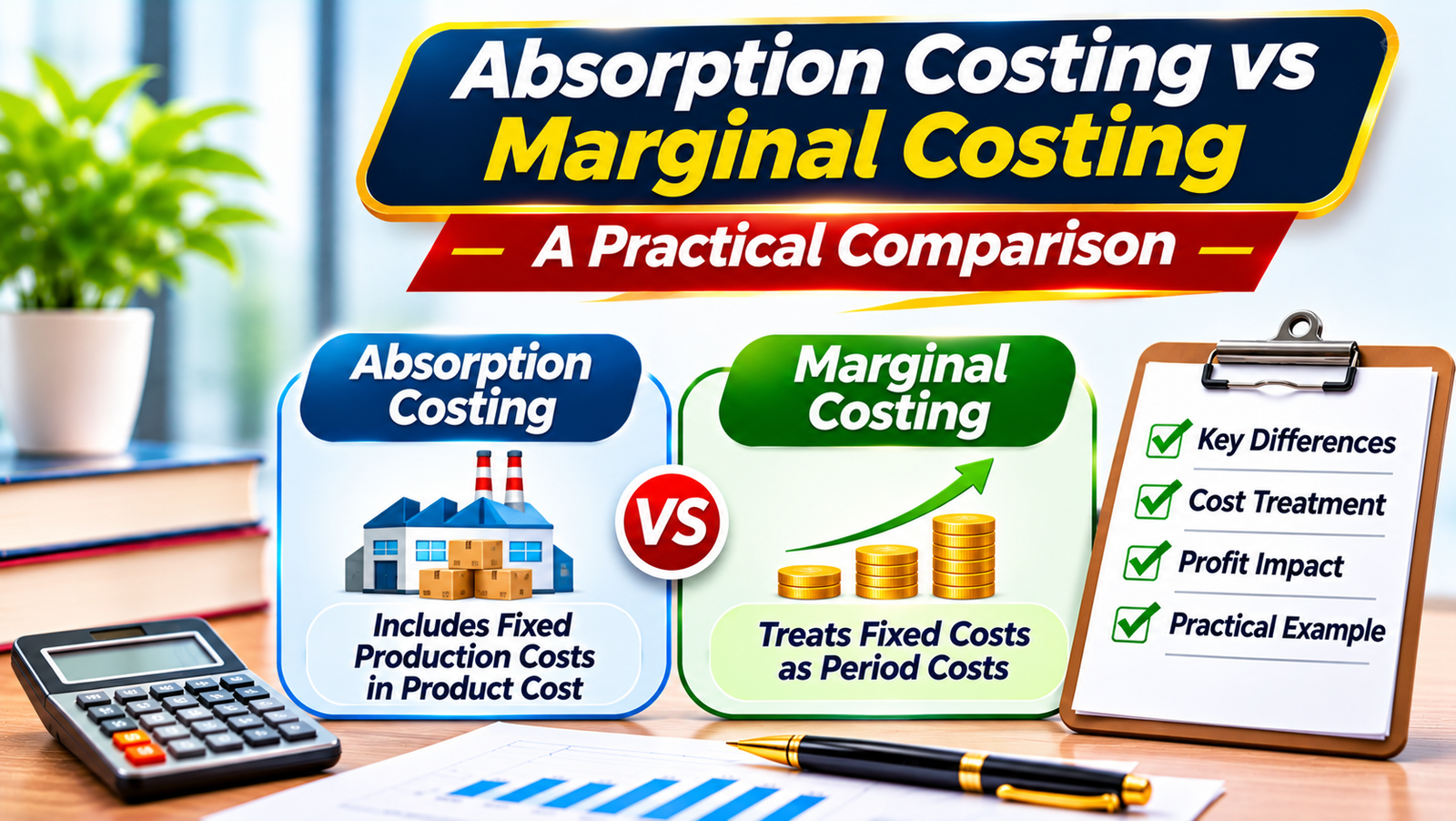
Absorption costing includes both variable and allocated fixed manufacturing costs in product costs. Marginal costing includes only variable production costs in product costs and treats fixed manufacturing overheads as period expenses.
The difference becomes particularly important when production and sales quantities are not equal.
This article explains both methods using practical business examples, costing statements, formulas and profit calculations.
What Is Absorption Costing?
Absorption costing is a costing method in which all manufacturing costs, including variable and fixed production overheads, are included in the cost of manufactured products.
It is also called full costing or full absorption costing.
Under absorption costing, product cost generally includes:
- Direct materials.
- Direct labour.
- Variable manufacturing overheads.
- Allocated fixed manufacturing overheads.
Fixed manufacturing overheads may include factory rent, depreciation of production machinery and factory supervision costs.
These costs are allocated to production using an appropriate absorption basis.
For example, a factory may allocate fixed production overheads using normal production capacity or another suitable basis, depending on the applicable accounting requirements.
Absorption Costing Formula
Absorption Cost per Unit = Direct Materials + Direct Labour + Variable Manufacturing Overheads + Allocated Fixed Manufacturing Overheads per Unit
Consider a company manufacturing office chairs.
| Cost Component | Amount per Unit |
|---|---|
| Direct materials | ₹500 |
| Direct labour | ₹300 |
| Variable manufacturing overhead | ₹100 |
| Allocated fixed manufacturing overhead | ₹200 |
| Total Absorption Cost | ₹1,100 |
The absorption cost of each chair is ₹1,100.
This amount includes both variable production costs and the allocated share of fixed manufacturing overheads.
If some chairs remain unsold, their inventory cost includes the appropriate portion of fixed production overheads.
What Is Marginal Costing?
Marginal costing is a costing technique in which variable production costs are charged to products, while fixed manufacturing overheads are treated as expenses of the accounting period.
It is also known as variable costing.
Marginal costing focuses on the relationship between sales, variable costs, contribution and fixed costs.
The main formula is:
Contribution = Sales − Variable Costs
Profit is calculated as:
Profit = Contribution − Fixed Costs
For example, suppose a company sells a product for ₹1,500.
Its variable manufacturing cost is ₹900 per unit, and its variable selling cost is ₹100 per unit.
Total variable cost per unit:
₹900 + ₹100 = ₹1,000
Contribution per unit:
₹1,500 − ₹1,000 = ₹500
This contribution is available to recover fixed costs and generate profit.
Unlike absorption costing, marginal costing does not include fixed manufacturing overheads in the value of closing inventory.
Absorption Costing vs Marginal Costing: Key Differences
The following table explains the major differences between the two methods.
| Basis | Absorption Costing | Marginal Costing |
|---|---|---|
| Meaning | Includes variable and allocated fixed production costs in product cost | Includes only variable production costs in product cost |
| Fixed manufacturing overhead | Included in product cost | Treated as a period expense |
| Product cost | Generally higher because fixed overhead is included | Excludes fixed manufacturing overhead |
| Inventory valuation | Includes allocated fixed production overhead | Excludes fixed production overhead |
| Profit calculation | Based on sales less cost of goods sold and other expenses | Based on contribution less fixed costs |
| Main focus | Full manufacturing cost | Cost behaviour and contribution |
| Profit differences | Can arise when inventory changes | Can arise when inventory changes |
| Common application | Inventory costing and financial reporting | Internal decision-making |
| Cost classification | Production and non-production costs | Fixed and variable costs |
The fundamental difference is the treatment of fixed manufacturing overhead.
Under absorption costing, an appropriate portion of fixed manufacturing overhead may remain in closing inventory.
Under marginal costing, the entire fixed manufacturing overhead for the period is charged against that period’s contribution.
Absorption Costing vs Marginal Costing: Practical Business Example
Consider ABC Manufacturing Ltd., a fictional company producing office tables.
The company has the following information for one month.
| Particulars | Amount |
|---|---|
| Selling price per table | ₹2,000 |
| Variable manufacturing cost per table | ₹1,000 |
| Fixed manufacturing overhead | ₹3,00,000 |
| Fixed selling and administrative expenses | ₹1,00,000 |
| Units produced | 1,000 |
| Units sold | 800 |
| Opening inventory | Nil |
Assume the factory operates at normal production capacity, fixed manufacturing overhead is allocated at ₹300 per unit, and there are no variable selling expenses.
The company produces 1,000 tables but sells only 800.
Closing inventory:
1,000 − 800 = 200 tables
Let us calculate profit under both methods.
Profit Calculation Under Absorption Costing
Under absorption costing, fixed manufacturing overhead is included in product cost.
Step 1: Calculate Fixed Manufacturing Overhead per Unit
Fixed manufacturing overhead per unit:
₹3,00,000 ÷ 1,000 = ₹300
Step 2: Calculate Absorption Cost per Unit
| Cost Component | Amount per Unit |
|---|---|
| Variable manufacturing cost | ₹1,000 |
| Fixed manufacturing overhead | ₹300 |
| Absorption Cost per Unit | ₹1,300 |
Step 3: Calculate Sales Revenue
800 × ₹2,000 = ₹16,00,000
Step 4: Calculate Cost of Goods Sold
800 × ₹1,300 = ₹10,40,000
Step 5: Calculate Closing Inventory
200 × ₹1,300 = ₹2,60,000
The closing inventory includes both variable manufacturing costs and allocated fixed manufacturing overheads.
Absorption Costing Profit Statement
| Particulars | Amount |
|---|---|
| Sales Revenue | ₹16,00,000 |
| Less: Cost of Goods Sold | ₹10,40,000 |
| Gross Profit | ₹5,60,000 |
| Less: Fixed Selling and Administrative Expenses | ₹1,00,000 |
| Operating Profit | ₹4,60,000 |
ABC Manufacturing reports an operating profit of ₹4,60,000 under absorption costing.
A portion of fixed manufacturing overhead remains included in the value of unsold inventory.
Profit Calculation Under Marginal Costing
Under marginal costing, only variable manufacturing costs are included in product cost.
Fixed manufacturing overhead is treated as a period expense.
Step 1: Calculate Variable Cost of Goods Sold
800 × ₹1,000 = ₹8,00,000
Step 2: Calculate Contribution
Sales − Variable Costs
₹16,00,000 − ₹8,00,000 = ₹8,00,000
Step 3: Calculate Total Fixed Costs
Fixed manufacturing overhead: ₹3,00,000
Fixed selling and administrative expenses: ₹1,00,000
Total fixed costs:
₹3,00,000 + ₹1,00,000 = ₹4,00,000
Step 4: Calculate Profit
₹8,00,000 − ₹4,00,000 = ₹4,00,000
Marginal Costing Profit Statement
| Particulars | Amount |
|---|---|
| Sales Revenue | ₹16,00,000 |
| Less: Variable Cost of Goods Sold | ₹8,00,000 |
| Contribution | ₹8,00,000 |
| Less: Fixed Manufacturing Overhead | ₹3,00,000 |
| Less: Fixed Selling and Administrative Expenses | ₹1,00,000 |
| Operating Profit | ₹4,00,000 |
ABC Manufacturing reports an operating profit of ₹4,00,000 under marginal costing.
Closing inventory is valued at:
200 × ₹1,000 = ₹2,00,000
The fixed manufacturing overhead is excluded from closing inventory.
Why Is Profit Different Under the Two Methods?
The company reports different profits even though sales revenue, production costs and operating activities remain unchanged.
| Particulars | Absorption Costing | Marginal Costing |
|---|---|---|
| Sales Revenue | ₹16,00,000 | ₹16,00,000 |
| Cost of Goods Sold / Variable Cost of Goods Sold | ₹10,40,000 | ₹8,00,000 |
| Contribution | Not separately calculated in this statement | ₹8,00,000 |
| Fixed Manufacturing Overhead Charged to Period | Included in cost of goods sold | ₹3,00,000 |
| Fixed Selling and Administrative Expenses | ₹1,00,000 | ₹1,00,000 |
| Operating Profit | ₹4,60,000 | ₹4,00,000 |
| Closing Inventory | ₹2,60,000 | ₹2,00,000 |
The profit difference is:
₹4,60,000 − ₹4,00,000 = ₹60,000
Why does this difference arise?
Under absorption costing, the 200 unsold tables carry fixed manufacturing overhead of:
200 × ₹300 = ₹60,000
This amount remains in closing inventory rather than being recognised as an expense during the current month.
Under marginal costing, the entire ₹3,00,000 fixed manufacturing overhead is charged to the current period.
Therefore, absorption costing reports ₹60,000 more profit in this example.
Formula for Profit Difference Between Absorption and Marginal Costing
When the fixed manufacturing overhead absorption rate is consistent and there are no complicating factors, the profit difference can be calculated as:
Profit Difference = Change in Inventory Units × Fixed Manufacturing Overhead Rate per Unit
For the ABC Manufacturing example:
Change in inventory = 200 units
Fixed manufacturing overhead rate = ₹300 per unit
Profit difference:
200 × ₹300 = ₹60,000
This agrees with the calculated difference between the two profit statements.
The formula is useful for examination problems, but it should be applied carefully.
When opening and closing inventory carry different fixed overhead rates, or when under-absorption or over-absorption adjustments arise, a more detailed reconciliation may be required.
What Happens When Production Is Greater Than Sales?
When production exceeds sales, closing inventory generally increases.
Under absorption costing, some fixed manufacturing overhead remains included in closing inventory.
Under marginal costing, fixed manufacturing overhead is charged entirely to the current period.
Therefore, assuming consistent overhead rates and no other adjustments:
Absorption costing profit is generally higher than marginal costing profit when inventory increases.
Consider the previous example.
- Production: 1,000 units.
- Sales: 800 units.
- Inventory increase: 200 units.
- Fixed overhead rate: ₹300 per unit.
The additional fixed overhead included in inventory is ₹60,000.
This explains the higher absorption costing profit.
What Happens When Sales Are Greater Than Production?
When sales exceed production, a company generally sells part of its opening inventory.
Under absorption costing, the fixed manufacturing overhead included in opening inventory becomes part of the cost of goods sold.
Under marginal costing, those fixed manufacturing overheads were already charged as expenses in earlier periods.
As a result, marginal costing profit is generally higher when inventory decreases, assuming consistent overhead rates and no other complicating factors.
Practical Example
Suppose a company has:
- Opening inventory: 300 units.
- Closing inventory: 100 units.
- Fixed manufacturing overhead rate: ₹200 per unit.
Inventory decreases by:
300 − 100 = 200 units
The fixed overhead associated with the inventory reduction is:
200 × ₹200 = ₹40,000
Under the simplified assumptions, marginal costing profit would be ₹40,000 higher than absorption costing profit.
The difference arises because absorption costing releases fixed manufacturing overhead previously included in opening inventory.
What Happens When Production Equals Sales?
When production equals sales and opening and closing inventory levels remain unchanged, the two methods generally report the same profit, assuming consistent fixed overhead absorption rates and no other adjustments.
For example, suppose a company produces and sells 1,000 units.
There is no change in finished goods inventory.
All fixed manufacturing overhead allocated to the units produced is included in the cost of goods sold under absorption costing.
Under marginal costing, the same fixed manufacturing overhead is charged as a period expense.
Therefore, the timing difference disappears under the stated assumptions.
Summary of Profit Differences
| Inventory Movement | General Profit Relationship |
|---|---|
| Inventory increases | Absorption costing profit is higher |
| Inventory decreases | Marginal costing profit is higher |
| Inventory remains unchanged | Profits are generally equal |
These relationships assume consistent overhead absorption rates and no unusual inventory or overhead adjustments.
Treatment of Fixed Manufacturing Overheads
Fixed manufacturing overhead is the most important area of difference between absorption and marginal costing.
Examples include:
- Factory building rent.
- Depreciation of production machinery.
- Salaries of factory supervisors.
- Factory insurance.
- Other fixed production-related costs.
Under Absorption Costing
Fixed manufacturing overhead is allocated to products using an appropriate basis.
For external financial reporting under Ind AS 2, the allocation of fixed production overheads is based on normal capacity.
When production is unusually low, the fixed overhead allocated to each unit is not increased merely to absorb all fixed costs.
Unallocated overheads are recognised as expenses in the period in which they are incurred.
Under Marginal Costing
Fixed manufacturing overhead is treated as a period cost.
It is not included in the cost of closing inventory.
Instead, it is deducted from contribution when calculating profit.
This makes marginal costing useful for understanding how fixed costs affect overall profitability.
Absorption Costing vs Marginal Costing for Inventory Valuation
Inventory valuation is another important difference between the two methods.
Under absorption costing, inventory includes qualifying variable and allocated fixed production costs.
Under marginal costing, inventory includes variable production costs but excludes fixed manufacturing overhead.
Consider a company with:
- Variable manufacturing cost per unit: ₹700.
- Allocated fixed manufacturing overhead per unit: ₹200.
- Closing inventory: 500 units.
Absorption Costing Inventory Value
500 × (₹700 + ₹200)
= ₹4,50,000
Marginal Costing Inventory Value
500 × ₹700
= ₹3,50,000
Difference:
₹4,50,000 − ₹3,50,000 = ₹1,00,000
The difference represents fixed manufacturing overhead included in closing inventory under absorption costing.
For financial reporting under applicable inventory accounting standards, qualifying fixed production overhead generally forms part of inventory cost.
This is why absorption costing is relevant to external financial reporting.
Advantages of Absorption Costing
Absorption costing provides several benefits.
Includes Full Manufacturing Costs
It considers both variable and fixed manufacturing costs when determining product cost.
Supports Inventory Valuation
It provides a basis for valuing manufactured inventory in accordance with applicable accounting standards.
Useful for Long-Term Cost Analysis
Understanding full manufacturing costs can help businesses evaluate long-term pricing and production decisions.
Supports Financial Reporting
Absorption costing is consistent with the general requirement to allocate qualifying fixed manufacturing overheads to inventory under applicable accounting standards.
However, the method requires appropriate allocation procedures and should not be used to justify arbitrary overhead absorption.
Limitations of Absorption Costing
Fixed Overhead Allocation Can Be Complex
Allocating fixed manufacturing overheads to products requires a suitable absorption basis.
Different allocation methods can affect reported product costs.
Profit May Be Influenced by Inventory Changes
When inventory increases, some fixed manufacturing overhead remains capitalised in closing inventory.
This can result in higher reported profit even when sales do not increase.
Less Direct for Short-Term Decisions
Full product cost includes allocated fixed overheads that may not change when a business accepts an additional order.
Therefore, absorption cost per unit may not always represent the relevant incremental cost of a short-term decision.
Advantages of Marginal Costing
Helps Analyse Contribution
Marginal costing clearly separates sales, variable costs, contribution and fixed costs.
Useful for Break-Even Analysis
Contribution calculations help businesses determine the sales volume required to cover fixed costs.
Supports Short-Term Decisions
Management can use marginal costing to evaluate special orders, pricing decisions and product selection.
Helps Understand Cost Behaviour
Separating fixed and variable costs makes it easier to analyse how profitability changes with sales volume.
Limitations of Marginal Costing
Fixed Costs Are Excluded from Product Cost
Marginal costing does not allocate fixed manufacturing overheads to products.
This can make it unsuitable as the sole basis for external inventory valuation.
Cost Classification May Be Difficult
Some costs contain both fixed and variable elements.
Separating these components may require estimates.
Not Sufficient for Every Long-Term Decision
Long-term pricing and investment decisions must consider fixed costs, capacity requirements and other relevant financial factors.
Assumptions May Change
Marginal costing often assumes that variable cost per unit and fixed costs remain stable within a relevant activity range.
In practice, these relationships may change as production expands.
Which Costing Method Is Better for Business Decisions?
Neither method is universally better.
The appropriate method depends on the purpose of the analysis.
Absorption costing is important when businesses need to determine full manufacturing costs and prepare inventory valuations under applicable financial reporting requirements.
Marginal costing is particularly useful when management needs to understand contribution and evaluate short-term decisions.
For example, a manufacturer considering an additional order may use marginal costing to estimate the extra contribution from that order.
However, when evaluating long-term product pricing, the company must also consider fixed costs, capital investment, demand and the required return.
Many businesses therefore use different costing information for different management purposes.
Common Mistakes Students Make in Absorption and Marginal Costing
Including Fixed Manufacturing Overheads in Marginal Product Cost
Under marginal costing, fixed manufacturing overheads are treated as period expenses.
They are not included in the variable manufacturing cost of inventory.
Excluding Fixed Manufacturing Overheads from Absorption Cost
Absorption costing includes an appropriate allocation of fixed manufacturing overhead in product cost.
Ignoring this allocation can understate inventory values.
Confusing Contribution with Gross Profit
Contribution is calculated by deducting variable costs from sales.
Gross profit under absorption costing is generally calculated after deducting the absorption-based cost of goods sold.
These are different measures.
Assuming Profit Differences Always Exist
When inventory levels remain unchanged and other relevant assumptions hold, absorption costing and marginal costing generally produce the same profit.
Ignoring Opening and Closing Inventory
Profit reconciliation requires careful consideration of inventory movements.
Changes in inventory determine how much fixed manufacturing overhead is carried forward or released under absorption costing.
Using Marginal Costing for External Inventory Reporting Without Adjustments
Marginal costing excludes fixed production overhead from inventory.
Financial reporting under applicable standards generally requires qualifying fixed production overhead to be included.
Therefore, adjustments may be necessary when moving from internal marginal costing reports to external financial statements.
Why CA and CMA Students Should Understand Both Methods
Absorption costing and marginal costing are important concepts in cost and management accounting.
For CA students, understanding these methods helps build knowledge of inventory valuation, cost behaviour, profit reconciliation and management decision-making.
Students should be able to prepare costing statements and explain why profit differs when production and sales quantities are unequal.
For CMA students, the distinction is especially relevant to product costing, budgeting, contribution analysis and performance evaluation.
Management accountants frequently need to understand both the full cost of production and the incremental cost of business decisions.
Commerce students preparing for accounting and finance roles should also understand how different costing methods affect reported profit and inventory values.
The essential distinction is straightforward: absorption costing includes allocated fixed manufacturing overhead in product costs, while marginal costing treats fixed manufacturing overhead as a period expense.
Strengthen Your Cost Accounting Knowledge with Master Minds India
Understanding absorption costing and marginal costing helps students connect production costs, inventory valuation and profit measurement. Learning how to prepare costing statements and reconcile profits builds a strong foundation for cost accounting, management accounting and business decision-making.
Master Minds India provides educational resources for commerce students and aspiring CA and CMA professionals. Explore the available Master Minds courses to learn more about the educational programmes.
