

Blog
Bad Debts and Provision for Doubtful Debts: Accounting Treatment

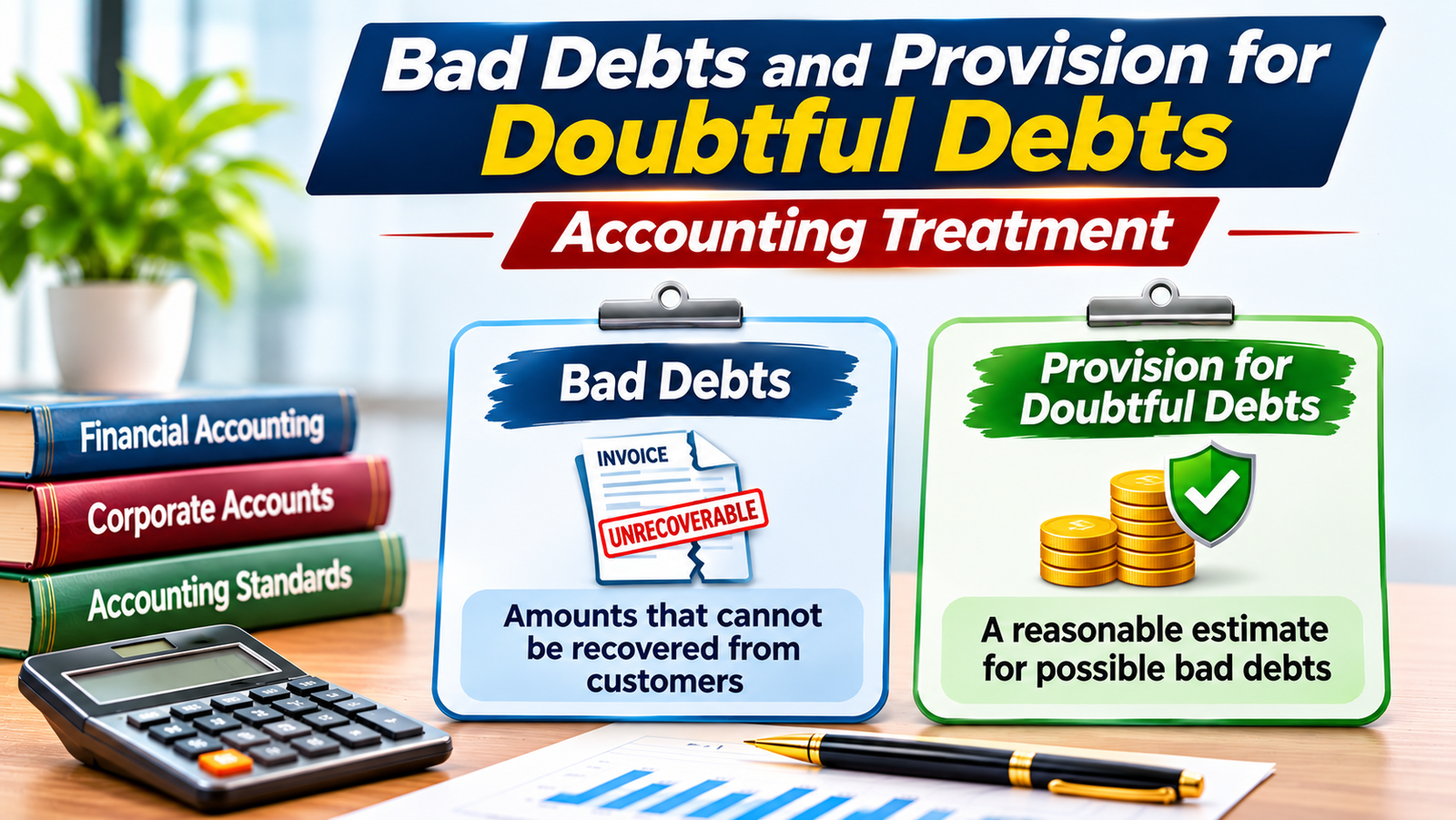
When a business sells goods or services on credit, it expects customers to pay within the agreed period. However, some customers may delay payment, face financial difficulties or fail to pay altogether.
This creates two important accounting concepts: bad debts and provision for doubtful debts.
A bad debt is a receivable that a business determines is uncollectible and writes off. A provision for doubtful debts, a term commonly used in traditional accounting, is an estimate of potential losses from customers who may not pay their outstanding balances.
Both concepts help businesses avoid overstating receivables and profits. They are particularly important for CA, CMA and commerce students studying financial accounting, final accounts, financial reporting and auditing.
What Are Bad Debts in Accounting?
Bad debts arise when a business determines that an amount owed by a customer cannot be recovered.
For example, ABC Traders sells goods worth ₹50,000 to a customer on credit. The customer later becomes insolvent, and the business determines that the amount is uncollectible.
The ₹50,000 receivable is written off as a bad debt.
In traditional accounting, this is recorded as a loss because the company will no longer receive the expected payment.
Common Reasons for Bad Debts
- A customer becomes insolvent or bankrupt.
- A business closes without settling its outstanding invoices.
- A customer cannot be contacted despite reasonable recovery efforts.
- A long-overdue balance is determined to be uncollectible.
- A legal or commercial dispute makes recovery unlikely.
An overdue invoice is not automatically a bad debt. Businesses must assess the circumstances before deciding whether an amount should be written off.
Journal Entry for Bad Debts
Suppose ABC Traders has a customer balance of ₹40,000 that is determined to be uncollectible.
Under the traditional direct write-off approach, the journal entry is:
| Account | Debit (₹) | Credit (₹) |
|---|---|---|
| Bad Debts A/c | 40,000 | |
| Trade Receivables A/c | 40,000 |
The entry reduces trade receivables by ₹40,000 and recognises the loss.
At the end of the accounting period, the Bad Debts Account is closed to the Profit and Loss Account under traditional bookkeeping.
However, under modern financial reporting standards such as Ind AS 109, credit losses are generally recognised through an expected credit loss allowance before an individual receivable is written off. The appropriate write-off entry therefore depends on whether an allowance has already been recognised.
What Is Provision for Doubtful Debts?
Provision for doubtful debts is a traditional accounting term for an estimated amount of receivables that may not be collected.
It is created when a business expects that some customers may fail to pay, even though the specific amount ultimately lost is not yet known.
For example, a company has outstanding customer balances of ₹10,00,000.
Based on its experience and assessment of collection risks, it estimates that 5% may not be recovered.
Estimated doubtful debts:
₹10,00,000 × 5% = ₹50,000
The business recognises an estimated loss of ₹50,000.
In traditional accounting textbooks, this is called a provision for doubtful debts.
In financial reporting under Ind AS 109, the corresponding concept is generally an expected credit loss (ECL) allowance.
This distinction matters because an allowance for credit losses is a reduction in the carrying amount of financial assets, not a provision liability under Ind AS 37.
Bad Debts vs Provision for Doubtful Debts: Key Differences
| Basis | Bad Debts | Provision for Doubtful Debts |
|---|---|---|
| Meaning | Receivables determined to be uncollectible | Estimated losses on outstanding receivables |
| Nature | Identified credit loss or write-off | Estimated credit loss |
| Timing | Written off when recovery is no longer reasonably expected | Recognised based on expected collection losses |
| Amount | Relates to identified receivables | Based on an assessment of outstanding receivables |
| Accounting treatment | Receivable is written off | Loss allowance is recognised or adjusted |
| Effect on receivables | Removes the written-off amount | Reduces the net carrying amount |
| Example | Customer’s ₹20,000 balance written off | Estimated 5% loss on receivables |
| Modern reporting | Write-off under applicable financial instruments rules | Expected credit loss allowance under Ind AS 109 |
The main difference is that bad debt write-off removes an amount no longer expected to be recovered, while a doubtful debt allowance recognises expected losses before final write-off.
Practical Example of Provision for Doubtful Debts
Consider a fictional company, Sunrise Electronics Pvt. Ltd.
At the end of the financial year, its trade receivables total ₹8,00,000.
Management assesses the outstanding balances and estimates that ₹40,000 may not be recovered.
For this simplified example, assume there is no existing doubtful debt allowance.
Step 1: Calculate the Estimated Loss
Estimated doubtful debts = ₹40,000
This represents 5% of total receivables.
Step 2: Record the Adjusting Entry
| Account | Debit (₹) | Credit (₹) |
|---|---|---|
| Doubtful Debts Expense A/c | 40,000 | |
| Allowance for Doubtful Debts A/c | 40,000 |
The expense reduces profit.
The allowance reduces the net amount of trade receivables reported in the balance sheet.
Step 3: Calculate Net Trade Receivables
| Particulars | Amount |
|---|---|
| Gross trade receivables | ₹8,00,000 |
| Less: Allowance for doubtful debts | (₹40,000) |
| Net Trade Receivables | ₹7,60,000 |
The company reports net receivables of ₹7.6 lakh.
This does not mean that ₹40,000 has already been written off against specific customer balances. It represents the estimated credit loss recognised at the reporting date.
Accounting Treatment When a Bad Debt Is Written Off
Suppose Sunrise Electronics subsequently determines that a customer’s outstanding balance of ₹15,000 is uncollectible.
Assume the company has already recognised an adequate allowance for credit losses.
The write-off entry is:
| Account | Debit (₹) | Credit (₹) |
|---|---|---|
| Allowance for Doubtful Debts A/c | 15,000 | |
| Trade Receivables A/c | 15,000 |
After the write-off:
- Gross trade receivables decrease by ₹15,000.
- The allowance decreases by ₹15,000.
- There is no additional expense from this write-off if the loss was already fully recognised.
The business must continue reviewing the remaining receivables and adjust its loss allowance when necessary.
How to Calculate Provision for Doubtful Debts in Final Accounts?
In traditional accounting examinations, students frequently encounter questions requiring a provision calculated as a percentage of debtors.
Consider the following information:
| Particulars | Amount |
|---|---|
| Sundry debtors | ₹5,00,000 |
| Additional bad debts to be written off | ₹20,000 |
| Required provision for doubtful debts | 5% |
Step 1: Deduct Additional Bad Debts
Adjusted debtors:
₹5,00,000 − ₹20,000 = ₹4,80,000
Step 2: Calculate the Required Provision
₹4,80,000 × 5% = ₹24,000
Step 3: Determine Net Debtors
| Particulars | Amount |
|---|---|
| Sundry debtors | ₹5,00,000 |
| Less: Additional bad debts | (₹20,000) |
| Balance after bad debts | ₹4,80,000 |
| Less: Provision for doubtful debts | (₹24,000) |
| Net Debtors | ₹4,56,000 |
The balance sheet reports net debtors of ₹4,56,000.
Assuming no existing provision, the profit and loss account includes:
- Bad debts expense: ₹20,000.
- Provision for doubtful debts expense: ₹24,000.
Total charge: ₹44,000.
This is a traditional examination-style calculation. In modern financial reporting, an expected credit loss allowance must follow the applicable impairment requirements rather than automatically applying a fixed percentage.
Adjustment of Existing Provision for Doubtful Debts
One of the most common mistakes in accounting problems is charging the entire closing provision to profit when an opening provision already exists.
Only the required adjustment is generally recognised as an additional expense or reversal.
Example: Increase in Provision
Suppose a business has:
- Existing provision: ₹15,000.
- Required closing provision: ₹25,000.
Additional provision required:
₹25,000 − ₹15,000 = ₹10,000
The adjusting entry is:
| Account | Debit (₹) | Credit (₹) |
|---|---|---|
| Doubtful Debts Expense A/c | 10,000 | |
| Allowance for Doubtful Debts A/c | 10,000 |
The business recognises an additional expense of ₹10,000.
Example: Decrease in Provision
Now assume:
- Existing provision: ₹30,000.
- Required closing provision: ₹20,000.
The allowance must decrease by ₹10,000.
| Account | Debit (₹) | Credit (₹) |
|---|---|---|
| Allowance for Doubtful Debts A/c | 10,000 | |
| Reversal of Doubtful Debts Expense A/c | 10,000 |
This reversal increases profit, assuming no other adjustments.
The important principle is to compare the existing allowance balance with the newly required closing balance.
Recovery of Bad Debts Previously Written Off
Sometimes a customer pays an amount that the business had previously written off.
This is known as recovery of bad debts.
Suppose ABC Traders wrote off ₹25,000 during an earlier accounting period.
The customer unexpectedly pays ₹10,000 during the current year.
Under a traditional simplified approach, the entry may be:
| Account | Debit (₹) | Credit (₹) |
|---|---|---|
| Bank A/c | 10,000 | |
| Bad Debts Recovered A/c | 10,000 |
The recovered amount is recognised in profit or loss.
Under an applicable financial instruments framework, the accounting treatment may instead involve the impairment loss or recovery account.
The amount should not be treated as fresh sales revenue because it relates to an earlier transaction.
Provision for Doubtful Debts Under Ind AS 109
Traditional accounting questions often use a fixed percentage of outstanding debtors.
However, modern financial reporting requires a more comprehensive approach.
Under Ind AS 109, companies recognise expected credit losses on applicable financial assets, including trade receivables.
For many trade receivables, the simplified approach requires recognition of lifetime expected credit losses.
This means businesses consider expected losses over the relevant life of the receivables rather than waiting until customers actually default.
A company may use a provision matrix based on factors such as:
- Age of outstanding receivables.
- Historical collection experience.
- Customer payment behaviour.
- Current economic conditions.
- Reasonable and supportable forward-looking information.
Illustrative Receivables Ageing Example
Consider the following simplified assessment:
| Age of Receivables | Outstanding Amount | Assumed Loss Rate | Expected Loss |
|---|---|---|---|
| Not overdue | ₹4,00,000 | 1% | ₹4,000 |
| 1–30 days overdue | ₹2,00,000 | 3% | ₹6,000 |
| 31–60 days overdue | ₹1,00,000 | 8% | ₹8,000 |
| More than 60 days overdue | ₹50,000 | 20% | ₹10,000 |
| Total | ₹7,50,000 | ₹28,000 |
The estimated expected credit loss is ₹28,000.
These rates are fictional and used only to demonstrate the calculation. Actual rates must be supported by appropriate historical data and forward-looking assessments.
This method can provide a more informative estimate than applying the same percentage to every customer balance.
How Bad Debts Affect the Profit and Loss Account and Balance Sheet?
Bad debts and doubtful debt allowances affect both financial performance and financial position.
Effect on Profit
Recognising a credit loss expense reduces accounting profit.
For example, if a company reports profit before credit loss adjustments of ₹6,00,000 and recognises an additional expected credit loss expense of ₹40,000:
Adjusted profit:
₹6,00,000 − ₹40,000 = ₹5,60,000
Effect on the Balance Sheet
The loss allowance reduces the net carrying amount of trade receivables.
Suppose gross receivables are ₹9,00,000 and the allowance is ₹40,000.
Net receivables:
₹9,00,000 − ₹40,000 = ₹8,60,000
This helps prevent the company from presenting receivables at an amount that does not appropriately reflect expected credit losses.
Why Businesses Need to Monitor Doubtful Debts?
Credit sales can help businesses attract customers and increase revenue.
However, excessive unpaid receivables may create financial difficulties.
A business may report strong sales but struggle to pay suppliers because customers are not paying on time.
Monitoring receivables helps management:
- Identify overdue customer balances.
- Assess collection risks.
- Review customer credit limits.
- Improve collection procedures.
- Estimate expected credit losses.
- Manage working capital and cash flow.
For example, if receivables are growing much faster than sales, management should investigate whether customers are taking longer to pay.
An ageing report is particularly useful because it separates receivables according to how long they have remained outstanding.
Common Mistakes Students Make in Bad Debts Accounting
Confusing Bad Debts with Doubtful Debts
A doubtful debt involves uncertainty about collection.
A bad debt write-off occurs when the business determines there is no reasonable expectation of recovery.
Calculating Provision Before Deducting Additional Bad Debts
In traditional final accounts problems, additional bad debts are usually deducted from debtors before calculating the closing provision percentage.
Students should follow the specific information and instructions provided in the question.
Ignoring the Existing Provision
When an opening provision already exists, the closing provision must be compared with the adjusted existing balance.
The entire required closing provision is not necessarily an additional current-year expense.
Recording the Same Loss Twice
If a credit loss has already been recognised through an allowance, writing off the receivable against that allowance does not automatically create another expense.
Treating Doubtful Debt Allowance as a Liability
An allowance for expected credit losses reduces the carrying amount of receivables.
It is not generally presented as an ordinary liability owed to another party.
Assuming Every Overdue Invoice Must Be Written Off
An overdue receivable may still be recoverable.
The company must assess the available evidence and applicable accounting requirements.
Why CA and CMA Students Should Understand Bad Debts?
For CA students, bad debts and doubtful debt allowances are relevant to financial accounting, financial reporting, auditing and the preparation of final accounts.
During audit assignments, students may examine customer balances, ageing reports, subsequent receipts and management’s assumptions when evaluating the recoverability of receivables.
For CMA students, credit losses are important in working capital management, budgeting and financial performance analysis.
A company may generate substantial revenue but experience cash shortages if customers delay payments.
Commerce students preparing for accounting roles should understand how credit sales create receivables, how collection risks are assessed and how losses affect financial statements.
The essential lesson is that bad debts relate to amounts written off as uncollectible, while doubtful debt allowances recognise expected losses on receivables before final write-off.
Build Stronger Accounting Knowledge with Master Minds India
Understanding bad debts and provision for doubtful debts helps students connect credit transactions with financial reporting, receivables management and business risk. These concepts are also important when studying final accounts, auditing and working capital management.
Master Minds India provides educational resources for students pursuing commerce and professional accounting studies. Explore the available Master Minds courses to learn more about the educational programmes.
