

Blog
Provision vs Reserve: Differences & Examples

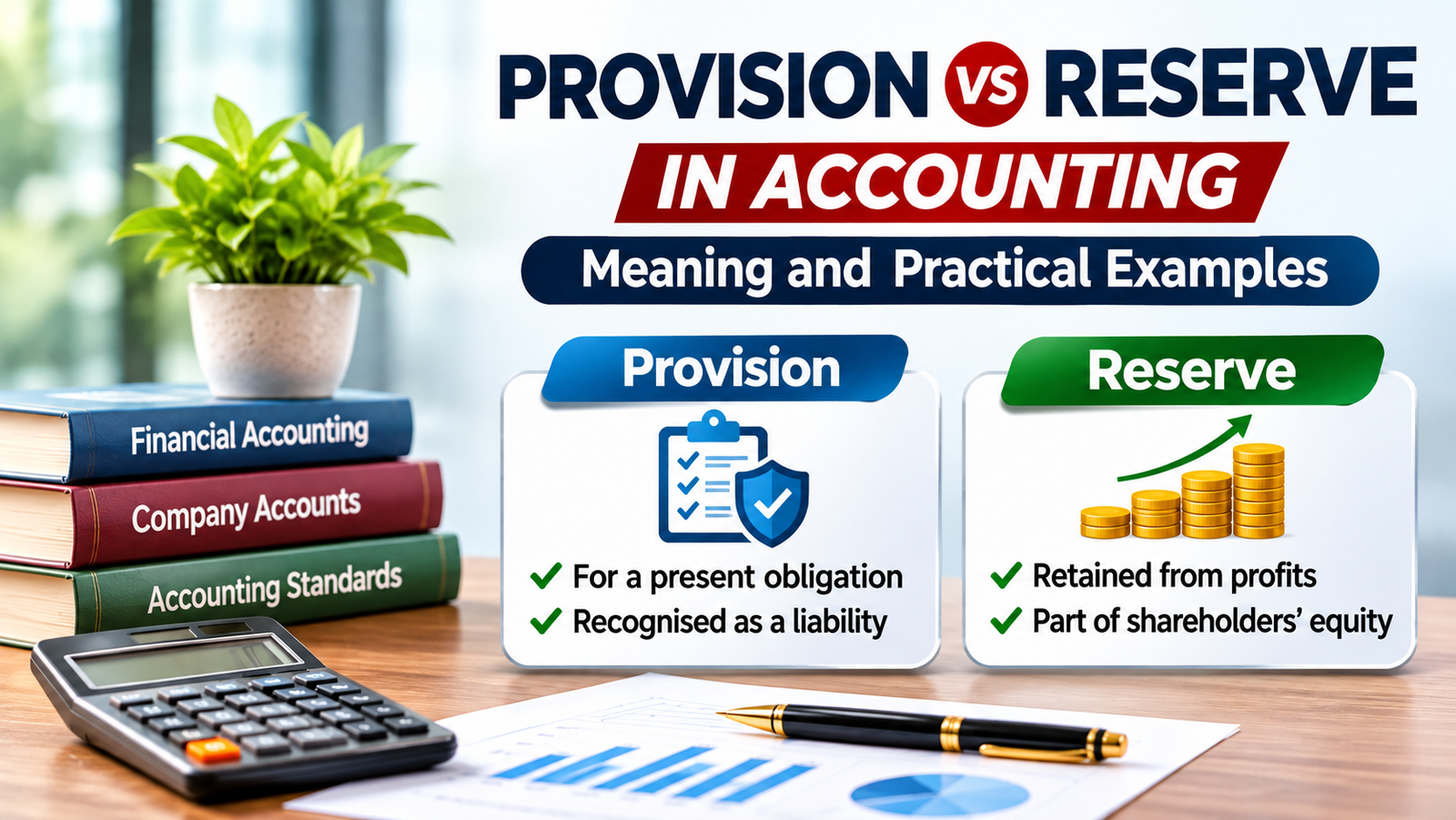
A business may set aside money because it expects to settle a legal claim. Another company may retain part of its profits to strengthen its financial position. Although both situations involve amounts recognised in the accounts, they are not treated in the same way.
Understanding provision vs reserve is important for CA, CMA and commerce students because the distinction affects profit measurement, liabilities and shareholders’ equity.
A provision is generally recognised for a present obligation involving uncertainty about its timing or amount. A reserve, on the other hand, is generally an amount retained or appropriated within equity, often from accumulated profits.
The main difference is that a provision relates to an obligation, while a reserve generally represents part of the owners’ interest in the business.
What Is a Provision in Accounting?
A provision is a liability of uncertain timing or amount.
Businesses may face obligations even when the exact amount payable or the settlement date is not known.
For example, a company selling electronic appliances may provide warranties to customers. Based on past experience, it expects some products to require repairs or replacements.
Although the company does not know which products will develop problems, it may be required to recognise a warranty provision.
Under Ind AS 37, a provision is recognised when:
- The company has a present legal or constructive obligation resulting from a past event.
- An outflow of resources to settle the obligation is probable.
- A reliable estimate of the obligation can be made.
If these conditions are not satisfied, a provision is not recognised under that standard.
The applicable accounting framework must always be considered, because terminology and specific requirements can differ between standards.
Common Examples of Provisions
Provisions may arise from:
- Product warranty obligations.
- Legal claims that meet recognition conditions.
- Environmental restoration obligations.
- Certain restructuring obligations.
- Other present obligations involving uncertain timing or amount.
A provision is not created merely because management expects that the business may incur an expense in the future.
There must be an obligation arising from a past event and the relevant recognition conditions must be satisfied.
What Is a Reserve in Accounting?
A reserve generally represents an amount retained or appropriated within shareholders’ equity.
Businesses may retain profits instead of distributing the entire amount to shareholders.
These retained amounts may support business expansion, financial stability or other corporate purposes.
For example, suppose a company earns a profit of ₹20 lakh and transfers ₹5 lakh from retained earnings to a general reserve.
The transfer changes the classification of amounts within equity.
It does not create an expense or a liability.
Common Types of Reserves
General Reserve
A general reserve is commonly created through an appropriation of profits without necessarily being assigned to a specific liability.
Capital Reserve
A capital reserve may arise from certain capital transactions or accounting adjustments, depending on the applicable legal and accounting requirements.
Revaluation Reserve
A revaluation reserve may arise when certain assets are revalued under an applicable accounting framework.
For example, under the revaluation model in Ind AS 16, an upward revaluation may be recognised in other comprehensive income and accumulated in equity as a revaluation surplus, subject to the standard’s requirements.
Not every reserve arises from a transfer of current-year profits.
This is an important distinction when studying different categories of reserves.
Provision vs Reserve: Key Differences
The following table explains the major differences between provisions and reserves.
| Basis | Provision | Reserve |
|---|---|---|
| Meaning | A liability involving uncertainty about timing or amount | An amount recognised or appropriated within equity |
| Main purpose | Recognise an existing obligation | Retain or classify amounts within shareholders’ equity |
| Accounting nature | Liability | Equity |
| Recognition | Based on applicable accounting requirements | Based on the nature of the reserve and relevant accounting rules |
| Effect on profit | Initial recognition generally involves an expense, subject to applicable exceptions | Transfer from retained earnings to a general reserve does not reduce profit |
| Financial statement presentation | Generally presented among liabilities | Generally presented within equity |
| Uncertainty | Usually involves uncertain timing or amount | Does not necessarily involve an obligation |
| Example | Warranty provision | General reserve |
| Use | Settles the obligation for which it was recognised | Depends on the type of reserve and applicable restrictions |
The simplest way to remember the difference is:
A provision recognises an obligation. A reserve generally represents part of equity.
Provision in Accounting: Practical Business Example
Consider ABC Electronics Pvt. Ltd., a fictional company that manufactures and sells electronic appliances.
During the financial year, the company sells 2,000 appliances with a one-year warranty.
Based on reliable historical information, management estimates that 5% of the appliances will require warranty repairs.
The estimated average repair cost is ₹1,500 per affected appliance.
Step 1: Estimate the Number of Warranty Claims
Expected warranty claims:
2,000 × 5% = 100 appliances
Step 2: Calculate the Expected Warranty Cost
Expected warranty cost:
100 × ₹1,500 = ₹1,50,000
Assuming the applicable recognition conditions are satisfied, ABC Electronics recognises a warranty provision of ₹1,50,000.
Journal Entry for Warranty Provision
| Account | Debit | Credit |
|---|---|---|
| Warranty Expense A/c | ₹1,50,000 | |
| Provision for Warranty A/c | ₹1,50,000 |
The entry recognises the expected warranty expense and the corresponding obligation.
The expense reduces accounting profit, while the provision appears as a liability.
What Happens When Warranty Repairs Are Made?
Suppose the company subsequently settles warranty claims costing ₹40,000 in cash.
The journal entry is:
| Account | Debit | Credit |
|---|---|---|
| Provision for Warranty A/c | ₹40,000 | |
| Bank A/c | ₹40,000 |
The provision is reduced as the obligation is settled.
The remaining provision is:
₹1,50,000 − ₹40,000 = ₹1,10,000
The company must review the provision at each reporting date and adjust it to reflect the current best estimate of the obligation.
This example shows why a provision is different from simply retaining profits for future use.
Reserve in Accounting: Practical Business Example
Now consider XYZ Manufacturing Ltd., a fictional company.
The company earns a profit after tax of ₹20,00,000.
Management proposes transferring ₹5,00,000 from retained earnings to a general reserve, and the transfer is made following the applicable approval requirements.
Journal Entry for Transfer to General Reserve
| Account | Debit | Credit |
|---|---|---|
| Retained Earnings A/c | ₹5,00,000 | |
| General Reserve A/c | ₹5,00,000 |
This entry transfers ₹5 lakh from one component of equity to another.
The total shareholders’ equity remains unchanged.
For example:
| Equity Component | Before Transfer | After Transfer |
|---|---|---|
| Retained earnings | ₹20,00,000 | ₹15,00,000 |
| General reserve | ₹0 | ₹5,00,000 |
| Total Equity | ₹20,00,000 | ₹20,00,000 |
The transfer does not reduce the company’s reported profit after tax.
It simply changes how the retained amount is classified within equity.
Also, creating a general reserve does not mean that ₹5 lakh has been deposited into a separate bank account.
A reserve is an accounting classification, not necessarily a separate pool of cash.
How Provisions and Reserves Affect Financial Statements
Provisions and reserves appear differently in financial statements.
Suppose a company has the following financial information before recognising a warranty provision:
| Particulars | Amount |
|---|---|
| Profit before warranty provision | ₹10,00,000 |
| Warranty provision expense | ₹1,50,000 |
| Profit after provision expense | ₹8,50,000 |
The warranty provision reduces profit by ₹1.5 lakh.
The corresponding liability is recognised in the balance sheet.
Now suppose the company transfers ₹2 lakh from retained earnings to a general reserve.
The transfer does not reduce the ₹8.5 lakh profit figure.
Instead, it reallocates ₹2 lakh within equity.
This is one of the most important differences between provisions and general reserves.
Balance Sheet Treatment
| Particulars | Provision | General Reserve |
|---|---|---|
| Balance sheet classification | Liability | Equity |
| Creates an obligation? | Recognises an existing obligation | No |
| Reduces profit on initial recognition? | Generally yes, subject to exceptions | No, when transferred from retained earnings |
| Changes total equity directly? | Expense recognition generally reduces retained earnings | Transfer within equity does not change total equity |
For CA and CMA students, understanding this treatment is more useful than simply memorising definitions.
Provision for Doubtful Debts vs General Reserve
Students often encounter the term provision for doubtful debts in traditional accounting textbooks.
However, it is important to distinguish this usage from provisions recognised under Ind AS 37.
Under modern financial reporting, expected credit losses on trade receivables are generally recognised through a loss allowance under the applicable financial instruments standard, such as Ind AS 109.
This allowance reduces the net carrying amount of receivables.
It is not the same as a warranty provision or a general reserve.
Example: Expected Credit Loss Allowance
Suppose a company has trade receivables of ₹10,00,000.
Based on the applicable expected credit loss assessment, it recognises a loss allowance of ₹50,000.
The simplified journal entry is:
| Account | Debit | Credit |
|---|---|---|
| Impairment Loss A/c | ₹50,000 | |
| Loss Allowance A/c | ₹50,000 |
The net carrying amount of receivables becomes:
₹10,00,000 − ₹50,000 = ₹9,50,000
A general reserve, by comparison, remains within equity and does not reduce the carrying amount of receivables.
This distinction is particularly important when moving from traditional accounting terminology to financial reporting under Ind AS.
Provision vs Contingent Liability
Another important concept is the difference between a provision and a contingent liability.
A provision is recognised when the applicable recognition conditions are met.
A contingent liability is generally not recognised as a liability in the balance sheet under Ind AS 37, although disclosure may be required unless the possibility of an outflow is remote.
Consider a company facing a legal claim.
If the company has a present obligation, an outflow is probable and the amount can be reliably estimated, a provision may be required.
If an outflow is only possible rather than probable, the matter may instead be disclosed as a contingent liability, depending on the circumstances.
| Provision | Contingent Liability |
|---|---|
| Recognised when the required conditions are satisfied | Generally not recognised |
| Present obligation with probable outflow and reliable estimate | May involve a possible obligation or a present obligation that does not meet recognition conditions |
| Appears in the financial statements as a liability | May require disclosure in the notes |
| Example: Qualifying warranty obligation | Example: Certain unresolved legal claims |
The classification depends on the facts and applicable accounting standards.
A legal case does not automatically require a provision merely because a claim has been filed.
Can a Business Create a Reserve Without Having Cash?
Yes.
A company may transfer part of its retained earnings to a general reserve without moving any cash into a separate account.
For example, a business may report ₹15 lakh in accumulated profits while holding much of its resources in inventory, receivables or fixed assets.
A transfer of ₹5 lakh to a general reserve does not automatically increase its bank balance.
This explains why reserves should not be confused with cash savings.
Similarly, recognising a provision does not necessarily mean the business immediately pays cash.
A warranty provision may be recognised today even though repairs will take place during future months.
Accounting recognition and cash movement are separate concepts.
Are Provisions and Reserves Mandatory?
The answer depends on their nature and the applicable accounting requirements.
A provision must be recognised when the relevant recognition criteria under the applicable standard are satisfied.
Management cannot avoid recognising a qualifying obligation merely to report a higher profit.
Reserves are different.
Some reserves arise from mandatory accounting treatments or specific legal requirements. Others, such as certain transfers to general reserve, depend on corporate decisions and applicable rules.
Therefore, it would be incorrect to say that all reserves are optional or that all reserves are created from profits.
The accounting treatment must be assessed according to the specific type of reserve.
Common Mistakes Students Make in Provision and Reserve Accounting
Treating Every Reserve as a Liability
A general reserve is part of shareholders’ equity, not an obligation owed to an outside party.
Assuming Provisions Are Optional
When the applicable recognition conditions are satisfied, a provision must be recognised.
It is not simply an amount management chooses to set aside.
Confusing a Provision with a Cash Fund
Recognising a provision does not automatically involve transferring cash into a separate account.
Treating a General Reserve Transfer as an Expense
Transferring retained earnings to a general reserve does not reduce the current year’s profit.
It is an appropriation or reclassification within equity.
Assuming All Reserves Are Created from Revenue Profits
Some reserves arise from capital transactions, asset revaluations or other accounting treatments.
They do not necessarily originate from operating profits.
Using Traditional Terminology Without Checking the Accounting Standard
Terms such as provision for doubtful debts may appear in older accounting materials.
Students should understand the relevant modern treatment, including expected credit loss allowances where applicable.
Why CA and CMA Students Should Understand Provisions and Reserves
For CA students, provisions and reserves are important in financial accounting, financial reporting, auditing and company accounts.
Students must understand when liabilities should be recognised, how estimates affect profit and how different equity components are presented.
During audit work, provisions may require particular attention because they often involve management estimates and professional judgement.
For CMA students, provisions can affect reported expenses and financial performance, while reserves help explain how accumulated profits are retained and classified within a business.
Commerce students should also understand that provisions and reserves serve fundamentally different accounting purposes.
A provision is connected to an obligation. A general reserve is connected to the classification and retention of equity.
Recognising this difference helps students interpret financial statements more accurately.
Build Stronger Accounting Knowledge with Master Minds India
Understanding provisions and reserves helps students connect accounting adjustments with liabilities, profit measurement and shareholders’ equity. These concepts provide a useful foundation for financial reporting, auditing and corporate accounting.
Master Minds India provides educational resources for students pursuing commerce and professional accounting studies. Explore the available Master Minds courses to learn more about the educational programmes.
