

Blog
Capital Expenditure vs Revenue Expenditure: How to Identify the Difference

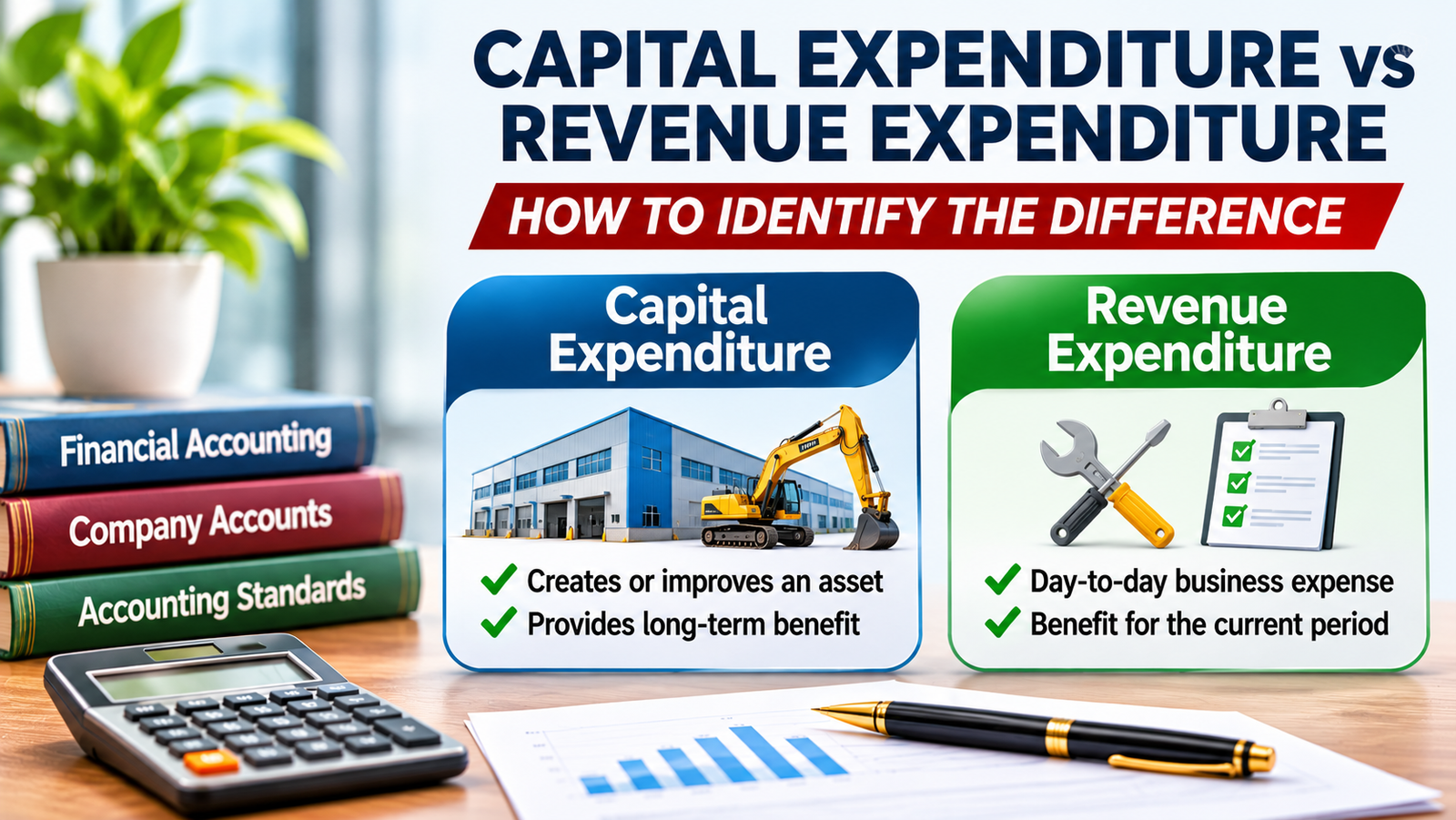
When a company purchases machinery for ₹10 lakh, the amount is generally recorded as an asset rather than an immediate expense. However, when the same company pays ₹20,000 for routine machinery maintenance, the amount is usually recognised as an expense.
Why are these payments treated differently?
The answer lies in understanding capital vs revenue expenditure, one of the fundamental concepts in financial accounting.
Capital expenditure generally involves acquiring or improving assets that provide economic benefits over multiple accounting periods. Revenue expenditure involves costs recognised as expenses in the relevant accounting period, such as routine operating and maintenance costs.
For CA, CMA and commerce students, knowing how to distinguish between these expenditures is essential for preparing accurate financial statements and understanding business profitability.
What Is Capital Expenditure?
Capital expenditure, commonly called CapEx, refers to spending on acquiring, constructing or improving long-term assets when the expenditure qualifies for recognition as part of an asset under the applicable accounting standards.
Businesses incur capital expenditure to establish operations, expand capacity or improve productive resources.
Common examples include:
- Purchasing machinery and equipment.
- Constructing a factory building.
- Acquiring vehicles for business operations.
- Installing new production equipment.
- Making qualifying improvements to existing assets.
- Purchasing computer systems for long-term business use.
Capital expenditure is generally recognised as an asset in the balance sheet rather than being charged entirely to the profit and loss account when incurred.
For depreciable assets, the recognised cost is usually allocated over the asset’s useful life through depreciation.
Practical Example of Capital Expenditure
Suppose ABC Manufacturing Ltd. purchases machinery for ₹8,00,000.
The company also pays ₹40,000 for transportation and ₹60,000 for installation.
Assume these expenses are directly attributable to bringing the machinery to the location and condition necessary for its intended operation.
The total capitalised cost is:
| Particulars | Amount |
|---|---|
| Machinery purchase price | ₹8,00,000 |
| Transportation charges | ₹40,000 |
| Installation charges | ₹60,000 |
| Total Cost of Machinery | ₹9,00,000 |
The company records machinery worth ₹9 lakh as an asset.
It does not automatically recognise the entire ₹9 lakh as an expense in the year of purchase.
Instead, depreciation is generally recognised over the asset’s useful life, subject to the applicable accounting requirements.
What Is Revenue Expenditure?
Revenue expenditure refers to spending recognised as an expense in the relevant accounting period rather than capitalised as part of an asset.
Such expenditure commonly arises from day-to-day business operations.
Examples include:
- Employee salaries.
- Office rent.
- Electricity charges.
- Routine machinery repairs.
- Regular maintenance expenses.
- Advertising expenses that do not qualify for asset recognition.
- Office stationery and other consumables.
Revenue expenditure is generally charged to the profit and loss account because it relates to the business’s operating activities or the consumption of economic benefits during the period.
However, the timing of payment alone does not determine when an expense is recognised.
For example, rent paid in advance for future months may initially be recorded as a prepaid expense.
Practical Example of Revenue Expenditure
Suppose ABC Manufacturing Ltd. incurs the following monthly expenses:
| Particulars | Amount |
|---|---|
| Employee salaries | ₹1,50,000 |
| Factory electricity | ₹45,000 |
| Routine machinery maintenance | ₹20,000 |
| Office rent | ₹35,000 |
| Total Expenditure | ₹2,50,000 |
Assuming these costs relate to the current period and do not qualify for capitalisation or inclusion in inventory costs, they are recognised as expenses.
They reduce the company’s profit for the relevant accounting period.
In practice, certain production-related expenses may form part of inventory costs before being recognised in profit or loss when the related goods are sold.
This is why accountants must consider the nature and purpose of each expenditure rather than relying only on its description.
Capital vs Revenue Expenditure: Key Differences
The following table explains the major differences between capital and revenue expenditure.
| Basis | Capital Expenditure | Revenue Expenditure |
|---|---|---|
| Meaning | Spending that qualifies for recognition as an asset | Spending recognised as an expense |
| Main purpose | Acquire, construct or improve qualifying assets | Support business operations or meet period expenses |
| Accounting treatment | Generally capitalised | Generally expensed, subject to applicable accounting rules |
| Financial statement | Initially recognised in the balance sheet | Recognised in the profit and loss account |
| Benefit | Often extends over multiple periods | Often relates to current operations |
| Profit impact | Usually affects profit over time through depreciation or amortisation | Generally affects profit when the expense is recognised |
| Examples | Machinery, buildings, qualifying improvements | Rent, salaries, routine repairs |
| Asset value | May increase the carrying amount of an asset | Generally does not increase the carrying amount of a long-term asset |
The most important distinction is whether the expenditure meets the requirements for recognising an asset.
An expense is not automatically capital expenditure simply because the amount is large or because management expects some future benefit.
How to Identify Capital and Revenue Expenditure
Students can use the following questions to classify business expenditure.
1. Does the Expenditure Create or Acquire an Asset?
If a business purchases machinery, equipment or another qualifying resource, the cost may be capital expenditure.
For example, purchasing a delivery vehicle for business operations generally creates a recognised asset.
However, paying for fuel used by that vehicle is normally an operating expense.
2. Does It Improve an Existing Asset?
Expenditure that increases an asset’s capacity, extends its useful life or improves its performance may qualify for capitalisation.
Consider a manufacturing machine that originally produces 1,000 units per day.
The company installs a new component that increases production capacity to 1,500 units per day.
If the component meets the applicable recognition requirements, the expenditure may be capitalised.
By comparison, routine servicing that maintains the machine’s existing operating condition is generally expensed.
3. Is It Routine Maintenance or a Qualifying Replacement?
Routine repairs are usually revenue expenditure.
However, replacing a significant component of an asset may qualify for capitalisation if the relevant recognition conditions are met.
Under applicable property, plant and equipment standards, the carrying amount of a replaced component may also need to be derecognised.
This means not every repair-related payment receives the same accounting treatment.
4. Does the Expenditure Meet Asset Recognition Requirements?
An expenditure should not be capitalised merely because it may benefit the business in the future.
For example, an advertising campaign may help generate sales over several months.
However, advertising expenditure is generally expensed under applicable accounting standards rather than recognised as an asset simply because it is expected to improve future revenue.
The accounting treatment depends on the relevant recognition requirements.
Capital and Revenue Expenditure: Practical Business Examples
Consider the following transactions of a fictional company, XYZ Industries.
| Transaction | Classification | Reason |
|---|---|---|
| Purchase of factory machinery | Capital | Acquisition of a long-term asset |
| Installation of new machinery | Capital | Directly attributable cost of preparing the asset for use |
| Monthly factory electricity | Revenue or inventory cost | Operating or production-related expenditure |
| Routine machinery servicing | Revenue | Maintains normal operating condition |
| Qualifying machinery upgrade | Capital | Improves an existing asset |
| Monthly office rent | Revenue | Expense relating to business operations |
| Purchase of office furniture | Capital | Acquisition of a qualifying long-term asset |
| Regular office cleaning | Revenue | Routine operating expense |
| Purchase of a delivery vehicle | Capital | Acquisition of a long-term asset |
| Fuel for delivery vehicle | Revenue | Day-to-day operating cost |
These classifications assume the relevant recognition conditions are satisfied.
The same type of payment may receive different accounting treatment depending on its purpose and circumstances.
Journal Entries for Capital Expenditure
Suppose a company purchases machinery for ₹5,00,000 and pays immediately through its bank account.
The journal entry is:
| Account | Debit | Credit |
|---|---|---|
| Machinery A/c | ₹5,00,000 | |
| Bank A/c | ₹5,00,000 |
The machinery is recognised as an asset.
Now assume the company uses the Straight Line Method of depreciation.
The machinery has:
- Cost: ₹5,00,000.
- Estimated residual value: ₹50,000.
- Useful life: 5 years.
Annual depreciation is:
Depreciation = (Cost − Residual Value) ÷ Useful Life
(₹5,00,000 − ₹50,000) ÷ 5 = ₹90,000
The annual depreciation entry is:
| Account | Debit | Credit |
|---|---|---|
| Depreciation Expense A/c | ₹90,000 | |
| Accumulated Depreciation A/c | ₹90,000 |
This expense reduces accounting profit.
The machinery’s carrying amount after one full year of depreciation would be ₹4,10,000, assuming no other adjustments.
Journal Entries for Revenue Expenditure
Suppose the company pays ₹25,000 for routine machinery repairs.
The journal entry is:
| Account | Debit | Credit |
|---|---|---|
| Repairs and Maintenance A/c | ₹25,000 | |
| Bank A/c | ₹25,000 |
The amount is recognised as an expense because it relates to maintaining the machinery rather than acquiring or improving a qualifying asset.
Similarly, if the company incurs office rent of ₹40,000 that remains unpaid at the reporting date:
| Account | Debit | Credit |
|---|---|---|
| Rent Expense A/c | ₹40,000 | |
| Rent Payable A/c | ₹40,000 |
This demonstrates that revenue expenditure can be recognised even when cash has not yet been paid.
How Capital and Revenue Expenditure Affect Profit
The classification of expenditure directly affects the profit reported by a business.
Consider ABC Manufacturing Ltd., which reports profit before considering a machinery-related expenditure of ₹10,00,000.
During the year, it spends ₹4,00,000 on a qualifying machinery asset.
Assume the asset is available for use from the beginning of the accounting year, has no residual value and is depreciated over four years using the Straight Line Method.
Annual depreciation:
₹4,00,000 ÷ 4 = ₹1,00,000
Correct Accounting Treatment
| Particulars | Amount |
|---|---|
| Profit before machinery-related expense | ₹10,00,000 |
| Less: Depreciation | ₹1,00,000 |
| Profit Before Tax | ₹9,00,000 |
The company recognises the machinery as an asset and charges depreciation of ₹1 lakh.
Incorrect Treatment as Revenue Expenditure
Suppose the entire machinery cost is incorrectly charged as an expense.
| Particulars | Amount |
|---|---|
| Profit before machinery-related expense | ₹10,00,000 |
| Less: Machinery cost incorrectly expensed | ₹4,00,000 |
| Profit Before Tax | ₹6,00,000 |
The company would report ₹3 lakh less profit than under the correct treatment.
Its assets would also be understated because the machinery would not be recognised properly.
This example shows why the distinction between capital and revenue expenditure is important for financial reporting.
Capital Expenditure vs Revenue Expenditure in the Balance Sheet
Capital expenditure generally results in the recognition or enhancement of an asset when the relevant accounting criteria are met.
For example, purchasing machinery increases property, plant and equipment.
The asset’s carrying amount subsequently changes through depreciation, impairment and other applicable adjustments.
Revenue expenditure generally reduces profit when recognised as an expense.
Lower profit may reduce retained earnings within shareholders’ equity.
However, some expenditures initially recognised as inventory or prepaid assets become expenses in later periods.
Therefore, it is important to distinguish between the nature of expenditure and the timing of expense recognition.
Can Repairs Be Capital Expenditure?
Yes, certain expenditure associated with repairs or replacements may qualify as capital expenditure.
The classification depends on what the work achieves and whether the applicable recognition conditions are satisfied.
Example 1: Routine Repair
A company pays ₹15,000 to service its production machine.
The servicing maintains the machine’s normal operating condition.
This is generally revenue expenditure.
Example 2: Major Component Replacement
A company replaces a significant component of machinery for ₹2,00,000.
The replacement is expected to provide economic benefits over future periods and meets the relevant asset recognition criteria.
The cost may be capitalised, while the carrying amount of the replaced component is derecognised where required.
The important question is not simply whether the payment is called a repair.
It is whether the expenditure qualifies for recognition as an asset under the applicable accounting standards.
Capital Expenditure vs Revenue Expenditure Under Income Tax
For Indian businesses, accounting treatment and income-tax treatment must be considered separately.
Capital expenditure is generally not deducted as an ordinary revenue expense when computing business income, although depreciation or other deductions may be available under the applicable provisions.
Revenue expenditure may qualify for deduction when it satisfies the relevant requirements of the Income-tax Act.
For example, Section 37(1) of the Income-tax Act, 1961 contains provisions relating to certain business expenditure that is not capital or personal in nature, subject to its conditions and exclusions.
Depreciation deductions are governed by separate provisions, including Section 32.
An amount capitalised for financial reporting purposes does not necessarily receive identical treatment for tax purposes.
Students should therefore distinguish between:
- Accounting recognition under applicable accounting standards.
- Tax deductions permitted under the relevant income-tax provisions.
The classification must be assessed using the law applicable to the relevant tax period.
Common Mistakes Students Make in Capital and Revenue Expenditure
Assuming Every Large Payment Is Capital Expenditure
The amount spent does not determine the classification.
A company may spend ₹10 lakh on routine advertising, but the expenditure does not automatically qualify as an asset.
Treating Every Repair as Revenue Expenditure
Routine maintenance is generally expensed.
However, certain qualifying component replacements or improvements may be capitalised.
Ignoring Directly Attributable Costs
The cost of machinery may include qualifying transportation, installation and testing costs necessary to prepare the asset for its intended use.
Ignoring these costs can result in incorrect asset measurement.
Capitalising Expenses to Increase Profit
Incorrectly capitalising ordinary operating expenses can overstate assets and profit.
Accounting standards do not permit capitalisation simply because management wants to report better financial results.
Confusing Cash Payment with Expense Recognition
A business may pay cash for an asset without recognising the entire amount as an immediate expense.
Similarly, it may recognise an operating expense before making payment.
Cash flow and expense recognition are different accounting concepts.
Why CA and CMA Students Should Understand This Difference
For CA students, the classification of capital and revenue expenditure is important in financial accounting, financial reporting, auditing and taxation.
During audit assignments, students may examine whether machinery purchases, repairs and other expenditures have been classified correctly.
An incorrect classification can affect both the statement of profit and loss and the balance sheet.
For CMA students, understanding expenditure classification helps connect asset investment, depreciation, production costs and business profitability.
It is also useful when studying budgeting and capital investment decisions.
Commerce students preparing for accounting roles should be able to identify the purpose of an expenditure, understand the applicable accounting treatment and explain its effect on financial statements.
The essential lesson is that capital expenditure generally creates or improves a qualifying asset, while revenue expenditure is recognised as an expense according to the relevant accounting principles.
Strengthen Your Accounting Fundamentals with Master Minds India
Understanding capital and revenue expenditure helps students make accurate accounting classifications and recognise how business spending affects assets, expenses and profitability. It also builds a foundation for learning depreciation, financial reporting, auditing and business taxation.
Master Minds India provides educational resources for commerce students and aspiring accounting professionals. Explore the available Master Minds courses to learn more about the educational programmes.
