

Blog
Trial Balance Errors: Errors Disclosed and Not Disclosed by a Trial Balance

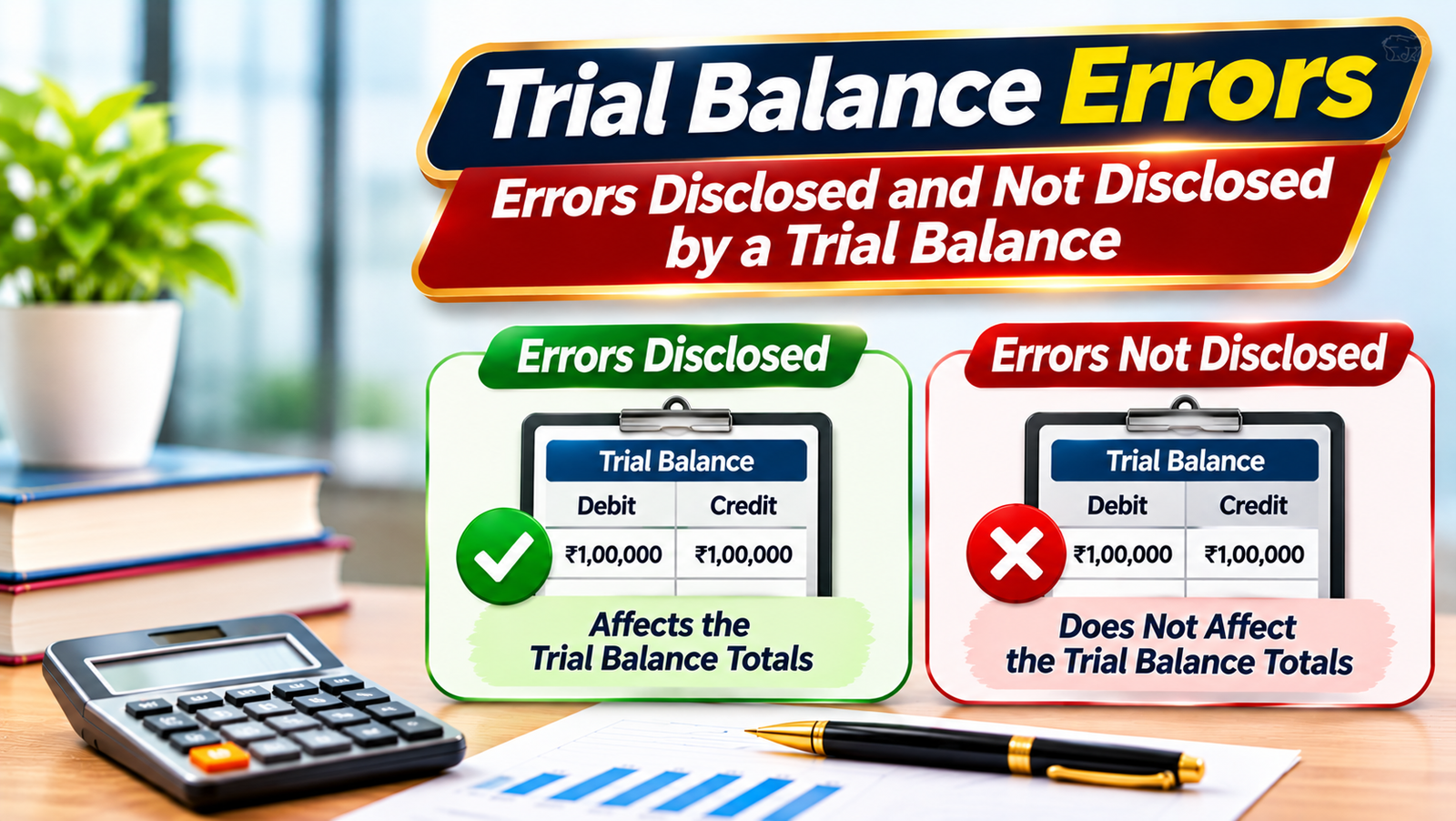
A trial balance is one of the first checks an accountant performs to verify whether ledger balances have been recorded correctly. But does a matching debit and credit total mean that every accounting entry is correct?
Not necessarily.
Trial balance errors are accounting mistakes that may or may not affect the agreement of debit and credit totals. Some errors cause the trial balance to disagree, while others remain undetected even when both columns show exactly the same amount.
Understanding errors disclosed and not disclosed by a trial balance is essential for CA, CMA and commerce students. It helps them identify accounting mistakes, understand their effects and make the necessary corrections.
What Is a Trial Balance?
A trial balance is a statement showing the debit and credit balances of ledger accounts on a particular date.
It is prepared to check the arithmetical accuracy of ledger postings and balances.
Under the double-entry accounting system, every transaction has equal debit and credit effects.
Therefore:
Total Debit Balances = Total Credit Balances
For example, consider the following simplified trial balance.
| Particulars | Debit (₹) | Credit (₹) |
|---|---|---|
| Cash | 40,000 | — |
| Purchases | 60,000 | — |
| Rent | 10,000 | — |
| Capital | — | 80,000 |
| Sales | — | 30,000 |
| Total | 1,10,000 | 1,10,000 |
The debit and credit totals agree.
This indicates that the ledger balances satisfy the basic arithmetical equality of double-entry accounting.
However, it does not prove that all transactions have been recorded in the correct accounts or at the correct amounts.
What Are Trial Balance Errors?
Trial balance errors are mistakes made while recording, posting, classifying or balancing accounting transactions.
They may occur because of:
- Incorrect amounts entered in accounts.
- Transactions posted to the wrong side.
- Failure to record a transaction.
- Incorrect ledger balancing.
- Mistakes while preparing the trial balance.
- Incorrect classification of transactions.
These errors are broadly classified into two categories:
- Errors disclosed by a trial balance.
- Errors not disclosed by a trial balance.
The distinction depends on whether the mistake causes the debit and credit totals to disagree.
Errors Disclosed by a Trial Balance
Errors disclosed by a trial balance are mistakes that cause the total debit balances and total credit balances to become unequal.
Such errors usually involve incorrect posting, balancing or extraction of ledger balances.
When the trial balance does not agree, the accountant must investigate the difference and identify its cause.
1. Posting an Amount to the Wrong Side
Suppose a business pays rent of ₹5,000.
The correct entry is:
| Account | Debit (₹) | Credit (₹) |
|---|---|---|
| Rent A/c | 5,000 | — |
| Cash A/c | — | 5,000 |
Now assume the accountant incorrectly posts ₹5,000 to the credit side of the Rent Account instead of the debit side.
The incorrect posting causes a difference of ₹10,000 between the debit and credit totals, assuming all other postings are correct.
This happens because the intended ₹5,000 debit is missing and an incorrect ₹5,000 credit has been recorded.
2. Posting an Incorrect Amount on One Side
Suppose goods worth ₹8,000 are purchased on credit.
The Purchases Account is correctly debited by ₹8,000, but the supplier’s account is credited by only ₹800.
The difference is:
₹8,000 − ₹800 = ₹7,200
The trial balance will disagree by ₹7,200, assuming there are no other errors.
3. Omitting One Side of a Transaction
Suppose a company receives ₹12,000 from a customer.
The Cash Account is debited by ₹12,000, but the corresponding credit to the customer’s account is omitted.
This creates a difference of ₹12,000 in the trial balance.
The transaction has not been posted completely.
4. Incorrect Balancing of a Ledger Account
A ledger account may contain correct transactions but still have an incorrect closing balance.
For example, the actual debit balance of an account is ₹25,000, but the accountant calculates it as ₹20,000.
If the incorrect balance is transferred to the trial balance, the totals may differ by ₹5,000.
5. Incorrect Transfer of Ledger Balances
Suppose the Furniture Account has a debit balance of ₹45,000.
While preparing the trial balance, the accountant enters ₹4,500.
The difference is:
₹45,000 − ₹4,500 = ₹40,500
The trial balance will disagree unless another error offsets this difference.
Summary of Errors Disclosed by a Trial Balance
| Type of Error | Example | Effect |
|---|---|---|
| Wrong-side posting | Rent debited incorrectly as a credit | Debit and credit totals differ |
| Incorrect amount on one side | ₹8,000 posted as ₹800 | Creates a difference |
| Omission of one posting | Debit recorded, credit omitted | Creates a difference |
| Incorrect ledger balance | ₹25,000 calculated as ₹20,000 | Creates a difference |
| Incorrect transfer | ₹45,000 entered as ₹4,500 | Creates a difference |
These errors can generally be identified by investigating the difference between the two columns.
Errors Not Disclosed by a Trial Balance
Errors not disclosed by a trial balance are mistakes that do not disturb the equality of total debit and credit balances.
These errors are particularly important because the trial balance may appear correct even though the accounting records contain mistakes.
1. Error of Complete Omission
An error of complete omission occurs when a transaction is entirely omitted from the books of account.
Example:
A business purchases furniture worth ₹20,000 on credit but does not record the transaction.
Neither the Furniture Account nor the supplier’s account is affected.
Since both the debit and credit entries are missing, the trial balance may still agree.
2. Error of Principle
An error of principle occurs when a transaction is recorded in violation of an accounting principle.
Example:
A company purchases machinery worth ₹50,000 but records the amount as Repairs and Maintenance Expense.
The incorrect entry is:
| Account | Debit (₹) | Credit (₹) |
|---|---|---|
| Repairs and Maintenance A/c | 50,000 | — |
| Bank A/c | — | 50,000 |
The correct debit should be to the Machinery Account, assuming the purchase qualifies for asset recognition.
Both entries contain equal debits and credits, so the trial balance still agrees.
However, expenses are overstated and assets are understated.
3. Error of Commission
An error of commission may occur when a transaction is recorded in the wrong personal account or when another clerical mistake is made.
Some errors of commission affect trial balance agreement, while others do not.
Example:
A credit sale of ₹15,000 to Ramesh is incorrectly debited to Suresh’s account.
The Sales Account is correctly credited by ₹15,000.
The debit and credit totals remain equal, but the customer balances are incorrect.
This particular error of commission is not disclosed by the trial balance.
4. Error of Original Entry
An error of original entry occurs when the wrong amount is recorded in the original books and the same incorrect amount is posted on both sides.
Example:
Goods purchased for ₹18,000 are recorded as ₹1,800.
| Account | Debit (₹) | Credit (₹) |
|---|---|---|
| Purchases A/c | 1,800 | — |
| Supplier A/c | — | 1,800 |
The debit and credit totals agree because both sides contain the same incorrect amount.
However, purchases and the amount payable are understated by ₹16,200.
5. Compensating Errors
Compensating errors occur when two or more mistakes offset one another.
Example:
- The debit balance of the Purchases Account is understated by ₹2,000.
- The debit balance of the Rent Account is overstated by ₹2,000.
The errors cancel each other when the debit balances are totalled.
As a result, the trial balance may still agree.
However, both ledger accounts contain incorrect amounts.
6. Complete Reversal of Entries
A complete reversal occurs when the correct accounts are used but their debit and credit positions are reversed.
Example:
A business receives ₹10,000 from a customer.
Correct entry:
Cash A/c Dr. ₹10,000
To Customer A/c ₹10,000
Incorrect entry:
Customer A/c Dr. ₹10,000
To Cash A/c ₹10,000
The debit and credit totals remain equal, but both account balances are affected incorrectly.
The trial balance does not disclose this error.
Errors Disclosed vs Not Disclosed by Trial Balance
The following comparison summarises the main differences.
| Basis | Errors Disclosed | Errors Not Disclosed |
|---|---|---|
| Meaning | Cause debit and credit totals to disagree | Do not disturb debit-credit equality |
| Detection | Indicated by a trial balance difference | Require additional checking |
| Nature | Often one-sided posting or balancing mistakes | Often classification, omission or equal-sided mistakes |
| Trial balance agreement | Usually prevented | May remain unaffected |
| Example | ₹5,000 debit posted as ₹500 | ₹5,000 posted to the wrong expense account |
| Rectification | May involve a suspense account | Generally corrected directly between relevant accounts |
A balanced trial balance provides evidence of arithmetical agreement, not complete accounting accuracy.
Practical Problem: Error Disclosed by Trial Balance
Consider ABC Traders.
The trial balance shows:
| Particulars | Amount |
|---|---|
| Total debit balances | ₹4,80,000 |
| Total credit balances | ₹4,75,000 |
| Difference | ₹5,000 |
The accountant discovers that rent of ₹5,000 was correctly credited to Cash Account but was not debited to Rent Account.
Step 1: Identify the Missing Entry
The debit to Rent Account is missing.
This explains why the debit total is ₹5,000 lower than it should be.
Step 2: Rectify the Error
If a suspense account has already been opened to temporarily balance the trial balance, the rectification entry is:
| Account | Debit (₹) | Credit (₹) |
|---|---|---|
| Rent A/c | 5,000 | — |
| Suspense A/c | — | 5,000 |
The entry restores the missing debit and clears the corresponding suspense balance.
If no suspense account has been opened, the omitted posting can be corrected through the appropriate ledger procedure.
Step 3: Verify the Trial Balance
After correction:
| Particulars | Amount |
|---|---|
| Corrected debit total | ₹4,85,000 |
| Credit total | ₹4,75,000 |
These figures would still differ, indicating that the original example contains an inconsistency if the stated error is the only one.
To reconcile the example correctly, the original totals should instead be:
- Debit total: ₹4,75,000.
- Credit total: ₹4,80,000.
After recording the missing ₹5,000 debit, both totals become ₹4,80,000.
This illustrates why checking the direction of a trial balance difference is essential before preparing a rectification entry.
Practical Problem: Error Not Disclosed by Trial Balance
Suppose XYZ Enterprises purchases office furniture for ₹30,000 through its bank account.
The accountant incorrectly records the amount as Office Expenses.
Incorrect Entry
| Account | Debit (₹) | Credit (₹) |
|---|---|---|
| Office Expenses A/c | 30,000 | — |
| Bank A/c | — | 30,000 |
The trial balance agrees because the debit and credit amounts are equal.
However, the furniture has not been recognised as an asset.
Correct Rectification Entry
| Account | Debit (₹) | Credit (₹) |
|---|---|---|
| Furniture A/c | 30,000 | — |
| Office Expenses A/c | — | 30,000 |
The entry transfers the amount from the incorrect expense account to the correct asset account.
The correction increases assets and reverses the incorrectly recognised expense.
This example shows why trial balance agreement alone cannot establish that financial statements are accurate.
What Is a Suspense Account?
A suspense account is a temporary account used when the trial balance does not agree and the difference has not yet been identified.
It allows the accountant to temporarily record the unexplained difference while investigating the underlying errors.
For example, if total debit balances are ₹2,50,000 and total credit balances are ₹2,55,000, the debit side is short by ₹5,000.
A temporary debit balance of ₹5,000 may be placed in the Suspense Account.
Once the error is identified and corrected, the suspense balance should be cleared.
A suspense account is not a substitute for correcting accounting mistakes.
It is only a temporary measure.
Errors that do not affect trial balance agreement generally do not require a suspense account.
How to Locate Trial Balance Errors?
When a trial balance does not agree, accountants can follow a systematic checking process.
Recalculate Both Columns
Check the addition of all debit and credit balances.
A simple arithmetic mistake may explain the difference.
Compare Trial Balance Figures with Ledger Balances
Verify that each ledger balance has been transferred correctly.
Check both the amount and the debit or credit classification.
Check for Omitted Balances
Ensure that every relevant ledger account has been included.
An omitted debit or credit balance can create a difference.
Investigate Differences That Are Multiples of Nine
Some transposition errors create differences divisible by nine.
For example, entering ₹5,400 as ₹4,500 creates a difference of ₹900.
This can be a useful clue, but divisibility by nine does not prove that a transposition error has occurred.
Review One-Sided Postings
Check whether both sides of journal entries have been posted correctly.
An omitted posting may explain the trial balance difference.
Examine Unusual Ledger Balances
Look for balances that appear on unexpected sides or are inconsistent with supporting records.
These checks can help identify errors more efficiently.
Why a Balanced Trial Balance Does Not Guarantee Correct Accounts?
The main purpose of a trial balance is to check the arithmetical agreement of ledger balances.
It cannot independently confirm that every transaction:
- Has been recorded.
- Was entered at the correct amount.
- Was posted to the correct account.
- Was classified according to accounting principles.
- Relates to the correct accounting period.
For example, purchasing machinery and recording it as an ordinary repair expense may leave the trial balance perfectly balanced.
However, the error affects both the balance sheet and profit and loss account.
This is why accountants also perform reconciliations, review supporting documents and examine individual transactions.
Common Mistakes Students Make in Trial Balance Problems
Assuming Every Error Affects Trial Balance Agreement
Many accounting errors affect both debit and credit sides equally.
These mistakes do not necessarily create a difference in the trial balance.
Treating All Errors of Commission as Undisclosed
Some errors of commission do not affect trial balance agreement, such as posting to the wrong customer’s account.
Others, including certain one-sided amount errors, can cause disagreement.
The actual effect depends on the mistake.
Confusing Complete Omission with Partial Omission
A completely omitted transaction does not affect either side.
If only one posting is omitted, the trial balance will generally disagree.
Using a Suspense Account for Every Correction
Suspense accounts are relevant mainly when dealing with unresolved differences affecting trial balance agreement.
Errors that leave debit and credit totals equal can usually be corrected without one.
Ignoring the Direction of the Difference
If the debit total is smaller than the credit total, the missing or incorrect posting must be analysed accordingly.
Simply adding the difference to the wrong side can create another error.
Why CA and CMA Students Should Understand Trial Balance Errors?
Trial balance errors form an important part of financial accounting and the rectification of errors.
For CA students, these concepts help build a foundation for ledger accounting, preparation of financial statements and auditing.
During accounting or audit assignments, students may need to identify incorrect balances, review journal entries and investigate unusual account movements.
For CMA students, accurate accounting records are essential for preparing cost statements, budgets and financial reports.
Incorrect expense classifications or missing transactions can affect cost calculations and management decisions.
Commerce students preparing for accounting roles should also understand that checking debit-credit equality is only the first stage of verifying financial records.
The real objective is to ensure that transactions are complete, correctly classified and accurately recorded.
Strengthen Your Accounting Skills with Master Minds India
Understanding errors disclosed and not disclosed by a trial balance helps students develop accuracy in ledger accounting, journal entries and financial statement preparation. These skills also provide a useful foundation for learning rectification of errors and auditing procedures.
Master Minds India provides educational resources for commerce students and aspiring CA and CMA professionals. Explore the available Master Minds courses to learn more about the educational programmes.
