

Blog
Outstanding Expenses and Prepaid Expenses: Journal Entries and Examples

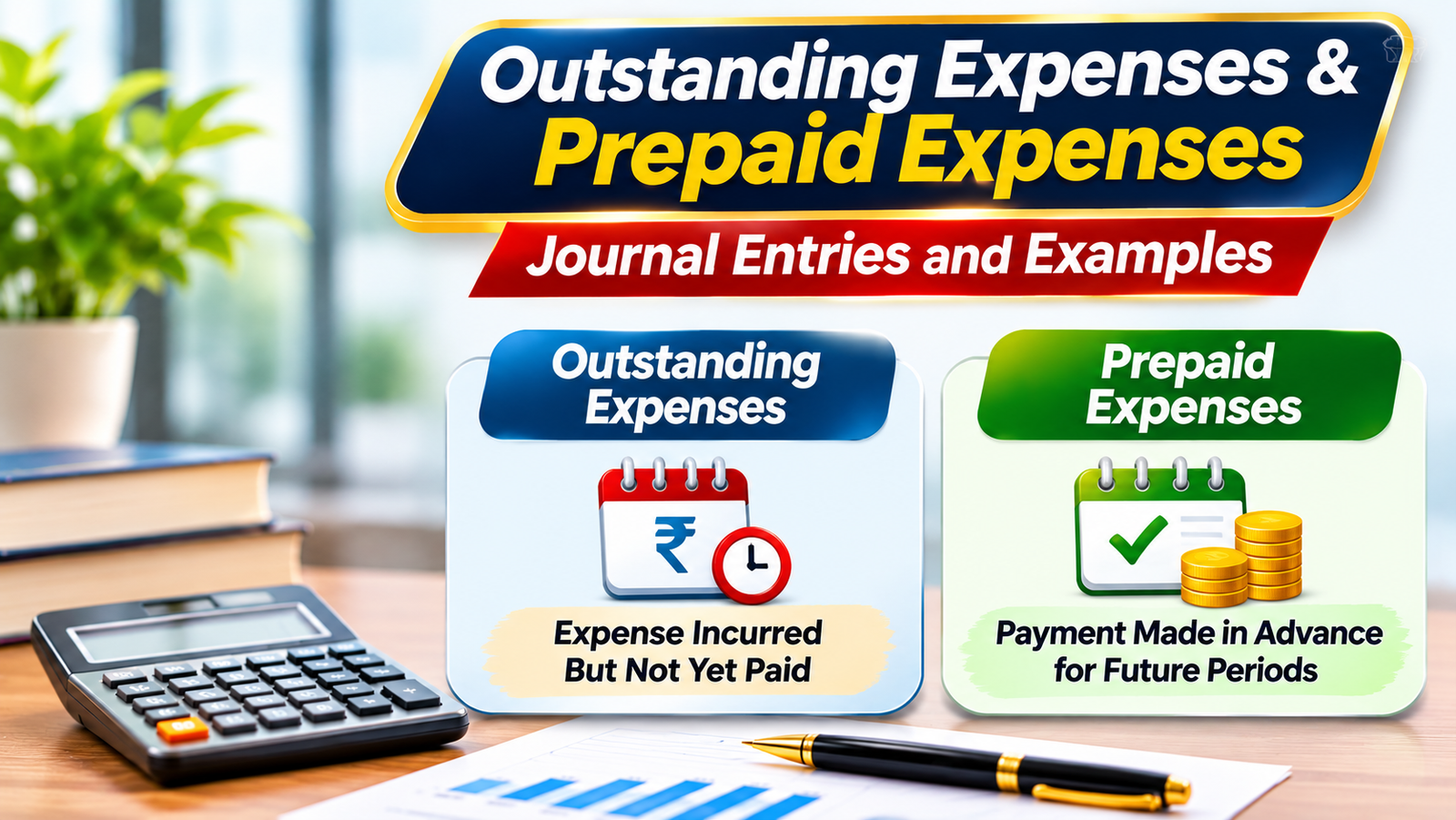
A company may use electricity in March but pay the bill in April. Another business may pay six months of office rent in advance. Although both transactions involve business expenses, they require different accounting treatments.
Understanding outstanding expenses and prepaid expenses is essential for CA, CMA and commerce students because these adjustments help businesses report expenses in the correct accounting periods.
Outstanding expenses are expenses incurred but not yet paid. Prepaid expenses are payments made in advance for benefits that relate to future accounting periods.
Under accrual accounting, outstanding expenses generally create liabilities, while prepaid expenses generally create assets until the related benefits are consumed.
These adjustments ensure that financial statements reflect the company’s actual financial position and performance rather than simply recording cash payments.
What Are Outstanding Expenses in Accounting?
Outstanding expenses are expenses that a business has incurred during an accounting period but has not yet paid.
They are also called accrued expenses or expenses payable.
For example, suppose a company owes employees ₹50,000 in salaries for March but plans to pay them in April.
The salaries relate to work performed in March. Therefore, under accrual accounting, the company recognises the expense in March even though payment will happen later.
The unpaid amount is recorded as a liability.
Common Examples of Outstanding Expenses
- Salaries payable to employees.
- Rent due but not yet paid.
- Electricity charges incurred but unpaid.
- Interest accrued on borrowings.
- Professional fees payable.
- Telephone and internet charges relating to the reporting period.
Outstanding expenses are recognised because the business has already received the related goods or services or incurred the relevant obligation.
Journal Entry for Outstanding Expenses
The basic adjusting entry is:
Expense Account Dr.
To Outstanding Expense Account
This entry recognises the expense and creates a liability.
Practical Example: Outstanding Salaries
ABC Technologies Pvt. Ltd. has a monthly salary expense of ₹1,20,000.
At the end of March, the company has not yet paid the salaries.
The journal entry on 31 March is:
| Account | Debit (₹) | Credit (₹) |
|---|---|---|
| Salaries Expense A/c | 1,20,000 | |
| Salaries Payable A/c | 1,20,000 |
The salary expense is recognised in the profit and loss account for March.
The unpaid amount appears as a current liability in the balance sheet.
Entry When Outstanding Salaries Are Paid
Suppose the company pays the salaries on 5 April.
The entry is:
| Account | Debit (₹) | Credit (₹) |
|---|---|---|
| Salaries Payable A/c | 1,20,000 | |
| Bank A/c | 1,20,000 |
The liability is settled when payment is made.
The company does not recognise the same salary expense again in April because it was already recorded in March.
This is one of the most important principles of accrual accounting.
What Are Prepaid Expenses in Accounting?
Prepaid expenses are payments made for goods or services that will provide benefits in future accounting periods.
When a business pays an amount in advance, the entire payment may not qualify as an expense immediately.
The portion relating to future periods is generally recognised as an asset.
As the business receives or consumes the related benefits, the prepaid amount is transferred to the appropriate expense account.
Common Examples of Prepaid Expenses
- Office rent paid in advance.
- Insurance premiums covering future periods.
- Annual software subscriptions paid upfront.
- Advance payments for maintenance services.
- Advertising services paid for but not yet received.
A prepaid expense represents a right to receive future goods or services rather than an amount already consumed.
Journal Entry for Prepaid Expenses
When a payment is made in advance, the entry is generally:
Prepaid Expense Account Dr.
To Bank Account
As the benefit is consumed, the relevant portion is recognised as an expense.
Expense Account Dr.
To Prepaid Expense Account
Practical Example: Prepaid Insurance
XYZ Manufacturing Ltd. pays ₹1,20,000 on 1 January for an insurance policy covering 12 months.
The insurance coverage runs from 1 January to 31 December.
Assume the cost is recognised evenly over the coverage period.
Monthly insurance expense:
₹1,20,000 ÷ 12 = ₹10,000
By 31 March, the company has received three months of insurance coverage.
Insurance expense for January to March:
₹10,000 × 3 = ₹30,000
The remaining prepaid insurance is:
₹1,20,000 − ₹30,000 = ₹90,000
Entry When Insurance Is Paid
| Account | Debit (₹) | Credit (₹) |
|---|---|---|
| Prepaid Insurance A/c | 1,20,000 | |
| Bank A/c | 1,20,000 |
Adjusting Entry on 31 March
| Account | Debit (₹) | Credit (₹) |
|---|---|---|
| Insurance Expense A/c | 30,000 | |
| Prepaid Insurance A/c | 30,000 |
After the adjustment:
- ₹30,000 is recognised as insurance expense.
- ₹90,000 remains as prepaid insurance.
- The remaining amount will be expensed over the subsequent coverage period.
This treatment prevents the company from charging the entire annual insurance payment to the first three months.
Outstanding Expenses vs Prepaid Expenses: Key Differences
The following table explains the major differences between outstanding and prepaid expenses.
| Basis | Outstanding Expenses | Prepaid Expenses |
|---|---|---|
| Meaning | Expenses incurred but not yet paid | Payments made for future benefits |
| Accounting nature | Liability | Asset |
| Payment timing | Payment occurs after the expense is incurred | Payment occurs before the related expense is recognised |
| Expense recognition | Recognised when incurred | Recognised as the benefit is consumed |
| Balance sheet treatment | Generally current liabilities | Generally current assets, depending on the benefit period |
| Example | Salary payable | Insurance paid in advance |
| Cash flow | Cash payment occurs later | Cash payment has already occurred |
| Adjusting entry | Debit expense, credit liability | Debit expense, credit prepaid asset as benefit is consumed |
The easiest way to remember the difference is:
Outstanding expenses: Expense first, payment later.
Prepaid expenses: Payment first, expense later.
How Outstanding and Prepaid Expenses Affect Financial Statements?
Both adjustments affect the profit and loss account and balance sheet.
However, they do so differently.
Effect of Outstanding Expenses
Suppose a company has profit before adjustment of ₹5,00,000.
It discovers that electricity expenses of ₹40,000 relating to the current year remain unpaid and have not been recorded.
The adjusting entry reduces profit.
| Particulars | Amount |
|---|---|
| Profit before adjustment | ₹5,00,000 |
| Less: Outstanding electricity expense | ₹40,000 |
| Adjusted Profit | ₹4,60,000 |
The balance sheet also recognises an electricity payable liability of ₹40,000.
Effect of Prepaid Expenses
Now suppose a different company has recorded an annual insurance payment of ₹1,20,000 entirely as an expense.
At the reporting date, ₹90,000 of the insurance relates to future periods.
The company must recognise the unexpired portion as a prepaid asset.
| Particulars | Amount |
|---|---|
| Profit before adjustment | ₹5,00,000 |
| Add: Insurance expense relating to future periods | ₹90,000 |
| Adjusted Profit | ₹5,90,000 |
The adjustment increases profit because an amount incorrectly charged as a current-period expense is reclassified as an asset.
The balance sheet recognises prepaid insurance of ₹90,000.
These examples show why year-end adjustments are necessary for accurate financial reporting.
Outstanding and Prepaid Expenses in Final Accounts
In traditional accounting problems, outstanding and prepaid expenses often appear as adjustments when preparing final accounts.
Students must understand their effect on both the income statement and balance sheet.
Treatment of Outstanding Expenses
Suppose rent expense recorded in the trial balance is ₹1,80,000.
Additional rent of ₹20,000 remains outstanding.
The total rent expense for the period becomes:
₹1,80,000 + ₹20,000 = ₹2,00,000
The accounting treatment is:
- Recognise ₹2,00,000 as rent expense in the profit and loss account.
- Show ₹20,000 as rent payable in the balance sheet.
Treatment of Prepaid Expenses
Suppose insurance expense recorded in the trial balance is ₹60,000.
Of this amount, ₹15,000 relates to the next accounting period.
The current-period insurance expense becomes:
₹60,000 − ₹15,000 = ₹45,000
The accounting treatment is:
- Recognise ₹45,000 as insurance expense.
- Show ₹15,000 as prepaid insurance in the balance sheet.
Summary of Final Accounts Adjustments
| Adjustment | Profit and Loss Account | Balance Sheet |
|---|---|---|
| Outstanding expense not yet recorded | Add to relevant expense | Recognise liability |
| Prepaid expense previously charged to expense | Deduct from relevant expense | Recognise asset |
These adjustments help ensure that income and expenses are recognised in the correct accounting periods.
Combined Practical Example: Outstanding Rent and Prepaid Insurance
Consider a fictional business, Sunrise Traders.
At the end of the financial year, its accountant identifies two adjustments:
- Office rent of ₹25,000 for March remains unpaid.
- Insurance of ₹18,000 relating to the next financial year was already charged as an expense.
Assume the company’s profit before these adjustments is ₹4,00,000.
Step 1: Adjust Outstanding Rent
Outstanding rent is an additional expense for the current year.
₹4,00,000 − ₹25,000 = ₹3,75,000
Step 2: Adjust Prepaid Insurance
The prepaid insurance relates to the next accounting period.
It should not remain as an expense of the current year.
₹3,75,000 + ₹18,000 = ₹3,93,000
Adjusted Profit Calculation
| Particulars | Amount |
|---|---|
| Profit before adjustments | ₹4,00,000 |
| Less: Outstanding rent | (₹25,000) |
| Add: Prepaid insurance adjustment | ₹18,000 |
| Adjusted Profit | ₹3,93,000 |
The balance sheet will also include:
- Rent payable: ₹25,000 under liabilities.
- Prepaid insurance: ₹18,000 under assets.
This example demonstrates how the two adjustments can affect profit in opposite directions when the original accounting records have not yet been adjusted.
Why Outstanding Expenses Are Liabilities
A liability represents a present obligation that the business is required to settle.
When employees have already worked for the company but their salaries remain unpaid, the business has an obligation to pay them.
The expense has been incurred even though the payment has not been made.
Therefore, the unpaid amount is recognised as a liability.
Outstanding expenses are commonly classified as current liabilities when they are expected to be settled within the normal operating cycle or meet other applicable current-liability criteria.
Why Prepaid Expenses Are Assets
An asset represents a present economic resource controlled by the business as a result of past events.
When a company pays rent or insurance in advance, it obtains the right to receive future benefits.
For example, paying six months of office rent in advance gives the company the right to use the office during the covered period.
The unexpired portion is therefore recognised as a prepaid asset, assuming the applicable asset recognition requirements are satisfied.
As time passes and the benefit is consumed, the asset decreases and the expense increases.
Outstanding Expenses and Prepaid Expenses Under Accrual Accounting
The treatment of outstanding and prepaid expenses follows the accrual basis of accounting.
Under accrual accounting, transactions are recognised when the relevant economic events occur rather than only when cash is received or paid.
This approach helps businesses measure financial performance more accurately.
For example:
- Salaries earned by employees in March are recognised as March expenses, even if paid in April.
- Insurance paid in January for the entire year is recognised as an expense over the relevant coverage period.
The objective is to report expenses in the periods to which they relate.
This distinction also helps explain why accounting profit and cash flow may differ.
A company may report expenses that have not yet been paid or make payments that will become expenses in future periods.
Common Mistakes Students Make in Outstanding and Prepaid Expenses
Recording Outstanding Expenses Only When Paid
Under accrual accounting, expenses are recognised when incurred.
Waiting until payment is made can understate expenses and liabilities at the reporting date.
Treating Prepaid Expenses as Current-Period Expenses
If a payment relates to future periods, the unexpired portion generally remains an asset until the benefit is consumed.
Recording the Same Expense Twice
When an outstanding expense is paid in the next period, the payment should settle the liability.
It should not create another expense for the same transaction.
Confusing Prepaid Expenses with Outstanding Expenses
Outstanding expenses involve an unpaid obligation.
Prepaid expenses involve a payment already made for future benefits.
Their balance sheet classifications are different.
Ignoring the Accounting Period
A payment made during the current year may relate partly to the next year.
Students should identify the relevant coverage or service period before calculating the expense.
Forgetting the Balance Sheet Adjustment
Outstanding and prepaid expenses affect more than the profit and loss account.
They also create liabilities or assets that must be reflected in the balance sheet.
Why CA and CMA Students Should Understand These Adjustments
Outstanding and prepaid expenses are fundamental concepts in financial accounting.
For CA students, they are relevant to journal entries, final accounts, financial reporting and auditing.
During practical accounting work, students may examine unpaid bills, salary liabilities, insurance policies and rent agreements to determine whether the correct adjustments have been recorded.
For CMA students, these concepts support accurate expense recognition, budgeting and financial analysis.
They help distinguish between the period in which cash is paid and the period in which the business consumes the related benefit.
Commerce students preparing for accounting roles should also understand how these adjustments affect profit and financial position.
The most useful approach is to identify three things for every transaction: when the expense was incurred, when payment was made, and which accounting period should recognise the expense.
Strengthen Your Accounting Fundamentals with Master Minds India
Understanding outstanding and prepaid expenses helps students prepare accurate journal entries, make year-end adjustments and interpret financial statements. These concepts also provide a foundation for learning accrual accounting, financial reporting and auditing.
Master Minds India provides educational resources for students pursuing commerce and professional accounting studies. Explore the available Master Minds courses to learn more about the educational programmes.
