

Blog
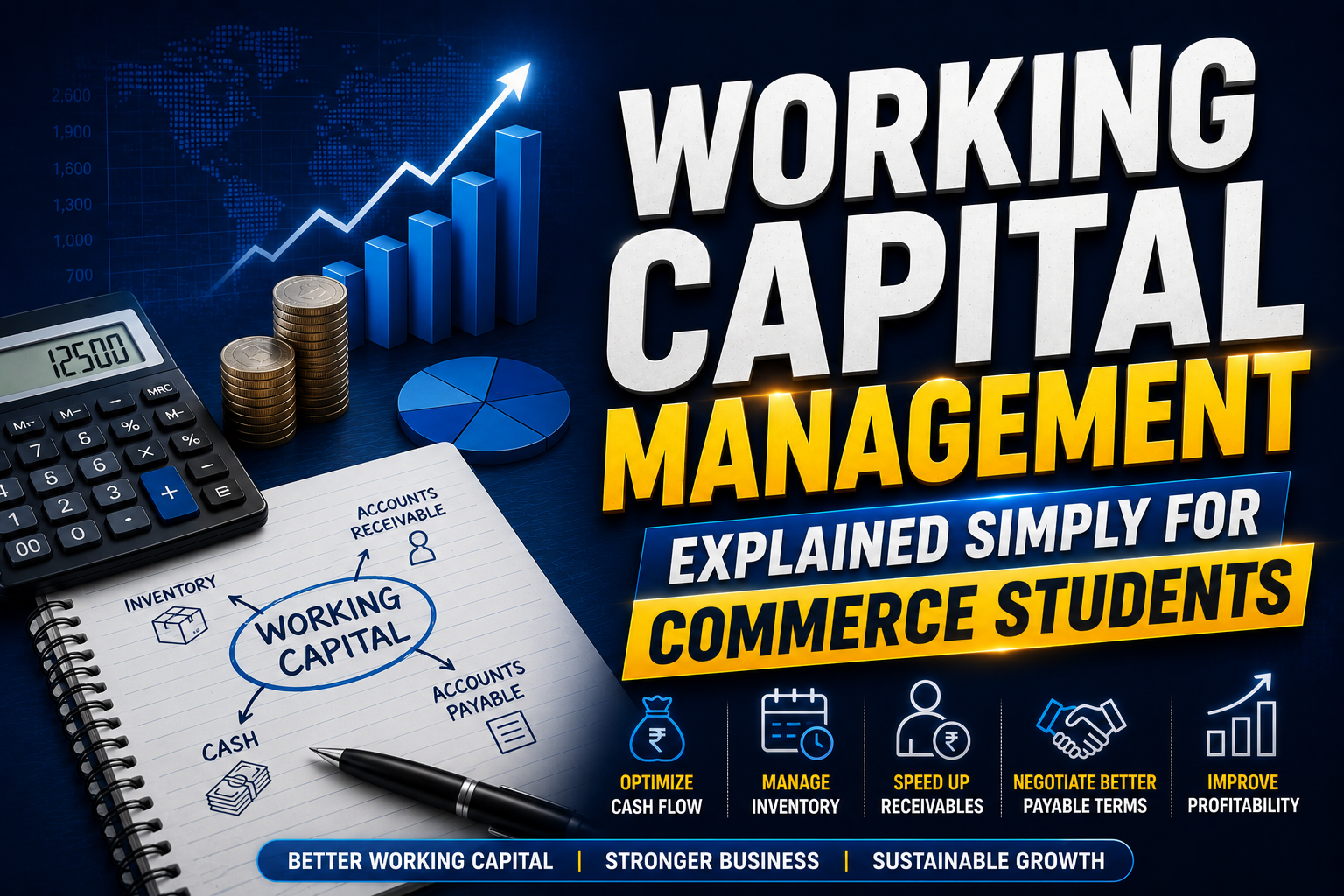
Working Capital Management Explained Simply for Commerce Students

Imagine you own a small stationery shop near a college.
Every morning, you purchase notebooks, pens and other supplies from wholesalers. Throughout the day, students buy these products. At the end of the month, you also need to pay employee salaries, electricity bills, shop rent and supplier invoices.
Now imagine this situation.
Your shop is profitable. Sales are increasing every month. Customers love your products.
But one morning, you realize you don’t have enough cash to restock inventory.
How is that possible?
You are making profits.
The answer lies in one of the most important concepts in finance—working capital management.
Many successful businesses don’t fail because they’re unprofitable. They fail because they run out of cash to manage their day-to-day operations.
That’s why finance professionals often say:
“Profit is important, but cash keeps the business alive.”
For commerce students, understanding working capital management is essential because it plays a critical role in corporate finance, banking, financial analysis, auditing and business management.
Let’s break this concept down in the simplest possible way.
What Is Working Capital?
Working capital is the money a business needs to manage its daily operations.
It ensures that a company has enough resources to:
- Purchase inventory
- Pay suppliers
- Pay employee salaries
- Cover electricity and rent
- Handle day-to-day expenses
Working capital is calculated using a simple formula.
Working Capital = Current Assets − Current Liabilities
If current assets are greater than current liabilities, the company usually has positive working capital.
If current liabilities exceed current assets, the business may struggle to meet its short-term obligations.
What Are Current Assets?
Current assets are resources that can usually be converted into cash within one year.
Examples include:
- Cash
- Bank Balance
- Inventory
- Accounts Receivable (Money Customers Owe)
- Short-Term Investments
- Prepaid Expenses
These assets help businesses operate smoothly.
What Are Current Liabilities?
Current liabilities are short-term financial obligations that must usually be paid within one year.
Examples include:
- Accounts Payable
- Short-Term Loans
- Outstanding Salaries
- Taxes Payable
- Utility Bills
- Rent Payable
Every business needs sufficient working capital to pay these obligations on time.
A Simple Example
Suppose a company has:
| Item | Amount |
|---|---|
| Cash | ₹10,00,000 |
| Inventory | ₹20,00,000 |
| Accounts Receivable | ₹15,00,000 |
| Total Current Assets | ₹45,00,000 |
| Accounts Payable | ₹18,00,000 |
| Short-Term Loan | ₹7,00,000 |
| Total Current Liabilities | ₹25,00,000 |
Working Capital = ₹45,00,000 − ₹25,00,000
Working Capital = ₹20,00,000
This indicates the company has a comfortable short-term financial position.
Why Is Working Capital Important?
Every business spends money before earning money.
A manufacturer purchases raw materials before selling finished products.
A retailer buys inventory before customers walk into the store.
An IT company pays employee salaries before clients settle invoices.
Working capital bridges this gap.
Without sufficient working capital, even profitable companies can face financial difficulties.
Good working capital management helps businesses:
- Maintain smooth daily operations
- Avoid unnecessary borrowing
- Pay suppliers on time
- Improve customer confidence
- Reduce financial stress
- Support business growth
Why Commerce Students Should Learn Working Capital Management?
Working capital isn’t just an accounting concept.
It’s a practical business skill.
Professionals in the following careers use it regularly:
- Corporate Finance
- Financial Planning & Analysis (FP&A)
- Treasury Management
- Banking
- Investment Banking
- Equity Research
- Auditing
- Business Consulting
Understanding working capital helps students analyze businesses more effectively and prepares them for real-world finance roles.
The Main Components of Working Capital
Working capital has four key components.
Cash
Cash is the most liquid asset.
Businesses use it to:
- Pay employees
- Purchase inventory
- Pay taxes
- Cover emergency expenses
Having too little cash creates problems.
Holding too much idle cash also isn’t ideal because it earns little return.
The goal is maintaining the right balance.
Inventory
Inventory includes products waiting to be sold.
Examples include:
- Raw Materials
- Work-in-Progress
- Finished Goods
Too much inventory locks up cash.
Too little inventory leads to lost sales.
Successful businesses maintain optimal inventory levels.
Accounts Receivable
These represent money customers owe the company.
If customers delay payments:
- Cash inflows slow down.
- Liquidity decreases.
- Businesses may need short-term loans.
Faster collections improve working capital.
Accounts Payable
Accounts payable represent money owed to suppliers.
Paying suppliers too early may reduce available cash.
Paying too late may damage supplier relationships.
Good businesses balance both.
Understanding the Working Capital Cycle
Working capital moves continuously through a business.
The cycle looks like this:
Cash → Inventory → Sales → Accounts Receivable → Cash
The faster this cycle repeats, the healthier the company’s cash position.
Businesses constantly try to shorten this cycle.
What Happens When Working Capital Is Poor?
Poor working capital management creates several problems.
For example:
- Suppliers stop providing credit.
- Salaries may be delayed.
- Production slows down.
- Businesses borrow more money.
- Interest costs increase.
- Customer service suffers.
Even profitable businesses can experience cash shortages if working capital isn’t managed properly.
Signs of Good Working Capital Management
A financially healthy business usually has:
- Sufficient cash reserves
- Fast inventory turnover
- Timely customer collections
- Strong supplier relationships
- Controlled short-term debt
- Positive cash flow
These signs indicate efficient financial management.
Common Working Capital Ratios
Finance professionals use several ratios to evaluate working capital.
| Ratio | What It Measures |
|---|---|
| Current Ratio | Short-term liquidity |
| Quick Ratio | Immediate liquidity |
| Inventory Turnover | Inventory efficiency |
| Receivables Turnover | Collection efficiency |
| Payables Turnover | Payment efficiency |
| Cash Conversion Cycle | Overall working capital efficiency |
These ratios help analysts compare businesses and identify potential issues.
Real-World Example
Imagine two supermarkets.
Both generate annual sales of ₹100 crore.
Supermarket A
- Keeps excessive inventory.
- Customers pay after 60 days.
- Pays suppliers within 15 days.
Cash becomes tight despite strong sales.
Supermarket B
- Maintains optimal inventory.
- Collects payments quickly.
- Negotiates longer payment terms with suppliers.
The business has more cash available for expansion.
The difference isn’t sales.
It’s working capital management.
Common Mistakes Students Make
Working capital is often misunderstood.
Avoid these mistakes.
- Assuming profit always means strong cash flow.
- Ignoring the Cash Flow Statement.
- Focusing only on revenue growth.
- Believing more inventory is always better.
- Looking at one ratio instead of the overall financial picture.
- Comparing companies from different industries without considering business models.
Professional analysts always evaluate the complete context.
Expert Tips for Commerce Students
If you want to build strong working capital management skills:
- Read annual reports of listed companies.
- Compare Current Ratios across competitors.
- Study inventory management strategies.
- Learn how cash flows through different businesses.
- Practice analyzing Balance Sheets.
- Strengthen your Excel skills.
- Understand how working capital affects profitability.
These habits will help you think like a finance professional.
Career Opportunities Where Working Capital Knowledge Is Essential
Working capital management is used extensively in finance careers.
Popular roles include:
- Corporate Finance Analyst
- FP&A Analyst
- Treasury Analyst
- Financial Analyst
- Credit Analyst
- Equity Research Analyst
- Investment Banking Analyst
- Auditor
- Business Consultant
Employers value candidates who understand how businesses manage liquidity and cash efficiently.
Future Trends in Working Capital Management
Technology is changing how businesses manage working capital.
Some emerging trends include:
- AI-powered cash forecasting
- Automated invoice processing
- Digital payment platforms
- Real-time financial dashboards
- Cloud-based ERP systems
- Predictive cash flow analytics
- Supply chain financing solutions
Finance professionals who combine financial knowledge with digital tools will have a competitive advantage.
Frequently Asked Questions (FAQs)
What is working capital management?
Working capital management is the process of managing a company’s current assets and current liabilities to ensure smooth day-to-day business operations while maintaining sufficient liquidity.
What is the formula for working capital?
Working Capital = Current Assets − Current Liabilities
A positive result generally indicates that the company can meet its short-term financial obligations.
Why is working capital important?
Working capital helps businesses pay suppliers, employees, rent, taxes and other short-term expenses. Without adequate working capital, businesses may face cash shortages even if they are profitable.
Why should commerce students learn working capital management?
Working capital management is widely used in corporate finance, banking, financial analysis, auditing, investment banking and business consulting. It is one of the most practical finance concepts students can learn.
What is the difference between working capital and cash flow?
Working capital measures short-term financial health based on current assets and current liabilities, while cash flow tracks the actual movement of cash into and out of the business over a period.
Which industries rely heavily on working capital management?
Manufacturing, retail, FMCG, pharmaceuticals, logistics, wholesale, automobile, e-commerce and hospitality businesses all require efficient working capital management to operate successfully.
