

Blog
FRM vs CFA: Which Certification Is Better for Finance Careers?

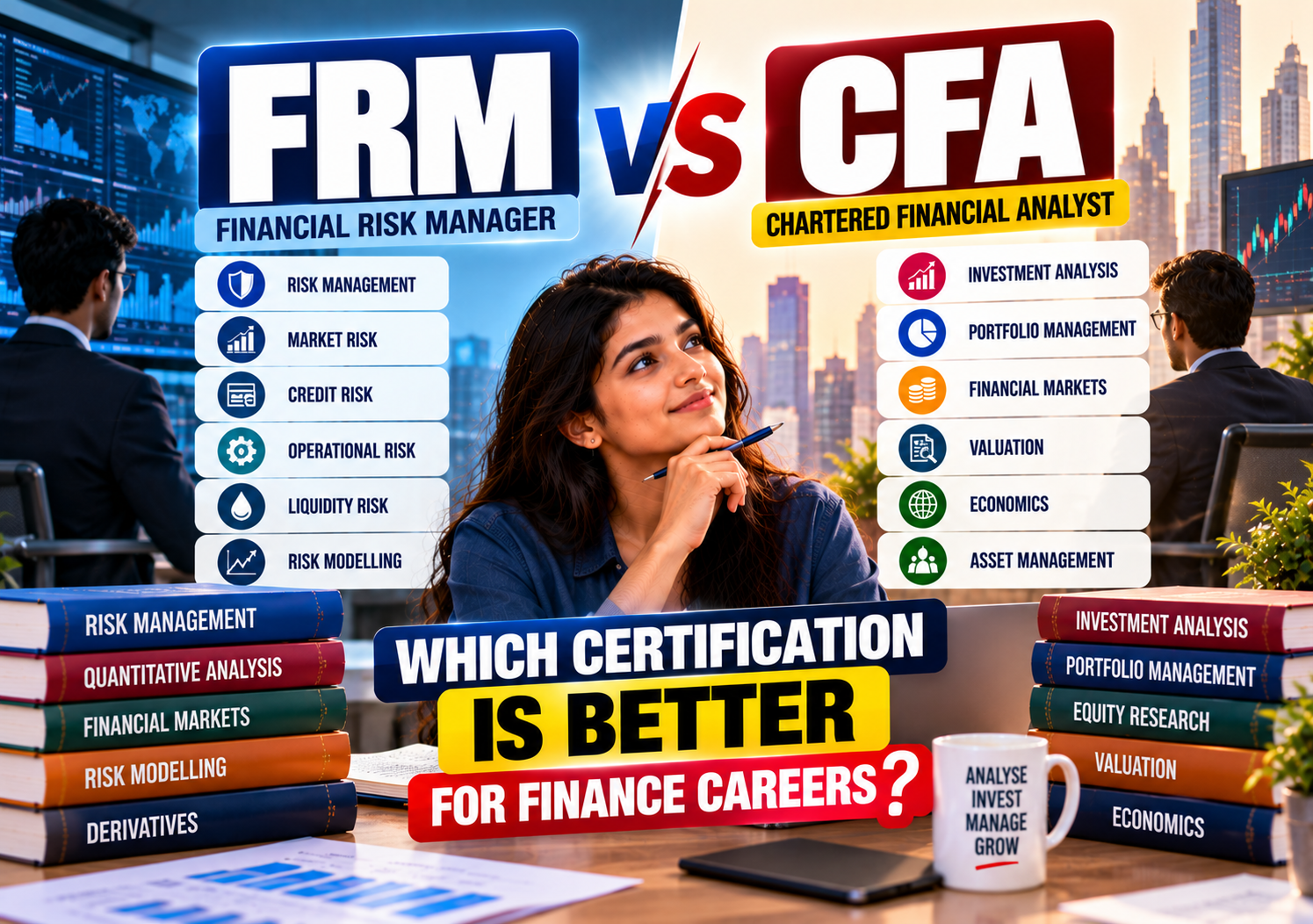
If you are planning a career in finance, the FRM vs CFA comparison can be confusing. Both are internationally recognized professional credentials, both require serious preparation, and both can support careers in financial services.
The difference is mainly in what you want to become good at.
FRM, or Financial Risk Manager, is focused on identifying, measuring and managing financial risk. CFA, or Chartered Financial Analyst, has a much broader investment focus covering financial analysis, valuation, portfolio management, financial markets and investment decision-making. GARP
So instead of asking which certification is universally better, start with a more useful question:
Do you want to specialise in financial risk, or build a broader career around investment and financial analysis?
FRM vs CFA: What Is the Main Difference?
The two certifications overlap in areas such as quantitative analysis, financial markets and risk, but their primary objectives are different.
| Area | FRM | CFA |
|---|---|---|
| Full form | Financial Risk Manager | Chartered Financial Analyst |
| Awarding body | GARP | CFA Institute |
| Main focus | Financial risk management | Investment analysis and portfolio management |
| Exam structure | Part I and Part II | Level I, Level II and Level III |
| Key areas | Market, credit, operational, liquidity and treasury risk | Financial analysis, equities, fixed income, valuation, portfolio management and more |
| Work experience for certification | 2 years of relevant full-time risk-management experience | 4,000 hours of qualifying professional work experience over at least 36 months |
| Typical career direction | Risk management and related analytical roles | Investment, research, portfolio management and broader finance roles |
| Best suited to | Students and professionals interested in risk | Students and professionals interested in investments and finance |
GARP currently requires candidates to pass both FRM exams and submit two years of relevant professional experience. CFA Institute requires candidates to pass three exams and meet its qualifying work-experience and membership requirements to earn the charter. GARP
What Does the FRM Certification Teach?
FRM is built around financial risk.
The two-part examination covers:
- Foundations of risk management
- Quantitative analysis
- Financial markets and products
- Valuation and risk models
- Market risk
- Credit risk
- Operational risk and resilience
- Liquidity and treasury risk
- Risk management and investment management
- Current issues in financial markets
These topics are designed to help candidates understand how financial risks are identified, measured, monitored and managed. GARP
Consider a bank that has given loans to thousands of customers.
A risk professional may need to think about questions such as:
- What happens if borrowers start defaulting?
- How much exposure does the bank have to a particular sector?
- How could interest-rate movements affect the business?
- Does the bank have enough liquidity?
- How should market or credit risk be measured?
That is the kind of thinking FRM is designed to develop.
What Does the CFA Program Teach?
CFA has a wider investment focus.
The current CFA curriculum includes:
- Financial statement analysis
- Corporate finance
- Equity investments
- Fixed income
- Derivatives
- Alternative investments
- Quantitative methods
- Economics
- Portfolio construction
- Risk management
- Ethics and professional standards
The three levels progressively move from learning foundational concepts to analysing and evaluating situations and then integrating knowledge into investment decisions. CFA Institute
For example, suppose an analyst is studying a listed company.
They may need to understand its financial statements, analyse the industry, estimate future performance, value the company’s shares and consider the risks involved before forming an investment view.
That is much closer to the core CFA skill set.
FRM vs CFA: Which One Is More Focused on Risk?
FRM is the more specialised risk-management qualification.
Risk is present throughout finance, but FRM makes it the centre of the program.
Market risk, credit risk, operational risk, liquidity risk and risk models are major components of the FRM curriculum. GARP
CFA also covers risk management, particularly within investment analysis and portfolio management. Its curriculum includes derivatives and risk management, portfolio construction and other areas where risk affects investment decisions. CFA Institute
The difference is one of emphasis.
FRM asks: How do we identify, measure and manage financial risk?
CFA asks: How do we analyse investments, value assets and construct portfolios while considering risk?
FRM vs CFA: Which One Is Better for Investment Careers?
If your target is an investment-oriented career, CFA has a more direct connection to the subject matter.
CFA Institute identifies career paths such as:
- Investment research
- Portfolio management
- Investment analysis
- Consulting
- Risk analysis
- Wealth management
- Investment banking
- Asset management
Its curriculum specifically covers investment tools, asset valuation and portfolio management. CFA Institute
FRM can also be useful within investment organisations, particularly where risk analysis is part of the job. GARP notes that relevant FRM experience can include risk analysis, model validation, trading, portfolio management, treasury, audit and consulting. GARP
So an investment professional may encounter both qualifications, but they represent different areas of expertise.
FRM vs CFA for Risk Management Careers
This is where FRM has its clearest connection.
FRM is directly designed around financial risk management and can be relevant to roles involving:
- Market risk
- Credit risk
- Operational risk
- Liquidity risk
- Treasury risk
- Risk analytics
- Model validation
- Risk consulting
- Financial risk analysis
GARP specifically describes relevant risk-management experience as work involving the identification, measurement, monitoring or management of risk. GARP
CFA can still be useful for risk-related careers. Its curriculum includes quantitative methods, derivatives, risk management, portfolio construction and investment analysis. CFA Institute also lists risk analysis and risk management among investment career paths. CFA Institute
The distinction is useful:
FRM builds depth around risk. CFA builds broader investment knowledge that includes risk.
FRM vs CFA: Which Is Better for Equity Research?
Equity research involves analysing companies and industries, studying financial statements, building forecasts, valuing securities and communicating investment views.
Those activities align closely with the CFA curriculum.
CFA’s curriculum includes financial statement analysis, equities, corporate finance, quantitative methods and valuation-related investment concepts. CFA Institute
FRM can add useful knowledge about financial risk, but equity research is not the central purpose of the FRM program.
For a commerce student specifically interested in company analysis and investment research, the curriculum fit is therefore an important consideration.
FRM vs CFA: What About Investment Banking?
Investment banking covers several different activities, so the answer depends on the role.
A professional working on transactions may need knowledge of:
- Financial statements
- Corporate finance
- Valuation
- Mergers and acquisitions
- Financial modelling
- Capital markets
- Risk
CFA develops knowledge across financial statement analysis, corporate finance, equities, fixed income, valuation and related investment concepts. CFA Institute also lists investment banking among sectors where charterholders work. CFA Institute
FRM can be relevant where risk analysis is part of the work, but risk management is not the entire investment-banking function.
For students targeting investment banking, it is important not to assume that earning either credential automatically qualifies them for an investment-banking job. Practical skills such as financial modelling, Excel, accounting and valuation still matter.
FRM vs CFA: Exam Structure
The programs have different structures.
FRM
FRM has two exams:
Part I focuses on foundations of risk management, quantitative analysis, financial markets and products, and valuation and risk models.
Part II moves into the application of risk concepts, including market risk, credit risk, operational risk, liquidity and treasury risk, and risk management and investment management. GARP
GARP states that candidates have four years from passing Part I to pass Part II. Certification also requires two years of relevant full-time professional experience. GARP
CFA
CFA has three exam levels:
Level I: foundational knowledge and concepts.
Level II: analysis and evaluation.
Level III: integration and application, with specialised pathways in portfolio management, private markets or private wealth. CFA Institute
To become a CFA charterholder, candidates must pass all three exams, complete qualifying professional experience and become a CFA Institute member. CFA Institute currently specifies 4,000 hours of relevant work experience over a minimum of 36 months. CFA Institute
How Difficult Are FRM and CFA?
Both require serious preparation, but comparing difficulty with a simple “FRM is harder” or “CFA is harder” statement is not particularly useful.
The content is different.
FRM places significant emphasis on quantitative analysis, financial risk models and risk measurement. GARP says candidates typically spend around 240 hours preparing for the FRM exam, although actual study time varies by background and experience. GARP
CFA covers a much wider investment curriculum across three levels. CFA Institute currently describes approximately 300 hours of study per level as a guideline. CFA Institute
Your background matters.
A student who enjoys probability, statistics and risk models may approach FRM differently from someone who enjoys company analysis, valuation and markets.
FRM vs CFA for Commerce Students After B.Com
For a B.Com graduate, both can make sense, but the career objective should come first.
Consider FRM if you are interested in:
- Bank risk management
- Market risk
- Credit risk
- Risk analytics
- Treasury risk
- Model validation
- Financial risk consulting
- Quantitative risk-related roles
Consider CFA if you are interested in:
- Equity research
- Investment analysis
- Portfolio management
- Asset management
- Wealth management
- Financial analysis
- Investment consulting
- Investment banking-related careers
There is also no requirement to make the decision based only on your degree. GARP states that there are no educational or professional prerequisites to register for the FRM Program. GARP
CFA Institute’s eligibility framework includes a bachelor’s degree route, a route based on being within the specified period of graduation eligibility, or a qualifying combination of education and professional work experience. CFA Institute
FRM vs CFA: Skills You Should Build Alongside the Certification
This is where many students make a mistake.
They assume the certification itself is enough.
It isn’t.
If you choose FRM
Build skills in:
- Advanced Excel
- Statistics
- Financial modelling
- Risk analytics
- Data analysis
- Python or other analytical tools
- Financial markets
- Banking fundamentals
- Communication
If you choose CFA
Build skills in:
- Excel
- Financial statement analysis
- Financial modelling
- Company valuation
- Equity research
- Investment research
- PowerPoint
- Data analysis
- Financial markets
- Business writing
A candidate who can explain how a risk model works or build a basic valuation model has something practical to demonstrate in an interview.
The qualification and the skill should work together.
FRM vs CFA: Can You Pursue Both?
Yes, but that does not mean everyone should.
The two qualifications cover different areas, so there can be a logical reason for combining them later in a career.
For example, an investment professional working heavily with risk could benefit from deeper risk-management knowledge. Similarly, someone working in financial risk may want broader knowledge of investment analysis and portfolio management.
But pursuing both simply to collect credentials can become counterproductive.
If you are a student, it is often better to first build a strong foundation in accounting, Excel, financial analysis, statistics and communication. Then add the professional qualification that matches the direction you want to pursue.
FRM vs CFA: A Practical Career Comparison
| Career interest | FRM relevance | CFA relevance |
|---|---|---|
| Market risk | Strong | Relevant |
| Credit risk | Strong | Relevant |
| Operational risk | Strong | Limited/related |
| Liquidity and treasury risk | Strong | Related |
| Risk analytics | Strong | Relevant |
| Equity research | Related | Strong |
| Investment analysis | Related | Strong |
| Portfolio management | Relevant | Strong |
| Asset management | Relevant | Strong |
| Financial statement analysis | Some coverage | Strong |
| Investment banking | Related | Relevant |
| Wealth management | Related | Strong |
| Risk consulting | Strong | Relevant |
This is a description of curriculum and career alignment, not a ranking. Actual hiring requirements vary by employer, role and market.
Common Mistakes When Choosing FRM or CFA
Choosing based only on the qualification’s reputation
A recognised credential does not automatically make it suitable for every finance role.
Looking only at the exam structure
Two exams versus three exams tells you very little about which program fits your career.
Look at the subjects.
Ignoring the job you actually want
If your target role involves credit risk and risk modelling, studying a qualification mainly because you want to work in equity research may create a mismatch.
Treating certification as a substitute for experience
Both GARP and CFA Institute have professional-experience components associated with their respective credentials. Practical exposure remains important. GARP
Collecting certifications without building technical skills
A finance candidate should be able to work with numbers, spreadsheets, financial information and business problems—not just discuss the names of certifications.
So, FRM or CFA for a Finance Career?
The answer depends on the kind of finance career you are targeting.
If you want to specialise in financial risk management, FRM provides a focused curriculum around market, credit, operational, liquidity and other risk areas. GARP
If you want to build a career around investment analysis, valuation, portfolio management and financial markets, CFA provides a broader investment-focused curriculum. CFA Institute
For a commerce student, the smartest starting point is not the certification brochure. Look at actual job descriptions for the roles you want, identify the skills employers ask for, and then see which qualification supports that direction.
The credential should follow the career plan—not replace it.
How Master Minds Can Help Commerce Students Build a Finance Foundation
The FRM vs CFA decision becomes much easier when students first understand their strengths in accounting, finance and business analysis. A strong commerce foundation can support later professional studies by making financial concepts easier to connect with practical business situations.
For students considering the CA or CMA route as part of a broader finance career plan, Master Minds provides professional commerce education and courses that can help build that foundation.
