

Blog
Treasury Management Explained for Commerce Students: A Beginner’s Guide to Corporate Treasury

Imagine a large company has ₹500 crore in its bank accounts.
At first glance, it looks financially strong.
But here’s the challenge.
Tomorrow, the company must pay employee salaries across five countries. Next week, it has to purchase raw materials worth ₹120 crore. At the same time, ₹200 crore is sitting idle in one account earning almost no return, while another business division is borrowing money at high interest rates.
Who decides where the cash should go?
Who ensures every payment happens on time?
Who makes sure surplus cash generates returns instead of sitting idle?
That’s the responsibility of the Treasury Management team.
Many commerce students know about accounting, auditing and taxation. Treasury management, however, is often overlooked—even though it plays a critical role in every large organization.
If accounting records what happened, treasury management ensures the business has enough money to operate today and grow tomorrow.
Understanding treasury management basics can open the door to exciting careers in corporate finance, banking, multinational companies and financial institutions.
What Is Treasury Management?
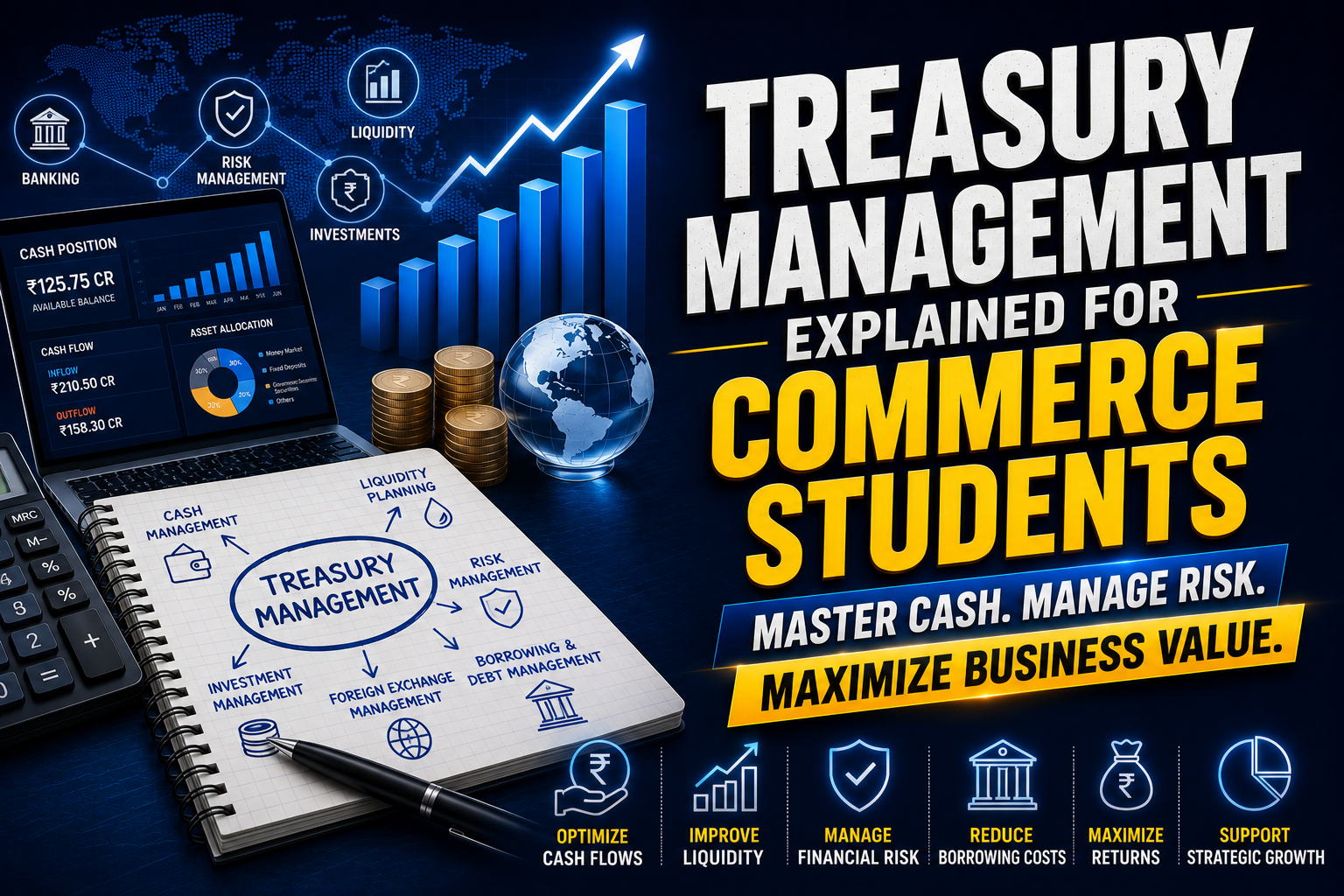
Treasury management is the process of managing a company’s cash, liquidity, investments, borrowing and financial risks.
Its primary objective is simple:
Ensure the company always has enough cash to run smoothly while making the best use of available funds.
Treasury professionals constantly monitor money moving into and out of the business and make decisions that improve financial efficiency.
Why Treasury Management Is Important?
Cash is the lifeblood of every business.
Even profitable companies can face serious problems if they don’t have enough cash available when payments become due.
Treasury management helps businesses:
- Maintain healthy cash flow
- Pay suppliers and employees on time
- Invest surplus funds wisely
- Reduce borrowing costs
- Manage financial risks
- Improve business stability
- Support long-term growth
Without an efficient treasury function, companies may struggle despite generating good profits.
Why Commerce Students Should Learn Treasury Management?
Treasury management combines finance, banking and business strategy.
It gives students a practical understanding of how companies manage money every day.
Knowledge of treasury management is valuable for careers in:
- Corporate Finance
- Banking
- Treasury Operations
- Financial Planning & Analysis (FP&A)
- Investment Banking
- Risk Management
- Financial Consulting
- Multinational Corporations
It also strengthens your understanding of working capital and cash flow management.
Main Functions of Treasury Management
Corporate treasury departments perform several important functions.
Cash Management
Cash management involves monitoring daily cash inflows and outflows.
Treasury professionals ensure there is enough cash available to:
- Pay salaries
- Purchase inventory
- Pay suppliers
- Meet tax obligations
- Handle unexpected expenses
They also avoid holding excessive idle cash.
Liquidity Management
Liquidity refers to a company’s ability to meet its short-term financial commitments.
Treasury teams continuously monitor available funds and ensure the business never faces unnecessary cash shortages.
Maintaining the right balance between liquidity and profitability is one of their biggest responsibilities.
Investment Management
Large businesses often have temporary surplus cash.
Instead of leaving it unused, treasury professionals invest it in relatively safe instruments such as:
- Fixed Deposits
- Treasury Bills
- Money Market Funds
- Commercial Paper
- Government Securities
The objective is to earn additional returns while keeping funds easily accessible.
Borrowing and Debt Management
When companies need external funding, treasury teams:
- Arrange loans
- Negotiate interest rates
- Plan repayment schedules
- Monitor debt levels
- Reduce financing costs
Effective debt management directly improves profitability.
Foreign Exchange (Forex) Management
Companies operating internationally receive and make payments in multiple currencies.
Treasury professionals monitor exchange rate fluctuations and use hedging strategies to reduce currency risk.
This function is especially important for exporters, importers and multinational corporations.
Financial Risk Management
Treasury departments identify and manage risks related to:
- Interest rate movements
- Currency fluctuations
- Liquidity shortages
- Credit exposure
- Market volatility
Managing these risks protects business performance during uncertain economic conditions.
Treasury Management Process
Treasury operations follow a structured workflow.
| Stage | Purpose |
|---|---|
| Cash Forecasting | Estimate future cash requirements |
| Liquidity Planning | Maintain sufficient operating cash |
| Investment Planning | Invest surplus funds efficiently |
| Debt Management | Arrange financing when needed |
| Risk Management | Reduce financial exposure |
| Performance Monitoring | Improve treasury efficiency |
Each stage helps ensure financial stability.
Treasury Management vs Accounting
Students often confuse treasury management with accounting.
Although both are part of the finance function, they serve different purposes.
| Accounting | Treasury Management |
|---|---|
| Records financial transactions | Manages company cash |
| Focuses on historical data | Focuses on present and future liquidity |
| Prepares financial statements | Plans cash availability |
| Ensures compliance | Optimizes financial resources |
| Measures business performance | Supports financial decision-making |
Accounting tells the story of past financial activities.
Treasury management helps shape future financial decisions.
Essential Skills for Treasury Professionals
Treasury professionals require both technical and analytical skills.
Important skills include:
Cash Flow Analysis
Understanding how cash moves through a business.
Financial Statement Analysis
Interpreting Balance Sheets, Income Statements and Cash Flow Statements.
Banking Knowledge
Understanding banking products, payment systems and corporate financing.
Financial Risk Management
Evaluating financial risks before they affect business performance.
Excel and Financial Tools
Treasury teams rely heavily on Excel for forecasting and cash management.
Knowledge of ERP systems and business intelligence tools is also valuable.
Communication Skills
Treasury professionals regularly interact with banks, senior management and business units.
Strong communication skills are essential.
Technology Used in Treasury Management
Modern treasury departments use advanced technology to improve efficiency.
Common tools include:
| Tool | Purpose |
|---|---|
| Microsoft Excel | Cash forecasting and financial analysis |
| SAP Treasury | Treasury operations |
| Oracle Treasury | Cash and liquidity management |
| Power BI | Dashboards and reporting |
| Bloomberg Terminal | Market information |
| Reuters Workspace | Financial market data |
| ERP Systems | Integrated financial management |
Technology enables treasury teams to make faster and better financial decisions.
Real-World Example
Consider two manufacturing companies.
Company A
- Maintains excess cash in multiple bank accounts.
- Frequently borrows short-term loans.
- Pays high interest costs.
Company B
- Consolidates available cash.
- Invests temporary surplus funds.
- Uses internal cash before borrowing.
Although both companies earn similar profits, Company B manages its treasury more efficiently and saves significant financing costs.
This demonstrates how treasury management directly improves financial performance.
Common Mistakes Students Make
Treasury management is often misunderstood.
Common mistakes include:
- Thinking treasury is only about banking.
- Confusing treasury management with accounting.
- Ignoring liquidity management.
- Assuming idle cash has no opportunity cost.
- Focusing only on profits instead of available cash.
- Overlooking financial risk management.
Treasury is about managing money strategically—not simply recording transactions.
Career Opportunities in Treasury Management
Treasury professionals are employed across industries.
Popular career roles include:
- Treasury Analyst
- Treasury Executive
- Treasury Operations Analyst
- Cash Management Analyst
- Liquidity Analyst
- Treasury Risk Analyst
- Corporate Treasury Manager
- Banking Relationship Manager
- Finance Manager
Large corporations and multinational companies often have dedicated treasury departments with excellent career growth opportunities.
Why Treasury Careers Are Growing?
Several factors are increasing demand for treasury professionals.
Businesses now operate globally.
Cross-border payments are increasing.
Financial risks have become more complex.
Digital banking continues to evolve.
Organizations need professionals who can optimize cash, manage liquidity and support strategic financial decisions.
As a result, treasury management has become one of the fastest-growing functions in corporate finance.
Future Trends in Treasury Management
Technology is reshaping treasury operations.
Emerging trends include:
- AI-powered cash forecasting
- Real-time payment systems
- Cloud-based treasury platforms
- Blockchain-enabled transactions
- Predictive liquidity analytics
- Automated treasury operations
- Digital banking integration
Finance professionals who understand both treasury concepts and technology will remain highly valuable.
Expert Tips for Commerce Students
If you’re considering a treasury career:
- Build a strong foundation in corporate finance.
- Learn working capital management thoroughly.
- Master Microsoft Excel.
- Understand banking operations.
- Study cash flow statements carefully.
- Read annual reports of listed companies.
- Learn financial modeling and forecasting.
- Follow RBI policy announcements and business news.
These habits will help you develop practical financial thinking.
Frequently Asked Questions (FAQs)
What is treasury management?
Treasury management is the process of managing a company’s cash, liquidity, investments, borrowing and financial risks to ensure efficient business operations and financial stability.
Why is treasury management important?
Treasury management helps businesses maintain sufficient cash, reduce financing costs, invest surplus funds wisely and manage financial risks effectively.
Is treasury management a good career for commerce students?
Yes. Treasury management offers excellent career opportunities in corporate finance, banking, multinational companies and financial institutions for commerce, CA and CMA students.
What skills are required for treasury management?
Important skills include cash flow analysis, financial statement analysis, liquidity management, banking knowledge, Excel, risk management and communication skills.
What is the difference between treasury management and accounting?
Accounting focuses on recording financial transactions and preparing reports, while treasury management focuses on managing cash, liquidity, investments and financial risks.
Which companies hire treasury professionals?
Treasury professionals are hired by banks, IT companies, manufacturing firms, pharmaceutical companies, FMCG businesses, telecom companies, infrastructure firms, energy companies and multinational corporations.
