

Blog
Risk Management Careers in Banking & Finance: A Complete Guide for Commerce Students

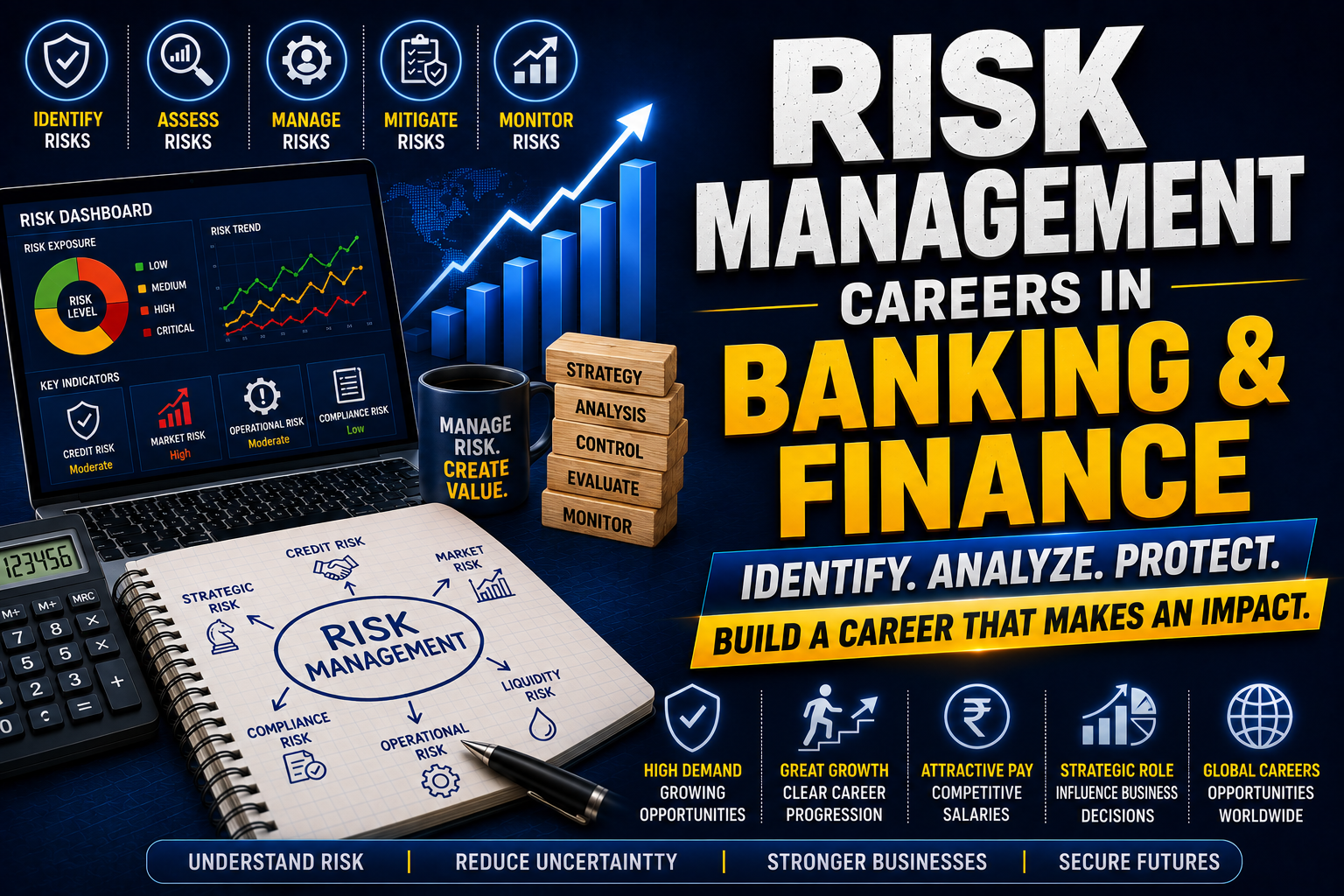
In 2008, several of the world’s biggest financial institutions collapsed.
The problem wasn’t that they lacked customers.
It wasn’t that they lacked revenue.
The real issue was that many organizations underestimated risk.
Fast forward to today, and every major bank, insurance company, investment firm and multinational corporation has one thing in common—they invest heavily in risk management.
Whether it’s a bank approving a ₹5 crore business loan, an investment company managing billions of rupees, or a multinational expanding into a new country, every financial decision involves risk.
The professionals who identify, measure and reduce these risks are among the most valuable people in modern finance.
That’s why risk management careers have become one of the fastest-growing opportunities for commerce graduates, CA aspirants and CMA students.
If you enjoy finance, analysis and problem-solving, risk management could be one of the most rewarding career paths available today.
What Is Risk Management?
Risk management is the process of identifying, assessing, monitoring and reducing financial and business risks before they negatively affect an organization.
Every business decision carries uncertainty.
Risk management helps companies answer questions like:
- Can this customer repay a loan?
- Will exchange rates affect profits?
- Could rising interest rates impact borrowing costs?
- What happens if the economy slows down?
- Are we complying with government regulations?
Instead of eliminating risk completely—which is impossible—risk professionals help businesses manage it intelligently.
Why Risk Management Matters?
Every organization takes risks to grow.
The challenge is taking the right risks.
Effective risk management helps businesses:
- Protect financial assets
- Reduce unexpected losses
- Improve decision-making
- Meet regulatory requirements
- Build investor confidence
- Maintain long-term stability
Banks, in particular, rely heavily on strong risk management because they deal with large volumes of customer money every day.
Why Commerce Students Should Consider Risk Management Careers?
Risk management combines finance, economics, data analysis and business strategy.
It is ideal for students who enjoy:
- Financial analysis
- Banking
- Investment decisions
- Business problem-solving
- Data interpretation
- Strategic thinking
Unlike many finance roles that focus on historical performance, risk management looks ahead and prepares organizations for future uncertainties.
Types of Risks Managed by Finance Professionals
Risk management covers several areas.
Credit Risk
Credit risk arises when borrowers fail to repay loans.
Banks carefully evaluate customer creditworthiness before approving loans.
Example:
A bank analyzes a company’s financial statements before sanctioning a ₹20 crore loan.
Market Risk
Market risk results from fluctuations in financial markets.
Examples include:
- Stock prices
- Interest rates
- Exchange rates
- Commodity prices
Investment firms constantly monitor market risk.
Liquidity Risk
Liquidity risk occurs when a company cannot meet its short-term financial obligations despite having valuable assets.
Treasury teams work closely with risk managers to maintain sufficient liquidity.
Operational Risk
Operational risk arises from failures in internal processes, systems or human error.
Examples include:
- Fraud
- Cyberattacks
- Technology failures
- Internal control weaknesses
Banks invest significantly in operational risk management.
Compliance Risk
Organizations must follow laws and regulations.
Failure to comply can result in penalties, legal action and reputational damage.
Compliance teams work alongside risk professionals to minimize these risks.
Industries Hiring Risk Management Professionals
Risk management professionals are in demand across multiple sectors.
Major employers include:
- Commercial Banks
- Investment Banks
- Insurance Companies
- Asset Management Firms
- Mutual Funds
- FinTech Companies
- Consulting Firms
- Credit Rating Agencies
- Manufacturing Companies
- Multinational Corporations
Almost every large organization now has dedicated risk management teams.
Popular Job Roles
Risk management offers diverse career opportunities.
Common positions include:
| Role | Primary Responsibility |
|---|---|
| Risk Analyst | Analyze financial and operational risks |
| Credit Risk Analyst | Evaluate borrower creditworthiness |
| Market Risk Analyst | Monitor investment and trading risks |
| Operational Risk Analyst | Improve internal controls |
| Enterprise Risk Manager | Oversee organization-wide risk |
| Compliance Analyst | Ensure regulatory compliance |
| Treasury Risk Analyst | Monitor liquidity and funding risks |
| Risk Consultant | Advise businesses on risk strategies |
Each role contributes to protecting an organization’s financial health.
Skills Required for Risk Management Careers
Successful risk professionals combine technical expertise with business judgment.
Important skills include:
Financial Statement Analysis
Understanding balance sheets, income statements and cash flow statements.
Analytical Thinking
Identifying patterns and evaluating complex financial information.
Excel Skills
Advanced Excel remains one of the most important tools for risk analysis.
Professionals frequently use:
- Pivot Tables
- Lookup Functions
- Scenario Analysis
- Financial Models
Data Analysis
Modern risk management increasingly relies on data-driven decision-making.
Knowledge of Power BI, SQL or Python can be an added advantage.
Business Knowledge
Understanding how industries operate helps identify practical risks.
Communication Skills
Risk professionals regularly explain complex financial concepts to senior management.
Clear communication is essential.
Technology Used in Risk Management
Technology has transformed the risk management function.
Popular tools include:
| Tool | Purpose |
|---|---|
| Microsoft Excel | Financial analysis |
| Power BI | Dashboards and reporting |
| Tableau | Data visualization |
| SAS | Risk analytics |
| SQL | Data management |
| Bloomberg Terminal | Market data |
| Moody’s Analytics | Credit risk analysis |
| SAP GRC | Governance, risk and compliance |
Finance professionals who combine analytical skills with technology have a significant competitive advantage.
Risk Management vs Auditing
Students often confuse these two career paths.
They are related but different.
| Auditing | Risk Management |
|---|---|
| Reviews past transactions | Evaluates future risks |
| Ensures financial accuracy | Protects business from potential losses |
| Focuses on compliance | Supports strategic decisions |
| Examines historical records | Monitors ongoing risks |
| Reports findings | Recommends preventive actions |
Both careers require strong analytical abilities but focus on different objectives.
Real-World Example
Imagine a bank receives two loan applications.
Both companies report similar annual profits.
A risk analyst digs deeper.
The first company has:
- Stable cash flow
- Low debt
- Strong repayment history
The second company has:
- Heavy outstanding loans
- Irregular cash flow
- Poor repayment record
Although profits appear similar, the second company carries much higher credit risk.
The bank approves only the first loan.
This decision protects the bank from potential financial losses.
That’s the practical value of risk management.
Common Mistakes Students Make
Students exploring risk management often:
- Believe risk management is only about banking.
- Ignore data analysis skills.
- Focus only on accounting knowledge.
- Underestimate communication skills.
- Learn formulas without understanding business context.
- Neglect technology and analytics tools.
Modern risk management combines finance with technology and strategic thinking.
Career Growth in Risk Management
Risk management offers excellent long-term career progression.
| Experience | Position |
|---|---|
| Entry Level | Risk Analyst |
| 3–5 Years | Senior Risk Analyst |
| 5–8 Years | Risk Manager |
| 8–12 Years | Senior Risk Manager |
| 12–15 Years | Head of Risk |
| Leadership | Chief Risk Officer (CRO) |
Large banks and multinational corporations provide attractive career advancement opportunities.
Why Risk Management Careers Are Growing?
Several factors are driving demand for risk professionals.
Businesses now face:
- Cybersecurity threats
- Global economic uncertainty
- Regulatory changes
- Digital banking risks
- Artificial Intelligence adoption
- Climate-related financial risks
- Cross-border business operations
Organizations need professionals who can anticipate risks before they become costly problems.
Future Trends in Risk Management
The field continues to evolve rapidly.
Emerging trends include:
- AI-powered risk analytics
- Predictive risk modeling
- Machine learning applications
- Real-time fraud detection
- ESG risk assessment
- Cyber risk management
- Climate risk analysis
- Integrated enterprise risk management
Risk professionals who embrace technology will remain highly sought after.
Expert Tips for Commerce Students
If you want to build a successful career in risk management:
- Strengthen financial statement analysis.
- Master Microsoft Excel.
- Learn financial modeling.
- Build basic data analytics skills.
- Stay updated on RBI and SEBI regulations.
- Read annual reports of banks and financial institutions.
- Follow economic and financial news regularly.
Risk management rewards professionals who combine financial knowledge with critical thinking.
Frequently Asked Questions (FAQs)
What is risk management?
Risk management is the process of identifying, assessing and reducing financial and business risks to protect an organization’s assets and operations.
Is risk management a good career for commerce students?
Yes. Risk management offers excellent opportunities in banking, finance, insurance, consulting and multinational companies. It is one of the fastest-growing finance careers.
What qualifications are useful for risk management careers?
Commerce graduates, CA, CMA, MBA (Finance) and finance professionals can all pursue careers in risk management. Specialized certifications can further enhance career prospects.
What skills are required for risk management?
Important skills include financial analysis, Excel, analytical thinking, business knowledge, communication skills and data analysis.
Is risk management only for banks?
No. Risk management is used across banking, insurance, investment firms, manufacturing, IT, consulting, healthcare, energy and many other industries.
Can CA and CMA students build successful careers in risk management?
Absolutely. CA and CMA students already possess strong financial knowledge, making them excellent candidates for roles in credit risk, enterprise risk, treasury risk and financial risk management.
