

Blog
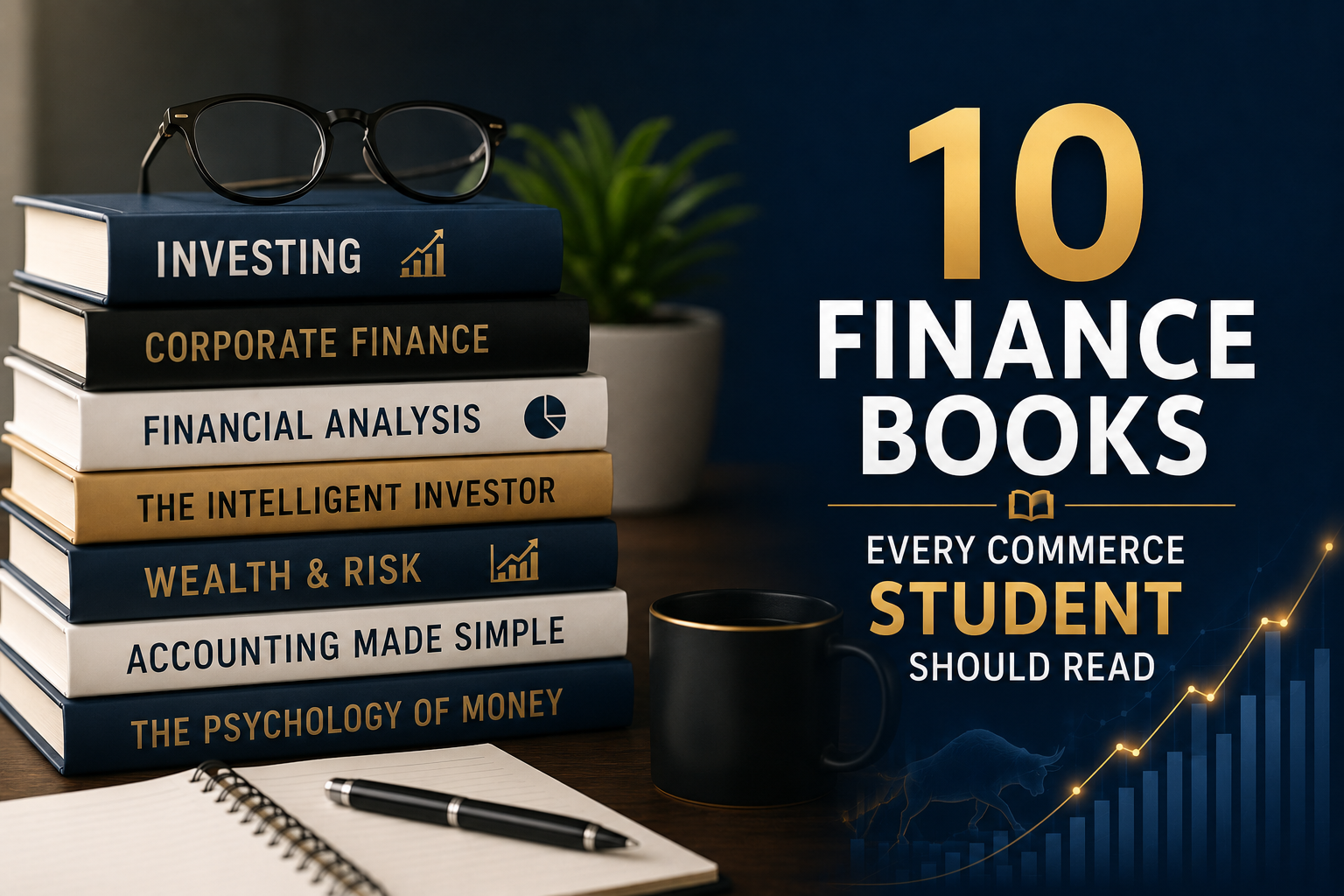
10 Finance Books Every Commerce Student Should Read

If you are studying commerce, finance can sometimes feel like a subject built around formulas, balance sheets, ratios, and long definitions. Then you start reading about how real investors and finance professionals think, and something changes.
You realise that finance is not only about knowing a formula. It is about understanding businesses, judging risk, interpreting numbers, and making decisions when the answer is not obvious.
That is why reading good finance books can be surprisingly useful for commerce students.
The right books can help you connect classroom concepts with investing, corporate finance, financial statements, valuation, personal money decisions, and business strategy. Some are easy to read. Others are more technical and work better as reference books.
This guide covers 10 finance books for students that offer a useful mix of theory, practical thinking, investing knowledge, accounting skills, and corporate finance concepts.
Why Should Commerce Students Read Finance Books?
Your college textbooks give you the foundation. Books written by investors, finance professionals, academics, and business writers can show you what happens beyond the syllabus.
For example, a textbook might explain the concept of intrinsic value. A good investing book can show you why estimating that value is difficult in the real world.
Similarly, you may learn the components of a balance sheet in class. A practical finance book can help you understand what those numbers might tell you about the health of a business.
Reading widely can help you develop:
- Financial statement reading skills
- Investment thinking
- Business analysis
- Valuation knowledge
- Corporate finance understanding
- Financial decision-making
- Risk awareness
- Long-term thinking
- Better money habits
- Professional vocabulary
There is another benefit that students often overlook: finance books can improve the quality of your questions.
That matters in interviews, internships, case studies, and finance-related careers.
The 10 Best Finance Books for Commerce Students
| Book | Author | Best For | Difficulty |
|---|---|---|---|
| Financial Intelligence | Karen Berman, Joe Knight & John Case | Understanding financial statements | Beginner |
| The Psychology of Money | Morgan Housel | Money behaviour and decision-making | Beginner |
| The Intelligent Investor | Benjamin Graham | Value investing fundamentals | Intermediate |
| One Up On Wall Street | Peter Lynch | Understanding businesses and stocks | Beginner–Intermediate |
| Investment Valuation | Aswath Damodaran | Business and company valuation | Advanced |
| Corporate Finance | Ross, Westerfield, Jaffe & Jordan | Corporate finance theory | Intermediate–Advanced |
| Financial Management: Theory & Practice | Prasanna Chandra | Financial management | Intermediate |
| Common Stocks and Uncommon Profits | Philip Fisher | Business quality and growth investing | Intermediate |
| Accounting Made Simple | Mike Piper | Accounting fundamentals | Beginner |
| The Most Important Thing | Howard Marks | Risk and investment thinking | Intermediate |
The list is deliberately mixed. You do not need ten highly technical textbooks. In fact, that would probably make reading feel like another semester of college.
The better approach is to combine technical knowledge with books that teach you how finance professionals think.
1. Financial Intelligence — Karen Berman, Joe Knight & John Case
If you are looking for one book to improve your understanding of financial statements, start here.
Financial Intelligence is designed to make financial information easier to understand, particularly for readers who do not come from a traditional finance background. The book covers income statements, balance sheets, cash flow, ratios, return on investment, and working capital.
For a commerce student, that makes it particularly useful.
You will encounter plenty of numbers in finance. The harder part is understanding what those numbers actually mean.
A company may report rising revenue, for example. That sounds positive. But what if receivables are rising even faster? What if operating cash flow is weak? What if profits are being supported by accounting estimates?
This is where financial statement analysis becomes more interesting.
What you can learn?
- Income statement analysis
- Balance sheet interpretation
- Cash flow analysis
- Financial ratios
- Working capital
- Return on investment
- The difference between accounting numbers and business reality
Best for: B.Com, BBA, MBA and finance beginners.
2. The Psychology of Money — Morgan Housel
This is probably one of the easiest books on this list to recommend to almost any commerce student.
The Psychology of Money is less about financial formulas and more about how people behave around money.
Morgan Housel uses short stories and observations to explore subjects such as wealth, greed, saving, investing, risk, and financial decision-making. The book’s central idea is simple: being good with money is not purely a knowledge problem; behaviour matters enormously.
That makes it a useful complement to technical finance education.
You might understand compounding perfectly in a textbook. Actually staying invested for years when markets are falling is a different challenge.
The book helps explain why.
Why commerce students should read it?
It introduces ideas around:
- Risk and uncertainty
- Compounding
- Saving
- Wealth creation
- Investor behaviour
- Financial expectations
- The role of luck and time
- Long-term thinking
There are also newer editions available. For example, a 2026 Jaico special edition includes two additional chapters.
Best for: Every commerce student, especially beginners.
3. The Intelligent Investor — Benjamin Graham
Benjamin Graham’s The Intelligent Investor is one of the foundational books associated with value investing.
It is not a book you should rush through.
Some sections can feel old-fashioned, and the investing environment has changed considerably since Graham wrote the original work. But several underlying ideas remain useful: understanding value, maintaining a margin of safety, distinguishing investment from speculation, and controlling emotional reactions.
The book is particularly useful once you have learned basic accounting and financial statement analysis.
What it teaches?
- Value investing
- Margin of safety
- Market psychology
- Defensive investing
- Risk management
- Price versus value
- Investor discipline
A useful way to approach this book is not to treat every example as a modern investing rule. Instead, focus on the principles behind the examples.
Best for: Students who already understand basic accounting and investing concepts.
4. One Up On Wall Street — Peter Lynch
Peter Lynch takes a different approach to investing.
His writing makes the idea of analysing companies feel more accessible. Instead of treating investing as something reserved for Wall Street professionals, Lynch explains how ordinary observations can sometimes lead investors toward interesting businesses.
That does not mean you should buy a stock simply because you like its product.
That’s an important distinction.
The real lesson is to investigate the business behind the investment.
Useful concepts for students
- Understanding businesses
- Growth companies
- Earnings
- Company fundamentals
- Industry analysis
- Investor research
- Identifying potential opportunities
For commerce students, this book can be a nice bridge between classroom finance and real companies.
Best for: Students interested in equity research and investing.
5. Investment Valuation — Aswath Damodaran
Now things get more technical.
Aswath Damodaran’s Investment Valuation is a strong choice for students who want to understand how professionals think about valuing companies and investments.
It is especially relevant if you are interested in:
- Equity research
- Investment banking
- Corporate finance
- Private equity
- Business valuation
- M&A
- Financial modelling
Valuation is not simply about putting numbers into a formula.
You have to make assumptions about revenue growth, margins, capital expenditure, working capital, risk, discount rates, and future cash flows.
That’s what makes it difficult.
And useful.
What you can learn?
- Discounted cash flow valuation
- Relative valuation
- Cash flow estimation
- Cost of capital
- Valuation multiples
- Risk
- Terminal value
- Corporate valuation
Best for: Advanced commerce students and students preparing for finance careers.
6. Corporate Finance — Ross, Westerfield, Jaffe & Jordan
If you want a serious academic foundation in corporate finance, Corporate Finance by Ross, Westerfield, Jaffe and Jordan is worth considering.
Unlike books that focus mainly on investing, corporate finance looks at how companies make financial decisions.
Questions include:
- Should a company invest in a project?
- How should it finance that investment?
- How much debt should it use?
- How should working capital be managed?
- How should projects be evaluated?
- How should risk affect investment decisions?
These are core questions in corporate finance.
The book is more textbook-like than some of the other recommendations here, so it may not be your ideal choice for casual reading. But it can become a valuable reference as your knowledge develops.
Best for: Students pursuing corporate finance, financial management or an MBA.
7. Financial Management: Theory & Practice — Prasanna Chandra
For Indian commerce students, a finance textbook that connects strongly with academic financial management can be particularly useful.
Prasanna Chandra’s Financial Management: Theory & Practice covers major areas of financial decision-making and is commonly used as a reference for students studying financial management.
It is useful when you want to strengthen your understanding of topics such as:
- Capital budgeting
- Cost of capital
- Capital structure
- Working capital
- Dividend decisions
- Financial planning
- Investment decisions
The advantage of this type of book is structure. You can use it when preparing for examinations while also referring back to it when learning practical finance concepts.
Best for: B.Com and other students studying financial management.
8. Common Stocks and Uncommon Profits — Philip Fisher
Philip Fisher’s approach adds another dimension to investment analysis.
Instead of focusing only on historical financial numbers, Fisher paid close attention to the quality and future potential of a business.
That means asking questions about management, competitive advantages, research and development, industry conditions and long-term growth.
This is particularly useful for students who are beginning to realise that financial analysis is not just spreadsheet work.
Two companies can have similar financial ratios today and completely different prospects five years from now.
Key ideas
- Business quality
- Management capability
- Growth potential
- Competitive position
- Long-term investing
- Qualitative analysis
Best for: Students interested in equity research and fundamental investing.
9. Accounting Made Simple — Mike Piper
Finance becomes much easier when your accounting foundation is strong.
That is why a simple accounting book can sometimes be more useful than jumping directly into advanced valuation.
Accounting Made Simple is aimed at explaining fundamental accounting concepts without requiring the reader to have a deep accounting background.
For commerce students, the value is straightforward: finance decisions are often built on accounting information.
If you cannot comfortably read a balance sheet or income statement, advanced financial modelling will eventually become frustrating.
Focus areas
- Accounting basics
- Financial statements
- Assets and liabilities
- Equity
- Revenue and expenses
- Accounting principles
- Financial reporting
Best for: Beginners who want to strengthen their accounting foundation.
10. The Most Important Thing — Howard Marks
Finance is often taught as a subject of returns.
Professionals eventually learn that risk matters just as much.
Howard Marks’ The Most Important Thing focuses heavily on investment thinking, risk, market cycles, uncertainty and decision-making.
It is not a beginner accounting textbook. It is better viewed as a book about developing investment judgement.
One useful lesson for students is that good decisions do not always produce good outcomes immediately.
Sometimes you can make a sensible decision and still get a poor result. Markets contain uncertainty.
Understanding that difference is important.
Best for: Students who already understand basic investing and want to develop stronger judgement.
How These Finance Books Fit Together?
Reading all ten books from beginning to end is not necessary.
A smarter approach is to choose books based on your current level and career interest.
| Your Goal | Start With | Then Consider |
|---|---|---|
| Learn financial statements | Financial Intelligence | Accounting Made Simple |
| Understand money behaviour | The Psychology of Money | The Most Important Thing |
| Learn investing | One Up On Wall Street | The Intelligent Investor |
| Learn valuation | Investment Valuation | The Intelligent Investor |
| Build corporate finance knowledge | Corporate Finance | Financial Management: Theory & Practice |
| Explore equity research | One Up On Wall Street | Common Stocks and Uncommon Profits |
| Learn financial management | Financial Management: Theory & Practice | Corporate Finance |
| Understand investment risk | The Most Important Thing | The Intelligent Investor |
| Build accounting basics | Accounting Made Simple | Financial Intelligence |
| Prepare for advanced finance | Financial Intelligence | Damodaran’s Investment Valuation |
Which Finance Books Should You Read First?
If you are completely new to finance, don’t start with the most difficult book on the list.
A better sequence would be:
Stage 1: Build the foundation
Start with Accounting Made Simple and Financial Intelligence.
You want to understand financial statements before trying to value companies.
Stage 2: Understand money and investing behaviour
Read The Psychology of Money.
It is relatively accessible and gives you a different perspective from technical textbooks.
Stage 3: Learn how investors analyse businesses
Move to One Up On Wall Street and Common Stocks and Uncommon Profits.
You will start thinking more about businesses rather than simply stock prices.
Stage 4: Develop technical finance knowledge
Then move toward Corporate Finance, Financial Management: Theory & Practice and Investment Valuation.
This is where concepts such as capital budgeting, cost of capital, valuation and financial decisions become more detailed.
Stage 5: Develop judgement
Finally, books such as The Intelligent Investor and The Most Important Thing can help you think more carefully about risk, valuation and investor behaviour.
Do Commerce Students Need Finance Books If They Already Study Finance?
Yes, but there is an important distinction.
College courses are designed to give you a structured academic foundation. Books outside the syllabus can expose you to different ways of thinking about the same concepts.
For example, your course might teach:
Net Present Value → Accept or reject an investment project
A professional discussion might go further:
- How reliable are the cash-flow assumptions?
- What happens if revenue growth is lower?
- How sensitive is the NPV to the discount rate?
- What risks are missing from the model?
- Does management have a history of delivering similar projects?
That second layer of questioning is where professional judgement starts developing.
How to Read Finance Books Without Getting Overwhelmed?
You don’t need to read every page at the same speed.
Finance textbooks, in particular, are often better used as reference books.
Try this approach:
Read difficult chapters slowly
If a concept such as discounted cash flow does not make sense, don’t simply continue reading.
Stop.
Find a simpler explanation, work through the concept again, and then return to the book.
Keep a finance notebook
Write down useful concepts such as:
- Free cash flow
- EBITDA
- Working capital
- ROE
- WACC
- NPV
- IRR
- P/E ratio
- Enterprise value
- Intrinsic value
But don’t just record definitions.
Write one sentence explaining why each concept matters.
That small habit can make revision much easier.
Connect books with real companies
Suppose you are reading about working capital.
Look at the annual report of a listed company and examine its receivables, inventory, payables and operating cash flow.
Suddenly, the textbook concept has somewhere to live.
That is when finance becomes much more interesting.
Common Mistakes Students Make When Choosing Finance Books
Not every popular finance book is equally useful for a commerce student.
A few mistakes are worth avoiding.
Choosing books only because they are famous
A famous investing book may be excellent but still be the wrong book for your current level.
Start with your learning goal.
Starting with advanced valuation
Damodaran is valuable, but jumping into advanced valuation without understanding accounting and basic corporate finance can make the subject unnecessarily difficult.
Build the foundation first.
Reading only investing books
Finance is much broader than stock markets.
Corporate finance, accounting, financial management, banking, risk, valuation and financial planning all matter.
Treating every book as a rulebook
Finance books contain frameworks, opinions and examples.
Markets change. Businesses differ. Circumstances matter.
Read critically.
Collecting books instead of reading them
Ten unread finance books on a shelf will not improve your finance skills.
One well-understood book probably will.
How Finance Books Can Help Your Career?
The value of reading goes beyond examinations.
If you are interested in equity research, books on investing, financial statements and valuation can help you understand how analysts think.
If you are interested in investment banking, corporate finance, valuation and financial modelling become more relevant.
For corporate finance, focus on capital budgeting, working capital, financial planning and capital structure.
For asset management, investing, valuation and risk management deserve more attention.
For banking, financial statements, credit analysis, risk and business fundamentals are useful.
| Career Path | Useful Knowledge |
|---|---|
| Equity Research | Financial statements, valuation, industry analysis |
| Investment Banking | Valuation, corporate finance, financial modelling |
| Corporate Finance | Capital budgeting, working capital, financial planning |
| Asset Management | Investing, valuation, risk |
| Banking | Financial analysis, credit, risk |
| FP&A | Financial statements, forecasting, budgeting |
| Private Equity | Valuation, financial modelling, business analysis |
| Financial Advisory | Accounting, valuation, corporate finance |
Reading alone will not qualify you for these careers.
But it can give you something equally important at the beginning: context.
The Best Finance Book Depends on What You Want to Become
There is no single “best finance book for students.”
If you are weak in accounting, start there.
If you want to understand investing, choose an investing book.
If corporate finance interests you, focus on financial management and valuation.
If you want to understand why intelligent people sometimes make poor financial decisions, read The Psychology of Money.
And if you are preparing for a serious finance career, eventually you should become comfortable with technical books too.
The goal isn’t to become someone who has read the most finance books.
It is to become someone who can look at a business, understand its numbers, ask sensible questions, and explain the financial logic behind a decision.
Frequently Asked Questions About Finance Books for Students
Which is the best finance book for a commerce student?
For a beginner, Financial Intelligence is a strong starting point because it explains financial statements, ratios, working capital and other core concepts in an accessible way.
Which finance book should I read first as a B.Com student?
If your accounting foundation is weak, start with Accounting Made Simple. If you already understand basic accounting, Financial Intelligence is a useful next step.
Is The Psychology of Money useful for commerce students?
Yes. It complements technical finance education by focusing on behaviour, risk, saving, investing and financial decision-making. It is also relatively easy to read compared with many finance textbooks.
Is The Intelligent Investor suitable for beginners?
It can be, but it is easier to appreciate once you understand basic accounting and investing concepts. Some of its examples and market context are historical, so students should focus on the underlying principles rather than treating every example as a modern investing rule.
Which book is best for learning company valuation?
Investment Valuation by Aswath Damodaran is a strong choice for students who want a deeper understanding of valuation techniques and financial analysis.
Which finance books are useful for equity research?
One Up On Wall Street, Common Stocks and Uncommon Profits, The Intelligent Investor, and Investment Valuation can collectively give you exposure to business analysis, investing, valuation and qualitative research.
Should commerce students read finance textbooks outside college?
Yes. A good textbook can strengthen your technical foundation, while practitioner-oriented books can help you understand how those concepts are applied in real decisions.
How many finance books should a student read?
There is no magic number. Five books that you understand well are more valuable than twenty books you barely remember.
Can reading finance books help with finance interviews?
It can help with conceptual knowledge and give you better questions and examples to discuss. But interviews also require practical skills such as Excel, financial modelling, accounting analysis, valuation and communication.
A Simple Reading Plan for Commerce Students
If you want to build your finance knowledge over the next year, you could start with this sequence:
1. Accounting Made Simple
Build your accounting foundation.
2. Financial Intelligence
Learn to read and interpret financial statements.
3. The Psychology of Money
Understand behaviour and financial decision-making.
4. One Up On Wall Street
Learn to think about businesses as investments.
5. The Intelligent Investor
Explore value investing and investment discipline.
6. Common Stocks and Uncommon Profits
Add qualitative business analysis to your toolkit.
7. The Most Important Thing
Develop a better understanding of risk.
8. Financial Management: Theory & Practice
Strengthen your financial management knowledge.
9. Corporate Finance
Go deeper into corporate financial decisions.
10. Investment Valuation
Build advanced valuation skills.
You do not have to follow the order perfectly. Your career goal should influence the sequence.
A commerce student interested in equity research might move toward valuation much earlier. Someone targeting corporate finance may spend more time on financial management and corporate finance.
The important thing is to keep progressing from understanding numbers → analysing businesses → making financial decisions.
That progression is far more useful than simply trying to finish a reading list.
And one final point: don’t judge a finance book by how difficult it is.
The best book is often the one that makes you stop, think, and look at a financial decision differently the next time you see one.
