

Blog
Financial Modeling Roadmap: What to Learn From Beginner to Advanced?

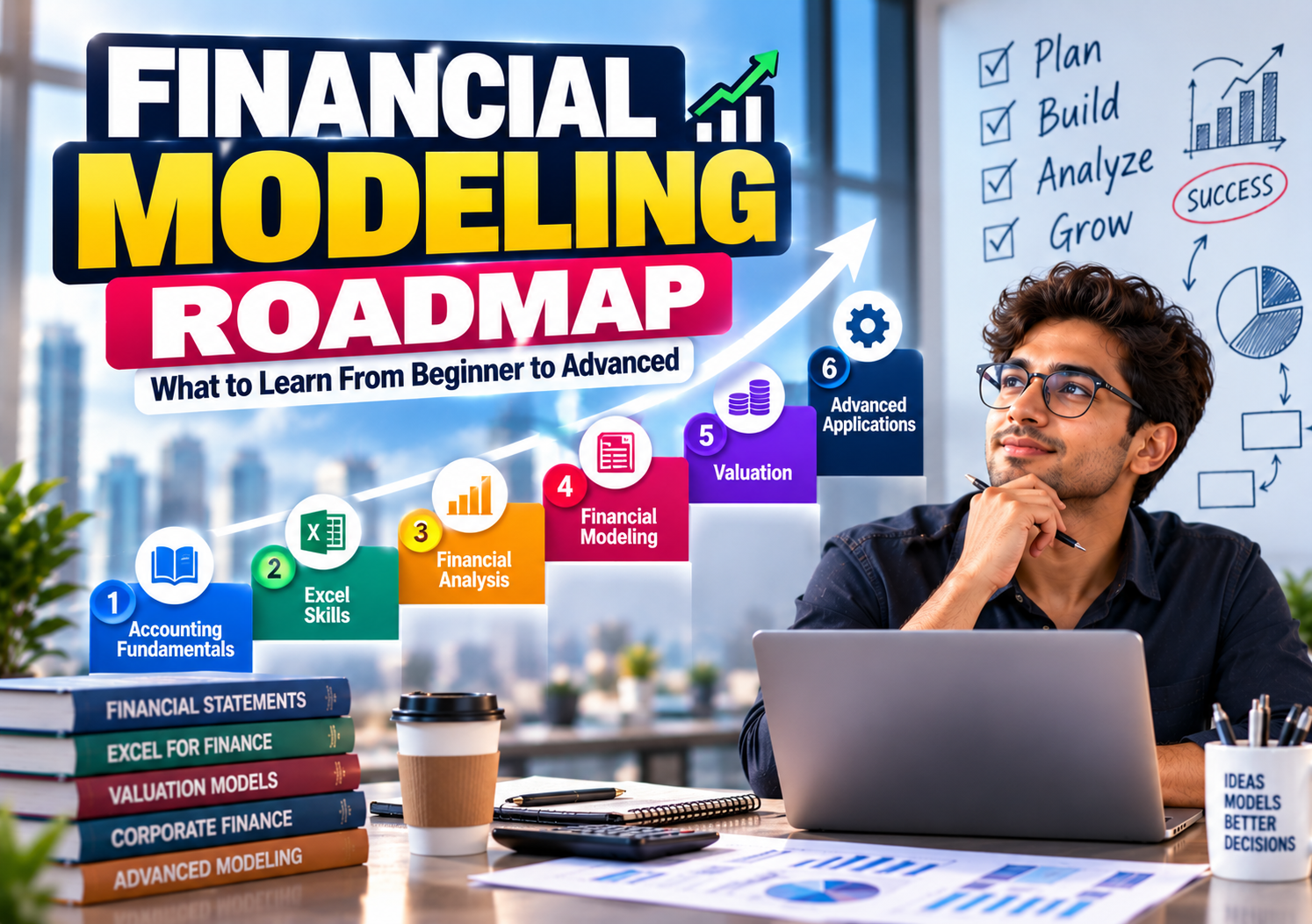
Financial modeling is easier to learn when you follow the right order. You do not need to master every accounting concept, memorize hundreds of Excel formulas, or build a complicated valuation model on your first day.
The better approach is to start with financial statements, become comfortable with Excel, learn how business assumptions affect financial results, and then build increasingly complex models.
This financial modeling roadmap takes you from the basics to advanced skills used in corporate finance, financial planning and analysis (FP&A), equity research, investment banking, valuation, and other finance-related roles. It is relevant to CA, CMA and CS students, commerce graduates, MBA Finance students, and professionals looking to strengthen their financial analysis skills.
What Is Financial Modeling?
Financial modeling is the process of building a structured representation of a business’s financial performance using historical data, assumptions, and calculations.
A financial model can help answer questions such as:
- How much revenue could a company generate next year?
- Will the business have enough cash to meet its obligations?
- What happens to profit if operating costs increase?
- Is a company potentially overvalued or undervalued?
- How much funding might a business need to expand?
Imagine a company that earns ₹100 crore in annual revenue. Its management plans to expand into two new cities. Before committing money, the company needs to estimate additional revenue, employee costs, rent, marketing expenses, capital expenditure, and cash requirements.
A financial model brings these estimates together. It allows decision-makers to test different assumptions before spending money.
The model does not predict the future with certainty. Its value lies in making assumptions visible and showing how changes in those assumptions affect the outcome.
The Financial Modeling Roadmap at a Glance
You can organise your learning into six stages. The time required depends on your existing accounting knowledge, Excel skills, and the amount of time you practise.
| Stage | What to learn | Practical outcome |
|---|---|---|
| 1. Financial fundamentals | Accounting and financial statements | Understand how business numbers connect |
| 2. Excel skills | Formulas, lookups, formatting and data handling | Work efficiently with financial data |
| 3. Financial analysis | Ratios, trends and working capital | Interpret historical performance |
| 4. Financial modeling | Forecasting and three-statement models | Build an integrated financial model |
| 5. Valuation | DCF, comparable companies and sensitivity analysis | Estimate business value |
| 6. Advanced applications | Scenario modeling, transaction models and automation | Solve more complex finance problems |
Do not rush through the early stages. A person who understands accounting and the logic behind a model will usually find advanced modeling easier than someone who knows many Excel shortcuts but cannot explain the numbers.
Stage 1: Build a Strong Foundation in Accounting
Before learning complex financial models, understand how a company’s financial statements work.
You should be comfortable reading an income statement, balance sheet, and cash flow statement. More importantly, you need to understand how the three statements connect.
Learn the three financial statements
Income statement: Shows revenue, expenses, and profit over a period.
Balance sheet: Shows assets, liabilities, and shareholders’ equity at a particular date.
Cash flow statement: Tracks cash generated and used by operating, investing, and financing activities.
Consider a company that sells products worth ₹10 lakh on credit. It may recognise revenue even though the customer has not paid yet.
The income statement records the sale, while the balance sheet may show an increase in accounts receivable. Cash does not increase until the customer pays.
This difference between accounting profit and cash flow is central to financial modeling.
Understand these accounting concepts
- Revenue recognition and expense recognition
- Depreciation and amortisation
- Accounts receivable and accounts payable
- Inventory and cost of goods sold
- Capital expenditure
- Debt, interest expense and repayments
- Retained earnings and shareholders’ equity
- Accruals, provisions and working capital
You should also understand how a change in one account affects other parts of the financial statements.
For example, if a company purchases equipment using cash, its cash balance falls and its property, plant and equipment balance rises. The purchase also affects future profit through depreciation, while the initial cash payment appears under investing activities.
Your target at this stage: Be able to explain why a financial number changes, not just where it appears in a statement.
Stage 2: Master Excel for Financial Modeling
Excel is one of the most widely used tools for financial modeling. You do not need to learn every feature, but you should become efficient with the functions commonly used in finance.
Start with formulas and cell references before moving to more advanced tools.
Excel skills to learn first
| Skill | What to learn | Why it matters |
|---|---|---|
| Basic formulas | SUM, AVERAGE, MIN, MAX | Calculate and summarise data |
| Cell references | Relative, absolute and mixed references | Copy formulas correctly |
| Logical formulas | IF, AND, OR, IFERROR | Apply conditions and handle errors |
| Lookup functions | XLOOKUP, INDEX and MATCH | Retrieve financial data |
| Conditional calculations | SUMIF, SUMIFS, COUNTIF | Analyse data by category |
| Date functions | YEAR, MONTH, EOMONTH | Work with financial periods |
| Data tools | Sort, filter, tables and data validation | Manage larger datasets |
| Financial functions | NPV, IRR and XIRR | Analyse investment cash flows |
| Presentation | Number formats, borders and consistent layouts | Make models easier to review |
You should also learn keyboard shortcuts, formula auditing, and how to trace precedents and dependents.
Learn modeling discipline, not just formulas
A good financial model should be easy for another person to understand and review.
Develop these habits early:
- Keep assumptions separate from calculations.
- Use consistent units, such as ₹ lakh or ₹ crore.
- Avoid hardcoding numbers inside formulas when an assumption cell would be clearer.
- Label historical data, forecast periods, and key assumptions.
- Check formulas for errors and unexpected results.
- Use consistent formatting to distinguish inputs, formulas, and linked figures.
For example, instead of entering =100*1.10 directly into a revenue forecast, keep the base revenue and growth assumption in separate cells. The formula can then reference both inputs. If the growth assumption changes, the forecast updates automatically.
Your target at this stage: Build a clean spreadsheet with linked formulas, clear assumptions, and no unexplained calculations.
Stage 3: Learn Financial Statement Analysis
Historical financial data gives you the starting point for a forecast. Before estimating future performance, understand what has driven the business so far.
Learn to compare financial results across multiple periods and identify changes in revenue, profitability, costs, debt, and cash flow.
Key financial analysis concepts
Profitability ratios: Gross profit margin, operating profit margin, net profit margin and return on equity.
Liquidity ratios: Current ratio and quick ratio.
Leverage ratios: Debt-to-equity ratio and interest coverage.
Efficiency ratios: Inventory turnover, receivables turnover and asset turnover.
You should also understand horizontal analysis, common-size statements, and working capital analysis.
Use the numbers to understand the business
Imagine a fictional company whose revenue grows from ₹100 crore to ₹120 crore, while operating profit increases from ₹15 crore to ₹15.6 crore.
Revenue has grown by 20%, but operating profit has grown by only 4%.
That gap deserves investigation. Perhaps employee costs increased, the company offered discounts, raw material prices rose, or it entered a lower-margin market.
The figures alone do not reveal the reason. They tell you what to investigate.
This is one of the most useful skills in financial modeling: connecting calculations to business activity.
Your target at this stage: Explain the main factors behind historical performance and identify the assumptions that deserve attention in a forecast.
Stage 4: Build Your First Financial Model
Once you understand accounting, Excel, and financial analysis, begin building actual models.
Start with a small, clearly defined problem. You do not need to model a large multinational company immediately.
1. Build a revenue forecast
Revenue forecasting is a good starting point because it forces you to think about how a business earns money.
For a simple business:
Revenue = Units Sold x Price per Unit
If a business expects to sell 20,000 units at ₹500 each, projected revenue is ₹1 crore.
You can then test what happens if sales volume rises by 10%, prices fall, or demand weakens.
Different businesses require different revenue drivers. A hotel might use available rooms and occupancy rates, while a subscription business may use customer numbers, pricing, and churn.
2. Forecast expenses and profit
After forecasting revenue, estimate the costs required to generate it.
You may forecast:
- Cost of goods sold as a percentage of revenue
- Employee costs based on headcount and average salary
- Rent and other operating expenses
- Depreciation based on assets and capital expenditure
- Interest expense based on debt and interest rates
- Tax expense using an appropriate assumption
Avoid applying the same growth rate to every expense without considering how the business operates. Some costs change with sales, while others remain relatively fixed over a certain range.
3. Build a working capital schedule
Working capital forecasting helps estimate how much cash a business needs to support its operations.
Learn how to forecast accounts receivable, inventory, accounts payable, and other operating balances.
For example, sales may increase significantly while customers take longer to pay. The company could report higher revenue and profit but still face cash pressure because more money is tied up in receivables.
This is why profit forecasts alone are not enough.
4. Build a capital expenditure and depreciation schedule
Capital expenditure covers spending on long-term assets such as machinery, equipment, and buildings.
Learn how to forecast asset purchases, depreciation, and closing asset balances. These calculations affect both the income statement and balance sheet, while capital expenditure also affects cash flow.
5. Build a debt schedule
A debt schedule tracks opening debt, new borrowings, repayments, and closing debt.
You should understand how interest expense depends on the debt balance and applicable interest rate. In more advanced models, debt and cash balances can influence each other, so the model needs a carefully designed calculation structure.
6. Build an integrated three-statement model
This is a major milestone in your financial modeling roadmap.
An integrated model connects the income statement, balance sheet, and cash flow statement so that changes in assumptions flow through the business’s financial results.
For example, an increase in sales may affect revenue, operating profit, receivables, taxes, and cash flow. The model should capture those relationships rather than treating each statement as a separate spreadsheet.
Once you build a working model, check that the balance sheet balances and that cash flow reconciles with the change in cash between periods.
Your target at this stage: Create a forecast model that links all three financial statements and responds correctly when assumptions change.
Stage 5: Learn Valuation and Investment Analysis
Financial models often support decisions about business value, investment opportunities, acquisitions, or capital allocation.
You should learn the main valuation methods after you understand how to build and interpret forecasts.
Discounted cash flow valuation
A discounted cash flow (DCF) model estimates the value of a business or investment by projecting future cash flows and discounting them to their present value.
The key concepts include:
- Forecasting free cash flow
- Understanding the time value of money
- Selecting and applying an appropriate discount rate
- Estimating terminal value
- Moving from enterprise value to equity value where required
- Testing how assumptions affect the valuation
A DCF model is only as useful as its assumptions. Small changes in long-term growth, margins, or discount rates can materially affect the estimated value.
Comparable company analysis
Comparable company analysis estimates value by examining how similar publicly traded businesses are valued by the market.
Learn common valuation multiples, including:
- Price-to-earnings (P/E)
- Enterprise value to EBITDA (EV/EBITDA)
- Enterprise value to sales (EV/Sales)
- Price-to-book (P/B), where appropriate
The challenge is selecting meaningful peers. Companies in the same industry may have very different growth rates, debt levels, profitability, and business risks. A multiple should never be interpreted without that context.
Precedent transaction analysis
This method examines valuation multiples from previous acquisitions or similar transactions.
Learn how transaction terms, market conditions, control premiums, and differences between businesses affect comparisons. Transaction data can also be incomplete or difficult to compare, so the results need careful interpretation.
Sensitivity and scenario analysis
A valuation should not be presented as if it were a perfectly precise number.
Sensitivity analysis shows how a result changes when one or two assumptions change. Scenario analysis examines a combination of assumptions under different business conditions.
For instance, you might compare a base case with a lower-growth case and a stronger-growth case. Each scenario could use different assumptions for revenue growth, operating margins, and working capital.
Your target at this stage: Build a valuation model, explain its key assumptions, and identify which inputs have the greatest influence on the result.
Stage 6: Develop Advanced Financial Modeling Skills
Advanced modeling is less about using complicated formulas and more about handling complex business decisions without losing control of the model.
Once you can build a reliable three-statement model and valuation model, choose advanced topics based on the work you want to do.
| Advanced topic | What you learn | Where it can be useful |
|---|---|---|
| M&A modeling | Purchase price, funding, synergies and pro forma financials | Mergers and acquisitions |
| Leveraged buyout (LBO) modeling | Debt financing, cash generation and investor returns | Private equity |
| Financial planning and analysis | Budgets, rolling forecasts and variance analysis | FP&A and corporate finance |
| Project finance modeling | Project cash flows, debt repayment and funding requirements | Infrastructure and project finance |
| Banking and credit models | Repayment capacity, credit metrics and downside cases | Lending and credit analysis |
| Advanced scenario modeling | Multiple business cases and operating sensitivities | Strategic planning and investment analysis |
| Automation and data tools | Power Query, Power Pivot and selected scripting tools | Repetitive reporting and larger datasets |
You do not need to learn every advanced topic to become useful in finance. An FP&A analyst may benefit more from budgeting, forecasting, and variance analysis than from a complex LBO model. Someone pursuing investment banking may need deeper valuation, transaction, and merger modeling skills.
Choose depth based on your intended role.
Which Financial Modeling Tools Should You Learn?
Excel is the best starting point for most beginners because it helps you understand formulas, assumptions, and model structure directly.
As your work becomes more complex, other tools can help.
- Microsoft Excel: Core spreadsheet modeling, forecasting, valuation and scenario analysis.
- Power Query: Importing, cleaning and combining data for repeatable reporting.
- Power BI: Building dashboards and analysing business performance.
- SQL: Retrieving data from databases, especially in analytical roles.
- Python: Automating repetitive tasks and performing more advanced data analysis where appropriate.
Do not try to learn every tool at once. Start with Excel and financial concepts. Add other tools when you have a clear reason to use them.
A sophisticated dashboard cannot compensate for a weak financial model.
How Long Does It Take to Learn Financial Modeling?
There is no single timeline that applies to everyone. Your starting point matters.
Someone who already understands accounting and works comfortably in Excel may progress faster than a beginner who is learning both at the same time.
The following is an illustrative learning plan, not a guaranteed completion schedule.
| Learning period | Main focus | Milestone |
|---|---|---|
| Weeks 1–2 | Accounting and financial statements | Explain how the statements connect |
| Weeks 3–4 | Excel formulas and spreadsheet discipline | Build a structured financial workbook |
| Weeks 5–6 | Financial statement analysis | Analyse historical company performance |
| Weeks 7–9 | Forecasting and schedules | Build revenue, expense, working capital and debt forecasts |
| Weeks 10–12 | Three-statement modeling | Connect the financial statements |
| After the foundations | Valuation and advanced models | Build models aligned with a chosen career path |
This plan assumes regular study and hands-on practice. Advanced modeling can take much longer, particularly when you are learning transaction structures, complex debt arrangements, or industry-specific drivers.
The important milestone is not finishing a course. It is being able to build, check, explain, and modify a model without relying on a step-by-step tutorial for every calculation.
Common Financial Modeling Mistakes Beginners Should Avoid
Learning Excel without understanding accounting
Knowing formulas does not mean you understand the financial result. Learn why each calculation exists and which financial statement it affects.
Jumping straight into valuation
A DCF model may look impressive, but it depends on forecasts of revenue, costs, taxes, capital expenditure, and working capital. Weak forecasts lead to weak valuation results.
Hardcoding assumptions into formulas
Hardcoding makes a model harder to review and update. Use clearly labelled assumption cells wherever practical.
Ignoring cash flow
A profitable company can still face cash shortages. Understand the effects of receivables, inventory, debt repayments, and capital expenditure.
Building a model without checking it
Use balance checks, formula reviews, and reconciliation tests. A model that produces a result is not necessarily a correct model.
Focusing on appearance instead of logic
Consistent formatting helps reviewers, but the quality of the calculations matters more. Make the model work correctly before spending too much time on presentation.
Learning advanced models without a career goal
There is little value in spending weeks on LBO modeling if your immediate goal is a corporate budgeting role. Build core skills first, then specialise.
How Financial Modeling Supports Different Finance Careers
Financial modeling is not limited to investment banking. Its usefulness depends on the decisions a professional needs to make.
| Career path | Modeling skills to prioritise |
|---|---|
| Corporate finance | Forecasting, capital expenditure, cash flow and funding analysis |
| FP&A | Budgets, rolling forecasts, variance analysis and scenario planning |
| Equity research | Financial statement forecasts, DCF and comparable company valuation |
| Investment banking | Valuation, transaction analysis and merger models |
| Private equity | LBO models, cash flow analysis and investment returns |
| Credit analysis | Debt schedules, cash flow forecasts and repayment capacity |
| Business finance | Revenue drivers, operating costs, profitability and working capital |
Your qualification can shape your starting point, but it does not determine your entire career path.
CA and CMA students may already have useful foundations in accounting, costing, and financial analysis. CS students may bring strengths in corporate structures, governance, and regulatory understanding. B.Com, M.Com, and MBA Finance students may have different levels of exposure to accounting, finance, and analytical tools.
Regardless of your background, practical modeling ability comes from applying these concepts to actual financial problems.
How to Practise Financial Modeling Effectively
Use a simple progression rather than downloading complicated templates and trying to understand everything at once.
- Choose a company with financial statements you can access.
- Organise its historical financial data in Excel.
- Calculate important margins, ratios, and working capital metrics.
- Build a forecast using clearly stated assumptions.
- Connect the income statement, balance sheet, and cash flow statement.
- Check the model for errors and reconcile the statements.
- Build a DCF or comparable-company valuation if it suits your learning goal.
- Change key assumptions and explain why the results move.
Keep a short record of the assumptions you made, the reasons behind them, and the checks you performed. This helps you explain your work in interviews and makes it easier to identify weaknesses in your own models.
When discussing a model with a recruiter or finance professional, be ready to explain its logic. A spreadsheet is evidence of your work; your explanation shows whether you understand it.
Build Your Financial Modeling Skills on a Strong Commerce Foundation
Financial modeling combines accounting knowledge, financial analysis, Excel skills, and business judgment. Each part supports the others. Learning them in sequence makes the process more manageable and helps you build skills you can apply across different finance roles.
For students and professionals building a career in finance, a strong foundation in accounting and cost management can make financial statements, forecasts, and valuation models easier to understand. Master Minds India provides commerce and professional-course learning pathways for students exploring qualifications such as CA and CMA.
Explore the Master Minds India homepage to learn about the institute, or visit the courses page to review its available programmes.
The best next step is simple: start with financial statements, become confident in Excel, and build one working model before moving to the next. Practical ability develops when you can explain not only what the spreadsheet calculates, but why the result makes business sense.
