

Blog
Risk Management Career Path: How to Build a Career in Financial Risk?

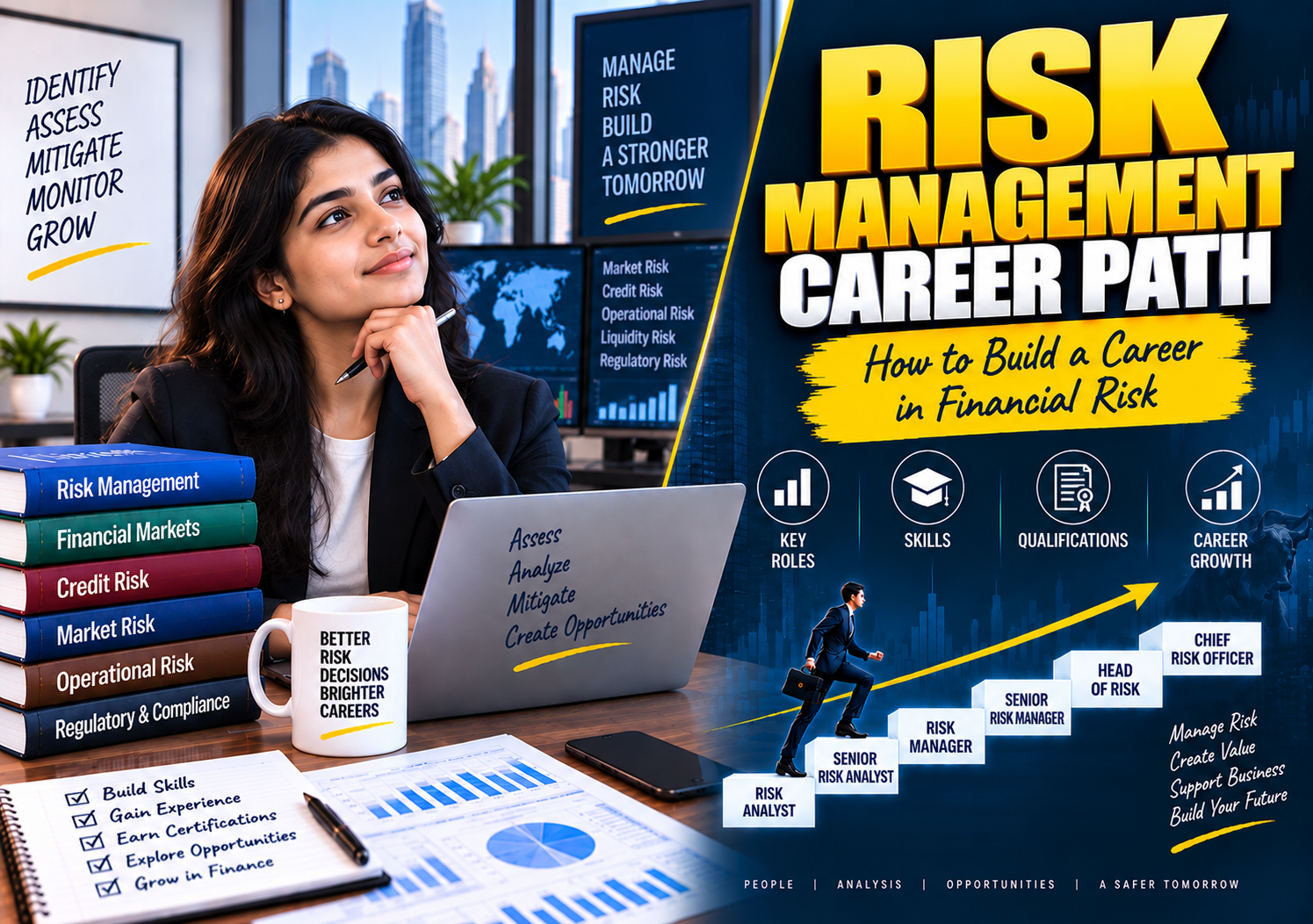
A risk management career path can take you from an entry-level Risk Analyst role to positions such as Risk Manager, Senior Risk Manager, Head of Risk and, in some organizations, Chief Risk Officer.
The field is much broader than simply checking whether a company is taking too much risk. Financial risk professionals study potential losses, assess uncertainty, monitor exposures and help businesses make decisions without taking risks they cannot handle.
For commerce students, risk management can be an interesting finance career because it combines accounting and finance knowledge with data analysis, financial markets, business judgment and problem-solving.
What Does Financial Risk Management Actually Mean?
Financial risk management is the process of identifying, measuring, monitoring and managing financial risks that could negatively affect an organization.
Some of the major areas include:
- Credit risk — the possibility that a borrower or counterparty fails to meet its obligations
- Market risk — losses caused by movements in interest rates, currencies, prices or other market variables
- Liquidity risk — the risk that an organization cannot meet its financial obligations when they are due
- Operational risk — losses arising from failures in processes, systems or people
- Fraud risk — financial losses resulting from fraudulent activity
- Regulatory and compliance risk — risks associated with failing to meet applicable rules and requirements
Risk analysts typically collect and evaluate data, while risk managers use those findings to develop strategies and make decisions.
The important distinction is this:
Risk management is not about eliminating every risk. It is about understanding risk well enough to manage it.
A bank cannot eliminate lending risk. An investment firm cannot eliminate market movements. A company cannot predict every economic event.
The goal is to make sure the organization understands what it could lose, how likely that loss may be and what can be done about it.
Risk Management Career Path: What Does the Progression Look Like?
There isn’t one universal career ladder, but a typical path can look like this:
| Career Stage | Common Roles | Typical Focus |
|---|---|---|
| Entry level | Risk Analyst, Credit Risk Analyst | Data, reporting, risk assessment |
| Early career | Risk Analyst, Senior Risk Analyst | Risk modelling, monitoring and analysis |
| Mid career | Risk Manager, Senior Risk Manager | Risk frameworks, decisions and teams |
| Senior | Head of Risk, Director of Risk | Enterprise-wide risk strategy |
| Executive | Chief Risk Officer | Overall risk governance and strategy |
Your specialization can change as you progress.
For example, someone who starts in credit risk may later move into enterprise risk, while another professional may build a career specifically in market risk or model risk.
GARP’s career resources also describe risk as a field with multiple specializations and career paths rather than a single narrow profession.
1. Risk Analyst: The Usual Starting Point
A Risk Analyst is often responsible for gathering financial and risk-related information and turning it into useful analysis.
Depending on the employer, your work could include:
- Monitoring risk indicators
- Analysing financial data
- Preparing risk reports
- Reviewing borrower or counterparty information
- Tracking market exposures
- Performing scenario analysis
- Supporting risk models
- Identifying unusual movements
- Presenting findings to senior team members
The work can vary significantly between banks, insurance companies, investment firms and large corporations.
For example, a Credit Risk Analyst may evaluate whether a borrower is financially capable of repaying a loan.
A Market Risk Analyst may study how changes in interest rates, currencies or asset prices could affect a portfolio.
Same profession. Very different day-to-day work.
2. Senior Risk Analyst
With experience, the role becomes less about simply producing reports and more about interpreting them.
You may be expected to:
- Review risk models
- Analyse larger datasets
- Perform stress testing
- Monitor risk limits
- Investigate unusual exposures
- Work with business teams
- Explain risk findings to management
- Help improve risk processes
This is where strong communication starts becoming as important as technical ability.
A technically correct risk report is not very useful if decision-makers cannot understand what the numbers mean.
3. Risk Manager
A Risk Manager has greater responsibility for how an organization responds to risk.
Instead of asking only:
“What is the risk?”
the discussion becomes:
“How much risk are we willing to accept, and what should we do about it?”
Risk Managers may oversee analysts, establish risk monitoring processes, review risk limits and work with senior management.
They also need a broader understanding of the business.
A credit risk decision, for example, should not be viewed only through a spreadsheet. The manager may need to consider the customer’s industry, financial position, concentration risk and broader economic conditions.
4. Head of Risk and Chief Risk Officer
At senior levels, risk management becomes increasingly strategic.
A Head of Risk or Chief Risk Officer may be responsible for the organization’s overall approach to risk.
Responsibilities can include:
- Enterprise risk management
- Risk governance
- Risk appetite
- Regulatory matters
- Board-level reporting
- Stress testing
- Major financial risks
- Emerging risks
- Risk policies and frameworks
The role is no longer about analysing individual transactions.
It is about understanding how different risks interact and whether the organization is prepared for adverse scenarios.
Which Areas of Financial Risk Can You Specialize In?
One of the biggest advantages of a risk management career is the number of specialization options.
Credit Risk
Credit risk focuses on the possibility that a borrower or counterparty fails to meet financial obligations.
Common employers include:
- Banks
- NBFCs
- Credit institutions
- Financial services companies
You need strong financial statement analysis because assessing repayment ability often starts with understanding the borrower’s financial position.
Market Risk
Market risk involves potential losses caused by movements in financial markets.
This can involve:
- Interest rates
- Foreign exchange
- Equity prices
- Commodity prices
- Other market variables
This area can be more quantitative than some other risk functions.
Liquidity Risk
Liquidity risk focuses on whether an organization has enough available funds to meet its obligations.
This becomes especially important for financial institutions, where managing cash and funding can be complex.
Operational Risk
Operational risk covers losses arising from failures in internal processes, people, systems or external events.
It can involve areas such as:
- Process failures
- Technology problems
- Fraud
- Human error
- Business disruption
Model Risk
Modern financial institutions often rely on models for lending, pricing, forecasting and risk measurement.
Model risk arises when a model is poorly designed, incorrectly implemented or used inappropriately.
This area can suit professionals who enjoy mathematics, statistics, programming and financial modelling.
Enterprise Risk
Enterprise risk management looks across the organization rather than focusing on one individual risk category.
The question becomes:
What combination of risks could materially affect the entire business?
What Qualifications Do You Need for Risk Management?
There is no single degree that everyone must have.
Relevant academic backgrounds include:
- B.Com
- BBA
- Economics
- Finance
- Mathematics
- Statistics
- Engineering
- Computer science
- Other quantitative disciplines
For commerce students, B.Com can provide a useful foundation, particularly in accounting, economics and financial management.
But academic knowledge is only the starting point.
CA
CA can be valuable for professionals who want strong accounting, auditing and financial knowledge.
This can be particularly useful in areas where understanding financial statements and business controls is important.
CMA
CMA can also provide a useful foundation through management accounting, costing, financial management and business decision-making.
This can support careers where financial analysis and business performance are closely connected to risk.
FRM
The Financial Risk Manager (FRM) certification from GARP is specifically focused on financial risk management.
GARP describes the FRM program as covering practical risk-management knowledge and notes that combining it with relevant academic backgrounds such as accounting, finance, economics, statistics or computer science can be useful for risk careers.
FRM can be particularly relevant if you already know that financial risk is the direction you want to pursue.
CFA
CFA can also be relevant to certain risk careers, particularly where investment analysis, markets, portfolio management and financial analysis overlap with risk management. CFA Institute lists risk analysis and risk management among the career areas available to its candidates and charterholders.
The right qualification depends on the specific risk role you want.
Don’t choose a certification simply because it sounds impressive.
What Skills Should You Build?
A strong risk professional needs a combination of finance knowledge, analytical ability and judgment.
Financial Analysis
Learn to read financial statements properly.
You should be able to identify issues involving:
- Debt
- Cash flow
- Profitability
- Working capital
- Leverage
- Interest coverage
For credit risk especially, this foundation is essential.
Excel
Excel is still useful for financial analysis, reporting, scenario analysis and modelling.
You should become comfortable with formulas, lookups, pivot tables, charts and data analysis.
Statistics and Quantitative Skills
Some risk roles require much stronger quantitative skills than others.
Market risk, model risk and quantitative risk roles can involve probability, statistics, forecasting and mathematical modelling.
You don’t necessarily need to become a mathematician to enter risk management. But if you want to move into highly quantitative roles, your mathematical foundation needs to improve.
Financial Modelling
Risk professionals often need to understand how changes in assumptions affect financial outcomes.
For example, imagine a lender has a portfolio of loans.
What happens if:
- Interest rates rise?
- Borrower defaults increase?
- Property prices fall?
- Economic growth slows?
A model can help estimate the potential impact.
Data and Technology
Risk management is becoming increasingly data-driven.
Depending on the role, useful skills can include:
- SQL
- Python
- Power BI
- Data visualization
- Statistical analysis
- Risk systems
GARP’s recent practice analysis also identifies quantitative ability as a starting point while emphasizing that modern risk professionals need broader skills beyond models and methods.
Communication
This is often overlooked.
A risk professional may identify a serious issue, but management needs to understand the problem before action can be taken.
You should be able to explain:
What happened → Why it matters → How large the potential impact is → What should be considered next
That ability can become increasingly valuable as you move into management.
How to Build a Risk Management Career After B.Com?
If you’re a commerce student starting from scratch, don’t try to become a quantitative risk expert immediately.
Build your foundation in stages.
Step 1: Learn Accounting and Financial Statements
Understand how the income statement, balance sheet and cash flow statement connect.
Step 2: Learn Financial Analysis
Practice analysing real annual reports.
Look for debt levels, cash flows, margins, working capital and other indicators that could signal financial stress.
Step 3: Become Comfortable With Excel
Build simple financial models and scenario analyses.
Step 4: Understand Financial Markets
Learn how interest rates, currencies, bonds, equities and credit markets work.
Step 5: Choose a Risk Specialization
Explore credit risk, market risk, liquidity risk, operational risk, model risk and enterprise risk.
You don’t need to make the final decision immediately.
Step 6: Add Relevant Credentials
Depending on your target role, consider CA, CMA, FRM, CFA or other relevant education.
Step 7: Get Practical Exposure
Internships, projects and entry-level roles can help you understand how risk work is actually performed.
GARP also recommends using career resources, professional networking and opportunities such as internships when building an early risk career.
How Does a Risk Management Career Grow?
Career progression is not simply about moving from Analyst to Manager.
Your decision-making responsibility should increase as you move upward.
Early in your career, you may spend most of your time collecting data and preparing analysis.
Later, you may interpret risk indicators and recommend actions.
At management level, you may be responsible for risk policies, teams, frameworks and business decisions.
At executive level, you’re expected to understand the organization’s entire risk profile.
That’s why technical knowledge alone isn’t enough for long-term growth.
Leadership, communication and business judgment become increasingly important. GARP’s 2024 Risk Careers Survey found that leadership and management skills ranked highly among the capabilities professionals considered important for advancement.
Risk Management vs Corporate Finance
These careers overlap, but their primary questions are different.
| Risk Management | Corporate Finance |
|---|---|
| What could go wrong? | How should the company use its money? |
| Measures and manages risk | Plans and manages financial resources |
| Focuses on potential losses and exposures | Focuses on profitability, investment and funding |
| Credit, market, liquidity and operational risk | FP&A, treasury, corporate development and finance |
| Risk monitoring and mitigation | Planning and financial decision-making |
Neither path is automatically better.
If you enjoy analysing uncertainty and asking what could cause a financial loss, risk management may suit you.
If you prefer budgeting, investment decisions, forecasting and business performance, corporate finance may be a better fit.
Common Mistakes to Avoid
Choosing FRM Without Understanding Risk
A certification can help, but you should first understand what type of risk work interests you.
Ignoring Accounting
Risk is often built on financial information. Weak accounting knowledge can make financial risk analysis much harder.
Focusing Only on Technical Skills
Risk professionals need to communicate findings to people who may not understand the technical details.
Treating Risk as a Back-Office Function
Good risk management can influence lending, investment, pricing, capital allocation and business strategy.
Learning Tools Without Understanding the Business
Knowing Python, Excel or Power BI is useful.
Knowing what problem you’re solving with those tools is more valuable.
Where Can a Risk Management Career Take You?
A long-term risk management career can lead to roles such as:
- Senior Risk Analyst
- Credit Risk Manager
- Market Risk Manager
- Liquidity Risk Manager
- Operational Risk Manager
- Model Risk Manager
- Enterprise Risk Manager
- Senior Risk Manager
- Head of Risk
- Director of Risk
- Chief Risk Officer
Risk skills can also open paths into related areas of banking, financial services, consulting, compliance and investment management.
GARP’s career research shows risk professionals working across commercial banking, consulting, investment management, insurance and other industries, while newer areas such as technology, data, climate and AI risk are also gaining attention.
FAQs About the Risk Management Career Path
Is risk management a good career for commerce students?
Yes. Commerce students have a useful foundation in accounting, economics and finance. Building analytical, quantitative and technology skills alongside that foundation can improve their readiness for risk roles.
Can I enter risk management after B.Com?
Yes. B.Com graduates can target entry-level risk, credit, financial analysis and related roles. Your chances improve when you combine your degree with practical financial analysis and data skills.
Is FRM necessary for a risk management career?
No. FRM is not the only route into risk management. However, it can provide specialized risk knowledge and may be useful for professionals targeting financial risk roles.
Is CA useful for risk management?
Yes. CA can provide strong accounting, auditing and financial knowledge that can be valuable in several risk-related roles, particularly where financial analysis and controls are important.
Is CFA useful for risk management?
It can be, particularly for roles connected to investment analysis, financial markets and portfolio risk. CFA Institute lists risk analysis and risk management among its relevant career areas.
What skills are most important for a Risk Analyst?
Financial analysis, Excel, data analysis, critical thinking, attention to detail and communication are strong starting points. Quantitative and programming skills become increasingly useful in more technical risk roles.
Does risk management require mathematics?
It depends on the specialization. Some roles require basic quantitative analysis, while market risk and model risk can require significantly stronger mathematics and statistics.
Can a Risk Analyst become a Chief Risk Officer?
Yes. With experience, specialization, leadership ability and broader business understanding, risk professionals can progress toward senior management and executive risk positions.
Is risk management only for banks?
No. Risk professionals work across banking, insurance, investment management, consulting, corporations and other industries. The type of risk simply changes according to the business.
Build Your Risk Management Foundation with Master Minds
A career in financial risk starts with understanding the numbers behind a business. Accounting, financial management, costing and business analysis give commerce students a useful base before they move into specialized areas such as credit risk, financial risk analysis or risk management.
For students considering CA or CMA, building this commerce foundation can also keep multiple finance career paths open. Master Minds focuses on professional commerce education, with CA and CMA courses designed around these core areas. You can explore Master Minds India to understand its programs and learning options.
The best time to start thinking about risk is before you get the job title. Learn how businesses make money, understand how financial losses can occur, and then build the analytical and technical skills needed to measure and manage those risks.
