

Blog
Stock Market Basics Every CA & CMA Student Should Know

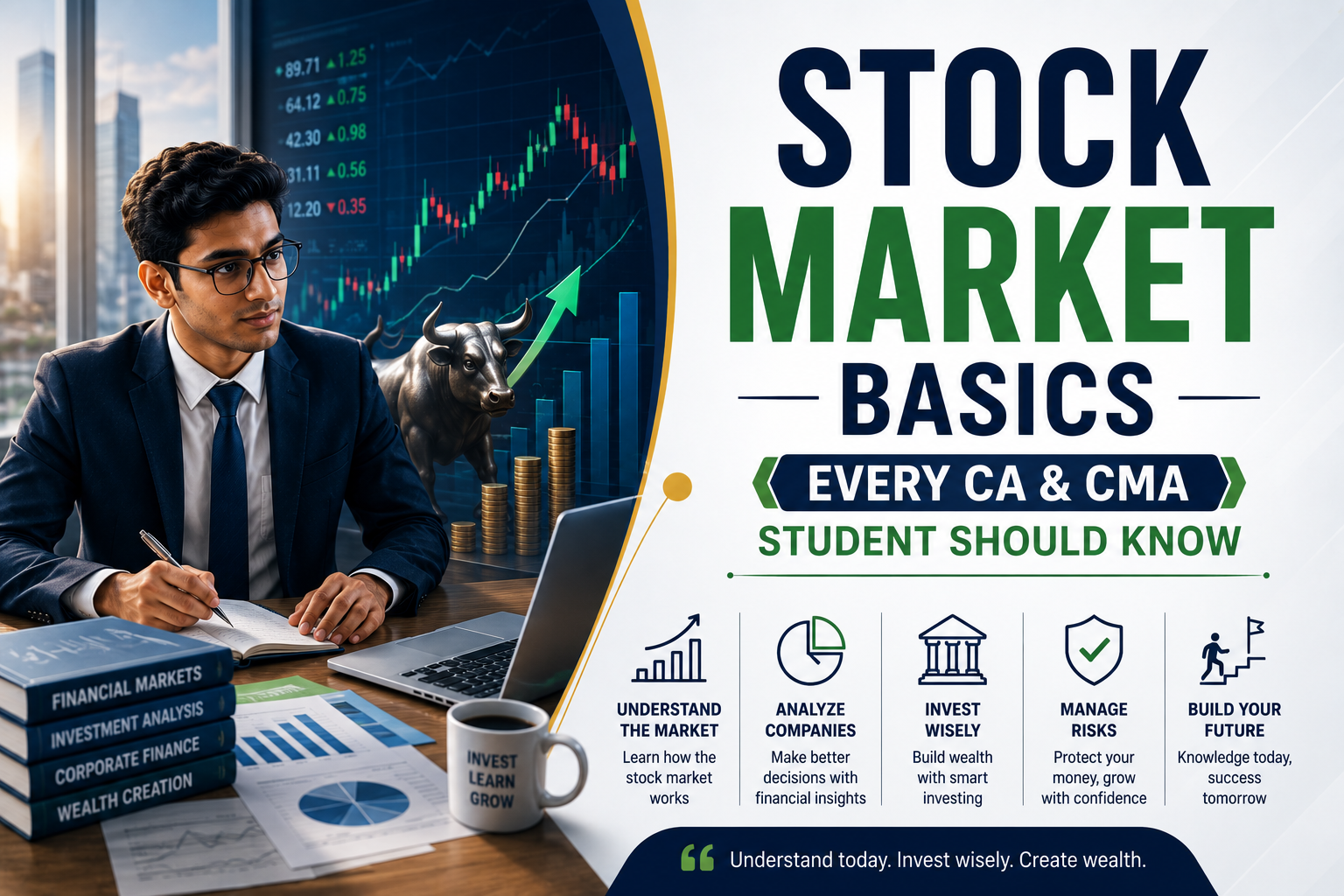
Every day, millions of shares change hands on stock exchanges around the world.
Companies raise billions of rupees.
Investors build wealth.
Markets react instantly to economic news, interest rates, corporate earnings and even global events.
If you’re a CA or CMA student, you’ve probably heard terms like Nifty 50, Sensex, IPO, market capitalization, or bull market.
At first, they can sound intimidating.
The good news?
The stock market isn’t as complicated as it seems.
Once you understand the fundamentals, you’ll realize that the stock market is simply a place where businesses and investors come together.
Learning stock market basics isn’t only useful if you want to become an investor. It also helps you understand corporate finance, business valuation, financial analysis, investment banking, equity research and wealth management—careers that many commerce students aspire to.
Whether you plan to become a Chartered Accountant, Cost and Management Accountant, financial analyst or entrepreneur, stock market knowledge gives you a significant advantage.
What Is the Stock Market?
The stock market is a marketplace where investors buy and sell ownership shares of publicly listed companies.
When you buy shares of a company, you become one of its owners—although your ownership may be very small.
For example:
If a company has one crore shares outstanding and you own 100 shares, you own a tiny fraction of that business.
As a shareholder, you benefit if the company grows in value.
Some companies also share profits through dividends.
Why Do Companies List on the Stock Market?
Growing businesses need money.
Instead of borrowing everything from banks, companies can raise capital by selling shares to the public.
This process allows companies to:
- Expand operations
- Build new factories
- Invest in technology
- Launch new products
- Reduce debt
- Enter new markets
Investors provide capital.
Companies use that capital to grow.
If the company succeeds, both the business and shareholders may benefit.
Why Commerce Students Should Learn the Stock Market?
Many students assume stock market knowledge is useful only for traders.
That’s a misconception.
Understanding the stock market improves your knowledge of:
- Financial Statements
- Business Valuation
- Corporate Finance
- Investment Banking
- Equity Research
- Wealth Management
- Portfolio Management
- Risk Analysis
Even if you never actively invest, understanding how markets work helps you become a stronger finance professional.
Stock Market vs Share Market
These terms are often used interchangeably.
Technically, there is a small difference.
| Stock Market | Share Market |
|---|---|
| Includes trading of various securities | Primarily refers to company shares |
| Broader financial market | Part of the stock market |
| Includes ETFs, bonds, derivatives and more | Mainly equity shares |
In everyday conversations, both terms usually refer to the same concept.
How Does the Stock Market Work?
Think of the stock market like an online marketplace.
Instead of buying products, investors buy ownership in companies.
Here’s a simplified process:
- A company lists its shares.
- Investors place buy or sell orders.
- Buyers and sellers agree on a price.
- The trade is executed electronically.
- Ownership changes hands.
Prices change continuously because demand and supply change throughout the trading day.
What Is an IPO?
IPO stands for Initial Public Offering.
It is the process through which a private company offers its shares to the public for the first time.
Imagine a successful startup planning nationwide expansion.
Instead of relying only on bank loans, it issues shares through an IPO.
Investors purchase those shares.
The company receives funds to support growth.
After listing, those shares begin trading on the stock exchange.
Primary Market vs Secondary Market
Understanding this difference is essential.
| Primary Market | Secondary Market |
|---|---|
| Shares sold for the first time | Existing shares traded among investors |
| Company receives funds | Company doesn’t receive money from these trades |
| Happens during IPO | Happens daily on stock exchanges |
Most daily buying and selling occurs in the secondary market.
Major Stock Exchanges in India
India has two major stock exchanges.
National Stock Exchange (NSE)
The NSE is India’s largest stock exchange by trading volume.
Its benchmark index is the Nifty 50.
Bombay Stock Exchange (BSE)
The BSE is one of the oldest stock exchanges in Asia.
Its benchmark index is the Sensex.
Both exchanges play an important role in India’s financial markets.
What Are Shares?
Shares represent ownership in a company.
Suppose a company divides ownership into one million shares.
Buying one share gives you ownership in that business.
If the company’s value grows, your investment may also increase.
Some companies also distribute part of their profits as dividends.
What Is Market Capitalization?
Market capitalization (Market Cap) represents the total market value of a company’s outstanding shares.
It is calculated as:
Market Capitalization = Share Price × Total Outstanding Shares
Companies are commonly classified as:
| Category | Characteristics |
|---|---|
| Large Cap | Established businesses with relatively stable performance |
| Mid Cap | Medium-sized companies with growth potential |
| Small Cap | Smaller businesses with higher growth opportunities and higher risk |
Understanding market capitalization helps investors compare companies of different sizes.
Bull Market vs Bear Market
These terms describe overall market trends.
| Bull Market | Bear Market |
|---|---|
| Prices generally rise | Prices generally fall |
| Investor confidence is high | Investor confidence is lower |
| Economic outlook is positive | Economic uncertainty increases |
Markets naturally move through both phases over time.
Successful investors understand that neither lasts forever.
Why Do Share Prices Change?
Many students ask this question.
The simple answer is demand and supply.
But several factors influence that demand.
Examples include:
- Company profits
- Quarterly results
- Economic growth
- Interest rates
- Inflation
- Government policies
- Global events
- Industry trends
- Investor sentiment
Stock prices reflect expectations about the future—not just today’s performance.
What Are Dividends?
Some companies share a portion of their profits with shareholders.
These payments are called dividends.
Not every company pays dividends.
Growing businesses often reinvest profits instead of distributing them.
Both approaches can benefit investors depending on the company’s strategy.
What Is a Stock Index?
A stock index measures the performance of a selected group of companies.
Popular Indian indices include:
- Nifty 50
- Sensex
- Nifty Bank
- Nifty Midcap
Indices help investors understand overall market performance without analysing every individual company.
Long-Term Investing vs Trading
Students often confuse investing with trading.
They are very different.
| Investing | Trading |
|---|---|
| Long-term approach | Short-term approach |
| Focuses on business growth | Focuses on price movements |
| Lower transaction frequency | Frequent buying and selling |
| Based on company fundamentals | Often based on technical analysis |
For beginners, understanding businesses is usually more valuable than trying to predict daily price movements.
Risks Every Investor Should Understand
Every investment involves risk.
Common risks include:
- Market volatility
- Economic slowdown
- Poor company performance
- Interest rate changes
- Industry disruption
- Global uncertainties
Understanding risk is more important than chasing quick returns.
One of the biggest mistakes new investors make is believing the stock market guarantees profits.
It doesn’t.
Basic Financial Ratios Investors Watch
Commerce students should gradually become familiar with important ratios.
| Ratio | Purpose |
|---|---|
| EPS (Earnings Per Share) | Company profitability per share |
| P/E Ratio | Valuation comparison |
| ROE (Return on Equity) | Profit generated from shareholder equity |
| Debt-to-Equity Ratio | Financial leverage |
| Dividend Yield | Dividend return relative to share price |
These metrics help investors evaluate companies beyond share prices.
Common Mistakes Beginners Make
Many first-time investors repeat similar mistakes.
Avoid:
- Investing without understanding the business
- Following social media tips blindly
- Chasing “hot stocks”
- Ignoring diversification
- Investing without financial goals
- Reacting emotionally to market fluctuations
Successful investing usually requires patience rather than constant activity.
How CA & CMA Students Can Start Learning?
You don’t need large amounts of money to begin learning.
Start by:
- Reading business newspapers
- Following quarterly company results
- Studying annual reports
- Tracking Nifty and Sensex movements
- Learning basic financial ratios
- Understanding industries
- Building simple watchlists
- Practising portfolio analysis
The objective is education—not speculation.
Career Opportunities Related to the Stock Market
Stock market knowledge opens doors to several finance careers.
| Career | Role |
|---|---|
| Equity Research Analyst | Analyses listed companies |
| Investment Banker | Helps companies raise capital |
| Portfolio Manager | Manages investment portfolios |
| Wealth Manager | Advises clients on investments |
| Financial Analyst | Evaluates company performance |
| Corporate Finance Professional | Supports strategic decisions |
| Financial Advisor | Guides investment planning |
| Business Valuation Analyst | Estimates company value |
Many of these careers are particularly attractive for CA and CMA graduates.
A Practical Exercise
Choose a company you admire.
It could be a bank, technology company, manufacturing firm or consumer brand.
Now answer these questions:
| Question | Your Observation |
|---|---|
| What products or services does the company offer? | |
| How does it earn revenue? | |
| Who are its competitors? | |
| Has revenue grown in recent years? | |
| Does the company pay dividends? | |
| Would you consider investing? Why? |
This simple exercise helps you think like an investor rather than just a student.
Frequently Asked Questions (FAQs)
What is the stock market?
The stock market is a marketplace where investors buy and sell shares of publicly listed companies.
Why should CA and CMA students learn the stock market?
Stock market knowledge improves understanding of corporate finance, valuation, financial analysis, investment banking, wealth management and business strategy.
What is an IPO?
An Initial Public Offering (IPO) is the process through which a private company offers its shares to the public for the first time.
What is the difference between investing and trading?
Investing focuses on long-term wealth creation through fundamentally strong businesses, while trading aims to profit from short-term price movements.
What is market capitalization?
Market capitalization is the total market value of a company’s outstanding shares and is calculated by multiplying the share price by the total number of outstanding shares.
Is the stock market risky?
Yes. Like all investments, the stock market carries risks. Understanding businesses, diversifying investments and maintaining a long-term perspective can help manage those risks.
