

Blog
Investment Banking Careers: A Complete Guide for Commerce Students

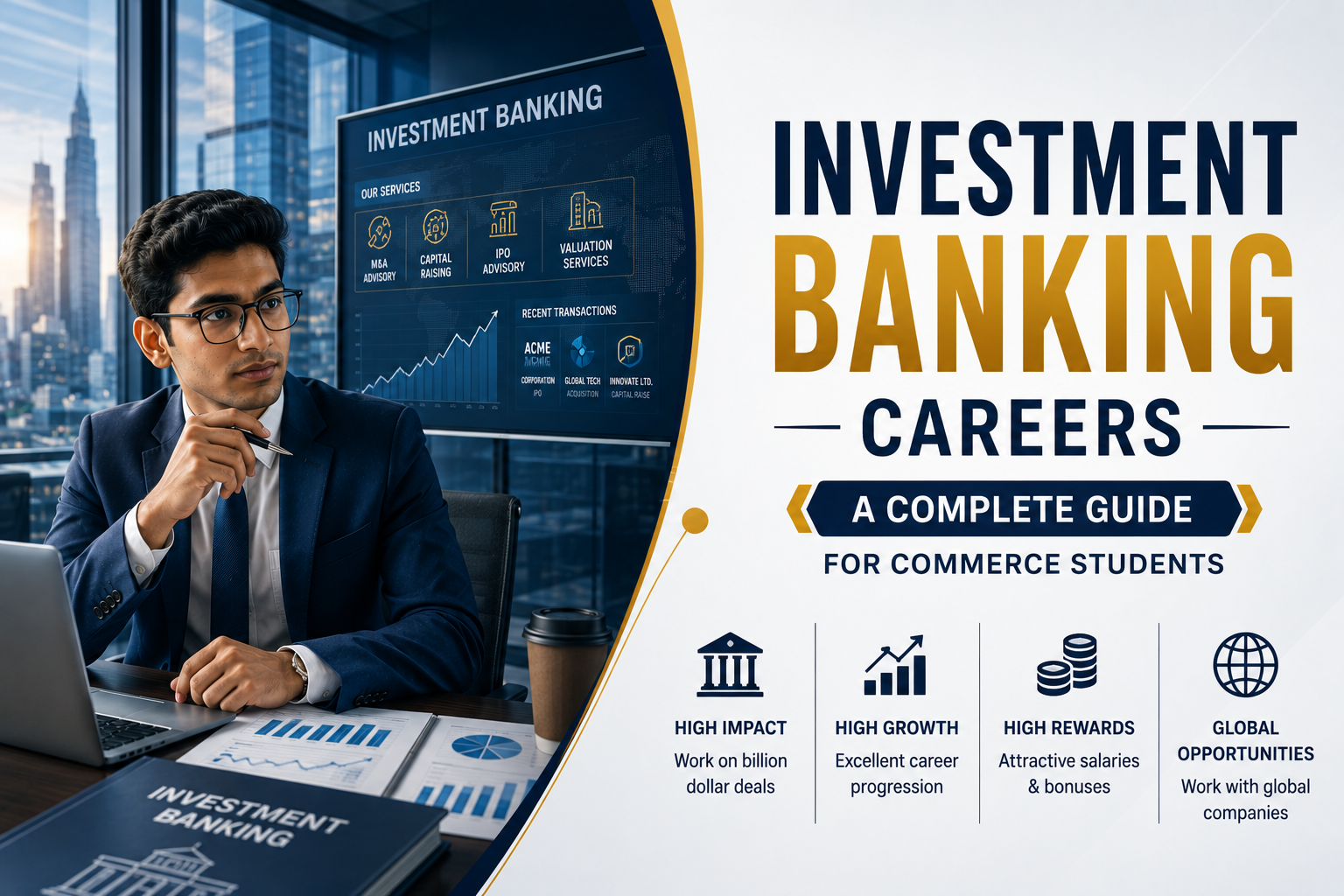
Ask a group of commerce students about the highest-paying careers in finance, and one profession almost always comes up.
Investment Banking.
The name itself sounds exciting.
Big corporate deals.
Multi-billion-dollar mergers.
IPO launches.
Global financial markets.
Boardroom presentations.
It certainly looks glamorous from the outside.
But behind every headline announcing a company acquisition or public listing is a team of finance professionals working long hours, analysing numbers, building financial models and advising business leaders on critical financial decisions.
Investment banking is demanding.
It’s competitive.
And for students who genuinely enjoy finance, corporate strategy and analytical thinking, it can also be one of the most rewarding career paths.
If you’re pursuing CA, CMA or a commerce degree, understanding investment banking careers can help you decide whether this fast-paced profession matches your interests and long-term goals.
What Is Investment Banking?
Investment banking is a specialized area of finance that helps companies, governments and institutions raise capital, manage financial transactions and execute major corporate deals.
Unlike commercial banks that accept deposits and provide loans, investment banks primarily advise organizations on large financial decisions.
Their work often involves:
- Raising capital through equity and debt
- Managing Initial Public Offerings (IPOs)
- Advising on mergers and acquisitions (M&A)
- Business valuation
- Financial modelling
- Corporate restructuring
- Strategic financial advisory
In simple terms, investment bankers help businesses make some of their biggest financial decisions.
Why Commerce Students Should Consider Investment Banking?
Commerce education already builds a strong financial foundation.
Students study:
- Accounting
- Financial Management
- Economics
- Business Laws
- Cost Accounting
- Corporate Finance
- Auditing
Investment banking combines many of these subjects into practical business applications.
If you enjoy analysing businesses rather than simply recording transactions, investment banking may be worth exploring.
What Does an Investment Banker Actually Do?
Many students imagine investment bankers buying and selling shares every day.
That’s actually more common in stockbroking or trading roles.
Investment bankers usually spend their time:
- Preparing financial models
- Analysing company financial statements
- Conducting business valuations
- Researching industries
- Preparing client presentations
- Coordinating mergers and acquisitions
- Advising management teams
- Supporting IPO transactions
- Raising capital from investors
A significant portion of the job involves problem-solving rather than trading.
Major Divisions in Investment Banking
Investment banking is a broad field.
Some of the common divisions include:
| Division | Primary Responsibility |
|---|---|
| Corporate Finance | Raising capital and financial advisory |
| Mergers & Acquisitions | Advising companies on acquisitions and mergers |
| Equity Capital Markets | Managing IPOs and equity fundraising |
| Debt Capital Markets | Raising funds through bonds and debt |
| Financial Advisory | Strategic business advice |
| Business Valuation | Estimating company value |
| Restructuring | Helping financially distressed companies |
Each area requires different technical and analytical skills.
Why Companies Hire Investment Banks?
Businesses don’t approach investment banks for routine accounting work.
They seek expertise during major financial events.
Examples include:
- Going public through an IPO
- Acquiring another company
- Selling a business
- Raising expansion capital
- Issuing corporate bonds
- Entering international markets
- Corporate restructuring
These transactions involve significant financial and legal complexity.
Experienced advisors help reduce risks.
Investment Banking vs Commercial Banking
Students often confuse these two career paths.
| Investment Banking | Commercial Banking |
|---|---|
| Advises businesses on large financial transactions | Provides banking services to individuals and businesses |
| Focuses on capital markets | Focuses on deposits and loans |
| IPOs, M&A, valuations | Savings accounts, loans, payments |
| Corporate clients | Retail and business customers |
| High analytical work | Customer relationship management |
Both careers are valuable but require different skill sets.
Typical Career Path in Investment Banking
A career in investment banking usually follows a structured progression.
| Position | Typical Responsibilities |
|---|---|
| Analyst | Financial modelling, research, presentations |
| Associate | Client coordination, deal execution |
| Vice President | Project management, client relationships |
| Director | Business development, strategic advisory |
| Managing Director | Leadership, client acquisition, major transactions |
Career growth depends on technical skills, performance and relationship management.
Skills Required for Investment Banking Careers
Technical knowledge is important.
But it’s only part of the equation.
Successful investment bankers combine finance with several other abilities.
Technical Skills
- Financial Accounting
- Corporate Finance
- Financial Modelling
- Business Valuation
- Excel
- PowerPoint
- Financial Statement Analysis
- Capital Markets
- Mergers & Acquisitions
Professional Skills
- Communication
- Critical Thinking
- Problem-Solving
- Time Management
- Attention to Detail
- Presentation Skills
- Teamwork
- Business Writing
The combination of technical and professional skills creates exceptional investment bankers.
Why CA & CMA Students Have an Advantage?
Professional commerce qualifications already cover many concepts used in investment banking.
CA and CMA students often have strong knowledge of:
- Financial Statements
- Cost Structures
- Taxation
- Auditing
- Corporate Finance
- Financial Management
- Business Analysis
This technical foundation can make learning investment banking concepts easier.
However, students should also strengthen financial modelling, valuation and presentation skills.
What Is Financial Modelling?
Financial modelling is one of the core skills in investment banking.
It involves creating spreadsheet-based financial models that help evaluate businesses and support decision-making.
Models are commonly used for:
- Company valuation
- Budget forecasting
- Investment analysis
- Acquisition decisions
- Scenario planning
Excel remains one of the most important tools for investment bankers.
Understanding Business Valuation
Investment bankers frequently estimate the value of companies.
Common valuation methods include:
- Discounted Cash Flow (DCF)
- Comparable Company Analysis
- Precedent Transaction Analysis
- Asset-Based Valuation
Commerce students don’t need to master these immediately.
Understanding the concepts early creates a strong advantage.
A Typical Day in Investment Banking
No two days are exactly alike.
A typical workday may include:
- Reviewing financial reports
- Building Excel models
- Researching industries
- Meeting clients
- Preparing presentations
- Analysing acquisitions
- Supporting live transactions
- Coordinating with legal and regulatory teams
Work can be intense, especially during major transactions.
Is Investment Banking Stressful?
It’s important to be realistic.
Investment banking is known for:
- Tight deadlines
- Long working hours
- High client expectations
- Fast decision-making
- Constant learning
Many professionals enjoy the challenge.
Others prefer finance careers with better work-life balance.
Understanding your own priorities is important before choosing this path.
Career Opportunities Beyond Investment Banking
Investment banking develops skills that open many future opportunities.
Professionals often move into:
- Private Equity
- Venture Capital
- Corporate Finance
- Equity Research
- Business Consulting
- Financial Advisory
- Hedge Funds
- Entrepreneurship
- CFO Leadership
The analytical skills gained remain valuable throughout a finance career.
How Students Can Prepare During College?
You don’t need to wait until graduation.
Start building relevant skills now.
Learn Excel
Become comfortable with:
- Financial formulas
- Pivot tables
- Charts
- Data analysis
Read Annual Reports
Study:
- Business models
- Financial performance
- Risk factors
- Management discussion
Follow Financial News
Read about:
- IPOs
- Mergers
- Acquisitions
- Corporate announcements
- Market trends
Understanding business events builds commercial awareness.
Learn Financial Modelling
Practice creating simple models.
Even basic forecasting exercises improve analytical thinking.
Participate in Internships
Internships provide exposure that textbooks cannot.
Observe how finance teams work.
Ask questions.
Learn from experienced professionals.
Common Misconceptions About Investment Banking
Many students believe:
“Investment bankers only buy stocks.”
Not true.
Most investment bankers advise businesses rather than actively trading.
“Only MBA graduates can enter investment banking.”
Many firms also recruit commerce graduates, CAs, CMAs and finance professionals.
“It’s only about mathematics.”
Strong analytical thinking is important.
Communication, teamwork and business understanding matter just as much.
“High salary means easy success.”
Investment banking offers attractive compensation.
It also demands continuous learning and consistent performance.
Emerging Trends in Investment Banking
The profession continues to evolve.
Current trends include:
- Artificial Intelligence in financial analysis
- ESG investing
- Digital IPO processes
- Cross-border transactions
- FinTech collaboration
- Data analytics
- Automation of routine financial tasks
Technology is changing how investment bankers work—not why they are needed.
Human judgment remains essential.
A Practical Exercise for Commerce Students
Choose any listed company.
Research:
| Question | Your Notes |
|---|---|
| What does the company do? | |
| How does it earn revenue? | |
| Recent acquisitions? | |
| Market capitalization? | |
| Major competitors? | |
| Growth opportunities? |
This simple exercise develops analytical thinking that investment bankers use every day.
Frequently Asked Questions (FAQs)
What is investment banking?
Investment banking is a specialized area of finance that helps companies raise capital, manage mergers and acquisitions, conduct business valuations and provide strategic financial advisory services.
Is investment banking a good career for commerce students?
Yes. Commerce students, especially those pursuing CA and CMA, already study many financial concepts relevant to investment banking, making it a strong career option.
What skills are required for investment banking?
Financial modelling, Excel, accounting, business valuation, communication, financial analysis, presentation skills and critical thinking are among the most important investment banking skills.
Can CA students become investment bankers?
Absolutely. Many Chartered Accountants work in investment banking, corporate finance, mergers and acquisitions, private equity and financial advisory roles.
Is investment banking stressful?
Investment banking can involve long working hours, tight deadlines and demanding projects. However, it also offers excellent learning opportunities and strong career growth.
What is the difference between investment banking and equity research?
Investment banking focuses on advising companies during financial transactions such as IPOs and acquisitions, while equity research focuses on analysing listed companies and providing investment recommendations.
