

Blog
Finance Certifications After CA & CMA: What Should You Study Next?

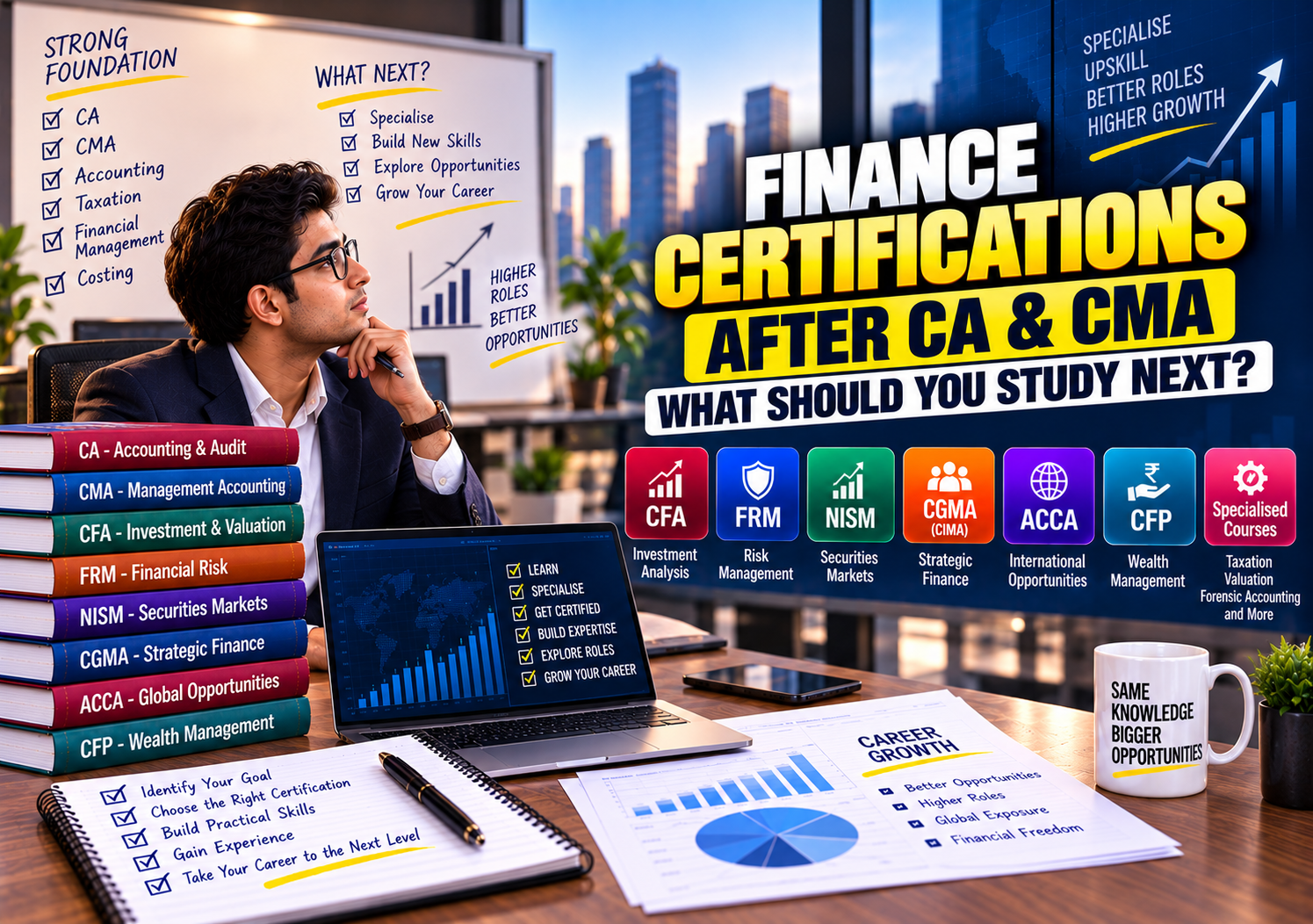
If you already hold CA and CMA, you have covered a large part of the accounting, financial reporting, taxation, cost management and management accounting landscape. The next certification should therefore add a new capability, not simply repeat what you already know.
That is the key idea behind choosing finance certifications after CA and CMA.
For some professionals, CFA can add investment and valuation expertise. For others, FRM makes more sense for financial risk. A finance professional working in capital markets may benefit from NISM certifications, while someone targeting wealth management may need a financial planning qualification.
The right choice depends heavily on the role you want next.
What Should You Study After CA and CMA?
There is no single certification that every CA and CMA should pursue.
Your options become more specialised:
| Career direction | Certification to consider |
|---|---|
| Investment analysis | CFA |
| Equity research | CFA + NISM Series XV |
| Financial risk | FRM |
| Wealth management | CFP / financial planning qualifications |
| Securities markets | NISM certifications |
| International finance | ACCA / CGMA, depending on career objective |
| Strategic finance | CGMA / CIMA pathway |
| Valuation | CFA + valuation-focused training |
| International taxation | ICAI post-qualification courses |
| Forensic accounting | ICAI specialised courses |
| Capital markets | CFA + relevant NISM certifications |
The important point is that CA and CMA already give you a strong professional foundation. Your next qualification should ideally take you deeper into a particular area.
1. CFA: For Investment, Valuation and Research Careers
The CFA Program is one of the most relevant choices if you want to move toward investment analysis, equity research, portfolio management or valuation.
The curriculum is designed around investment knowledge rather than traditional accounting alone.
For a CA or CMA, this can create a different skill combination:
Accounting + financial analysis + valuation + investment knowledge
CFA Institute currently allows candidates to enter the program through a bachelor’s degree, undergraduate status meeting specified timing requirements, or a combination of professional work experience and higher education.
CFA may make sense if you want to work in:
- Equity research
- Investment analysis
- Portfolio management
- Asset management
- Valuation
- Investment banking
- Corporate development
A CA may already understand financial statements very well. CFA can help take that knowledge further into how investors analyse businesses and value securities.
That distinction matters.
2. FRM: For Financial Risk Management
If your interest is risk rather than investment research, Financial Risk Manager (FRM) from GARP is another specialised option.
FRM covers areas such as:
- Market risk
- Credit risk
- Operational risk
- Liquidity and treasury risk
- Risk models
- Quantitative analysis
- Financial markets and products
GARP states that there are no educational or professional prerequisites for registering for the FRM exams. Certification requires passing Part I and Part II and submitting two years of relevant full-time financial risk management experience.
For a CA/CMA, FRM can be particularly relevant when moving toward:
Risk + finance + quantitative analysis
Possible career areas include banking risk, credit risk, market risk, treasury, risk consulting and model-related roles.
3. NISM Certifications: For India’s Securities Markets
Not every finance professional needs another large multi-year qualification.
If your target is the Indian securities market, NISM certifications can be a more focused way to build market-specific knowledge.
NISM offers certifications across different areas of the securities industry. Its Series XV: Research Analyst Certification Examination was revised effective January 20, 2026. The examination covers areas including securities markets, equity and debt markets, research analysis and related concepts.
This can be particularly relevant for professionals interested in:
- Equity research
- Securities markets
- Investment research
- Mutual funds and related areas
- Capital markets roles
NISM is also relevant from a regulatory perspective for certain securities-market roles. The exact certification required depends on the role and applicable regulations.
So don’t choose a NISM certification simply because it appears on a list. Choose the module that matches the work you want to do.
4. CGMA/CIMA: For Strategic and Management Finance
If your long-term goal is to become a senior finance leader, management accounting and strategic finance may be more relevant than investment analysis.
The CGMA qualification from AICPA & CIMA focuses on areas such as management accounting, finance business partnering, strategic thinking and business decision-making.
The 2026 CGMA syllabus places greater emphasis on finance business partnering, analytical thinking, strategic planning and technology-related competencies.
The qualification also includes practical experience requirements. AICPA & CIMA states that candidates generally need a minimum of three years of verified relevant practical experience, alongside the qualification requirements.
For an experienced CA/CMA, the important question is whether this qualification gives you something your current credentials and experience do not.
If your target is:
- Finance business partnering
- Strategic finance
- Management accounting leadership
- Business performance
- Senior finance management
then the CGMA pathway can be worth investigating.
5. ACCA: Useful for Specific International Career Goals
ACCA is another globally recognised accounting qualification, but there is an important consideration for someone who already has CA and CMA.
You should first ask:
What specific career opportunity will ACCA unlock for me?
ACCA currently combines examinations, an Ethics and Professional Skills module and a Practical Experience Requirement. Membership requires at least 36 months of relevant supervised experience and completion of performance objectives.
For someone who already has CA and CMA, ACCA may therefore involve significant overlap with existing accounting knowledge.
It becomes more interesting when there is a specific international career or employer requirement behind the decision.
Don’t pursue it simply because it is another well-known accounting qualification.
6. CFP and Financial Planning Qualifications
If your career goal is personal finance, wealth management or financial planning, a certification in that area may be more useful than CFA or FRM.
This is a different career direction.
Instead of analysing companies or managing institutional risk, financial planners work around areas such as:
- Investment planning
- Retirement planning
- Insurance
- Personal financial goals
- Asset allocation
- Wealth management
For a CA/CMA who wants to move into client-facing wealth management, this can provide a different professional skill set.
The important distinction is that corporate finance and personal financial planning are not the same career track.
7. ICAI Post-Qualification Courses
If you are already a CA, you don’t necessarily have to leave the ICAI ecosystem to specialise.
ICAI lists several post-qualification and certificate courses covering areas such as:
- Insurance and Risk Management
- Management and Business Finance
- Information Systems Audit
- International Taxation
- Forensic accounting
- Valuation
- Financial services and capital markets
- Business consulting
- AML
- BRSR and sustainability-related areas
ICAI’s current course listings include post-qualification options as well as specialised certificate courses.
These can be particularly useful when your career direction is already clear.
For example:
CA → International Taxation
can make more sense than:
CA → another broad accounting qualification
if international tax is where you want to build your career.
Should You Do CFA, FRM or Another Certification After CA and CMA?
Think about the role first.
If you want equity research or investment analysis
Consider CFA, potentially supported by relevant NISM certification depending on the role.
If you want financial risk
Consider FRM.
If you want securities-market knowledge in India
Look at the relevant NISM certification.
If you want strategic finance leadership
Explore CGMA/CIMA or specialised finance leadership education.
If you want international accounting opportunities
Evaluate ACCA against the specific markets and employers you are targeting.
If you want international taxation or forensic accounting
Explore the relevant ICAI specialised or post-qualification route.
If you want wealth management
Look at financial planning/CFP-oriented qualifications.
What If You Already Have Both CA and CMA?
This is where the decision becomes more interesting.
If you have both CA and CMA India, adding another general accounting qualification may not be the best use of your time.
Your professional profile may benefit more from developing a combination such as:
CA + CMA + CFA
Accounting + management accounting + investment analysis
CA + CMA + FRM
Accounting + management accounting + financial risk
CA + CMA + NISM
Accounting + management accounting + Indian securities markets
CA + CMA + Valuation Skills
Accounting + management accounting + business valuation
CA + CMA + Power BI/Advanced Excel/Financial Modelling
Professional finance knowledge + practical analytical capability
The last example is particularly important.
A certification looks good on a CV, but employers also need to see what you can actually do.
Don’t Ignore Practical Finance Skills
After CA and CMA, the next learning investment does not always need to be another professional qualification.
Depending on your target role, practical skills can be extremely useful:
- Advanced Excel
- Financial modelling
- Power BI
- SQL for finance
- Data analysis
- Business valuation
- Financial statement analysis
- Forecasting and budgeting
- Corporate finance
- Investment analysis
- Presentation and business communication
For example, someone targeting FP&A may gain more practical value from combining strong accounting knowledge with forecasting, budgeting, Excel, Power BI and business partnering than from collecting another unrelated certificate.
The same applies to investment careers.
A CFA qualification does not automatically make someone an effective equity research analyst. You still need to understand annual reports, build models, analyse industries and explain an investment thesis clearly.
A Better Way to Choose Your Next Certification
Before registering for anything, answer five questions:
- What role do I want in the next 2–3 years?
- What skills does that role actually require?
- Does the certification fill a genuine gap in my current profile?
- Will I use the knowledge in my job?
- Would practical training be more valuable than another qualification?
This prevents a common mistake: collecting credentials without building a clear professional direction.
For a CA/CMA, the goal should not be to have the longest list of qualifications.
It should be to build a profile where every qualification adds a meaningful layer.
Build the Next Layer of Your Finance Career
CA and CMA already provide a strong foundation in accounting, financial management and management accounting. The next step should therefore be based on specialisation.
If you are moving toward investments, look at CFA. If risk interests you, FRM may fit better. For securities-market roles in India, NISM can provide targeted market knowledge. For strategic finance, management accounting and leadership, CGMA/CIMA may be worth exploring. And for specialised areas such as international taxation, valuation or forensic accounting, ICAI’s post-qualification options are worth considering.
The strongest combination is usually professional qualification + specialised knowledge + practical skills + relevant experience.
Build Your Finance Foundation with Master Minds
For CA and CMA professionals, the next stage of a finance career is often about applying accounting and management-finance knowledge to a specialised role. Strong fundamentals in financial reporting, costing, financial management and business analysis can make advanced areas such as valuation, corporate finance, risk and investment analysis easier to build on. Master Minds focuses on professional commerce education through its CA and CMA programmes, which can provide the foundation for students planning a longer-term finance career.
Explore Master Minds India and its CA & CMA Courses for more information.
