

Blog
How to Get an Investment Banking Job Without an MBA?

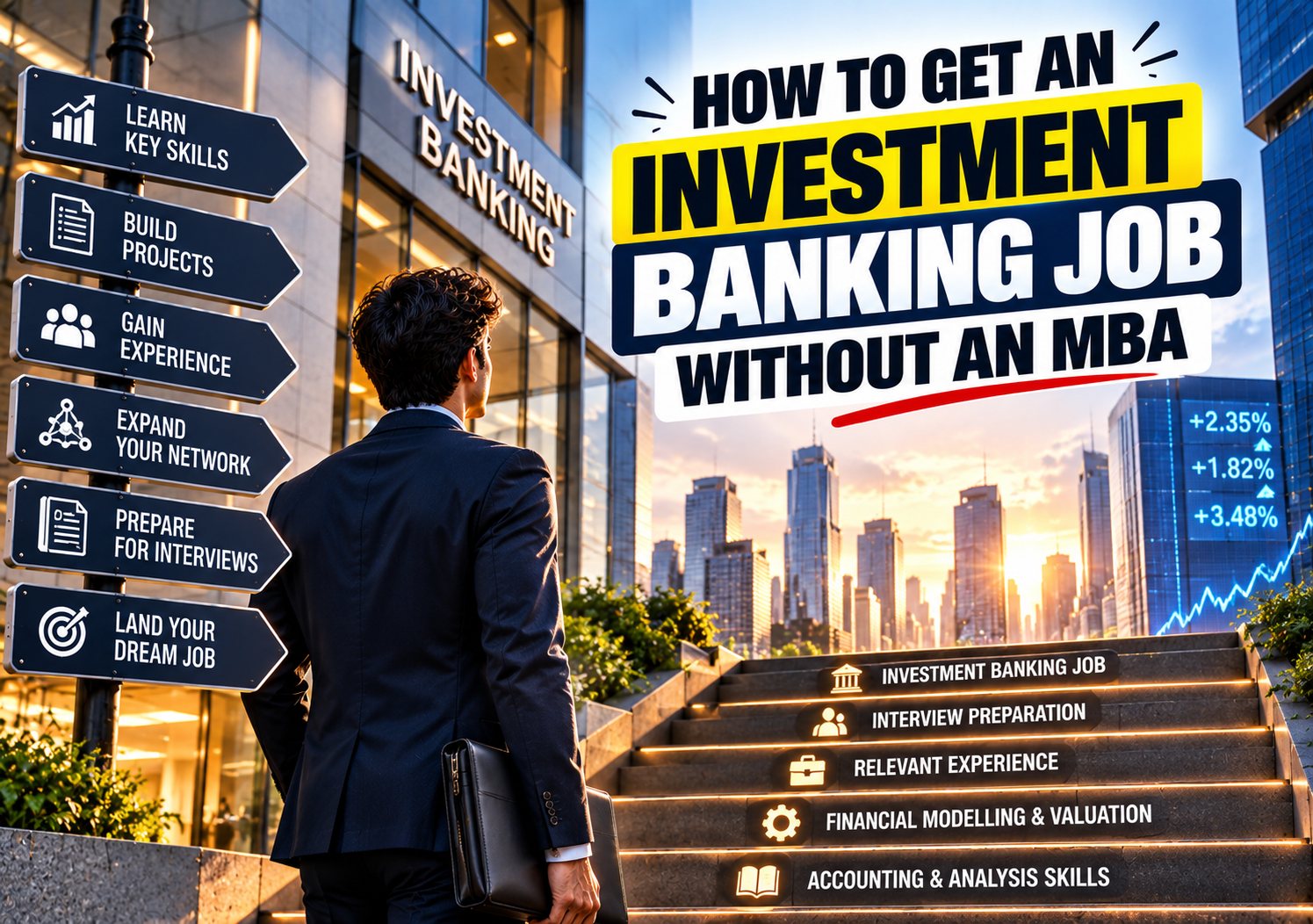
An MBA is one possible route into investment banking, but it is not the only route.
If you are a B.Com graduate, CA, CMA, CFA candidate or someone with another relevant degree, you can build toward investment banking jobs by developing the right technical skills, gaining relevant experience and targeting entry-level opportunities strategically.
The important distinction is this: not having an MBA means you need to demonstrate your ability in other ways.
Investment banking involves areas such as mergers and acquisitions, capital raising, financial modelling, valuation and corporate advisory. Entry-level roles often use the title Analyst, and internships can be an important route into the industry.
Is an MBA Required for Investment Banking?
No. An MBA can be useful, but it is not a universal requirement for entering investment banking.
CFA Institute notes that investment banks typically look for undergraduate and graduate degrees in areas such as business administration, finance, commerce, economics or analytical fields. It also notes that some institutions may prefer candidates with advanced business degrees for particular positions.
There are also direct graduate-entry routes. For example, Goldman Sachs’ India careers information says it recruits students from all academic backgrounds into university and entry-level programmes, while its New Analyst Program is open to students graduating from bachelor’s or master’s programmes.
So the practical question isn’t:
“How can I get an MBA?”
It is:
“How can I prove that I can do investment banking work?”
What Does an Investment Banking Analyst Actually Do?
An investment banking analyst supports transactions and financial advisory work.
Depending on the team, responsibilities can include:
- Building and updating financial models
- Company and industry research
- Valuation analysis
- Preparing presentations and pitch books
- Supporting mergers and acquisitions
- Analysing capital-raising opportunities
- Preparing transaction-related materials
- Reviewing financial statements
- Supporting senior bankers during client assignments
JPMorgan’s full-time investment banking analyst programme, for example, describes analysts working across advisory, capital markets and industry coverage, including financial modelling, reports and transaction support.
This gives you an important clue about what to learn before applying.
Which Skills Do You Need for Investment Banking Jobs?
1. Accounting
Start here.
You should understand:
- Income statements
- Balance sheets
- Cash flow statements
- Working capital
- Debt
- Depreciation
- EBITDA
- Revenue recognition
- Basic financial ratios
If you cannot comfortably read a company’s financial statements, valuation and modelling will be much harder.
For commerce graduates, this is an area where your academic background can provide a useful foundation.
2. Excel and Financial Modelling
Excel is one of the core technical tools you should learn.
Focus on:
- Financial statement modelling
- Three-statement models
- Revenue forecasting
- Expense assumptions
- Working capital
- Debt schedules
- Scenario analysis
- Sensitivity analysis
- Excel formulas and shortcuts
CFA Institute identifies Excel-based financial modelling as a continuing core finance capability, while current industry research also points to financial modelling and financial analysis as important employer requirements.
You don’t need to build the most complicated model possible.
Build a clean model that you can explain.
3. Valuation
Valuation is central to many investment banking assignments.
Start with:
Comparable Company Analysis
Compare companies using metrics such as:
- EV/EBITDA
- P/E
- EV/Revenue
Precedent Transactions
Study how comparable companies have been valued in previous transactions.
Discounted Cash Flow
Learn how projected cash flows can be discounted to estimate an enterprise or equity value.
You should understand the logic behind each method rather than simply memorising formulas.
For example, if two companies have similar revenue but very different EBITDA margins, you should be able to explain why applying the same valuation multiple may require further investigation.
4. PowerPoint and Presentation Skills
Investment banking involves a significant amount of presentation work.
You may need to help prepare:
- Pitch books
- Company profiles
- Industry presentations
- Transaction presentations
- Management presentations
- Valuation summaries
Your slides should be clear, accurate and easy to understand.
A strong analyst isn’t simply someone who can build a model. They also need to communicate the output effectively.
JPMorgan specifically highlights analytical, quantitative, interpretative, interpersonal and communication skills in its investment banking analyst hiring criteria.
5. Research and Commercial Awareness
Investment banking isn’t only about spreadsheets.
You need to understand businesses.
Pick a few industries and follow them regularly.
For example:
- Banking
- IT services
- Healthcare
- Consumer goods
- Manufacturing
- Energy
- Real estate
Read annual reports, earnings announcements, industry developments and major transactions.
When you study a company, ask:
How does it make money?
What drives its growth?
What are its major costs?
Who are its competitors?
What could make the business more valuable—or less valuable?
This develops the commercial thinking expected from finance professionals.
Can a B.Com Graduate Get Into Investment Banking Without an MBA?
Yes, but you need to build a profile around your target role.
A B.Com degree gives you exposure to accounting, economics, business and finance. You can then add investment banking-specific skills.
A possible path is:
B.Com → Excel → Financial Modelling → Valuation → Internship → Investment Banking Analyst
Another route could be:
B.Com → CA/CMA → Financial Modelling → Valuation → Transaction Advisory/Investment Banking
And another:
B.Com → CFA → Modelling & Valuation → Investment Research/Banking Roles
These are examples of possible pathways, not fixed requirements.
CFA Institute notes that finance employers value analytical ability, communication, industry knowledge and relevant financial skills alongside formal qualifications.
How to Get Relevant Experience Without an MBA?
This is where many candidates get stuck.
They think:
“I need an investment banking job to get investment banking experience.”
Instead, look for adjacent roles that develop relevant skills.
Consider opportunities in:
- Transaction advisory
- Valuation
- Equity research
- Corporate finance
- Financial due diligence
- Credit analysis
- Investment research
- Big 4 advisory
- Boutique investment banks
- Corporate development
- Financial modelling
An internship can also help.
CFA Institute specifically identifies internships as a useful way to develop financial skills, industry understanding and professional networks.
The first role doesn’t have to contain the exact words “Investment Banking Analyst.”
It needs to move you closer to the work.
Build Investment Banking Projects Before Applying
If you don’t have professional experience, create evidence of your skills.
Project 1: Three-Statement Model
Choose a listed company and build an illustrative model covering:
- Revenue
- Operating expenses
- EBITDA
- Depreciation
- Working capital
- Debt
- Cash flow
Clearly label the work as a personal or academic project.
Project 2: Company Valuation
Prepare a basic valuation using:
- Comparable companies
- Precedent transactions
- DCF
Explain why your assumptions were selected.
Project 3: M&A Case Study
Choose two fictional or publicly known companies and build an illustrative acquisition case.
Analyse:
- Strategic rationale
- Revenue and cost assumptions
- Purchase price
- Financing
- Potential synergies
- Valuation
The objective isn’t to pretend you have worked on a real transaction.
It is to demonstrate that you understand the process.
How to Make Your Resume Stronger Without an MBA?
Your resume should make your relevant skills obvious within seconds.
Instead of:
Skills: Microsoft Office, Communication, Teamwork
use specific skills that match the role:
Technical Skills:
Financial Modelling, Valuation, Excel, Financial Statement Analysis, Comparable Company Analysis, DCF
Then add relevant projects.
For example:
Company Valuation Project
Built an illustrative DCF and comparable-company valuation model using publicly available financial information; analysed revenue growth, margins and valuation assumptions.
This gives the interviewer something concrete to discuss.
Which Certifications Can Help?
Certification should support your career direction, not replace practical skills.
CFA
CFA can be relevant if you want deeper knowledge of investment analysis, valuation and financial markets.
It can complement a commerce, accounting or finance background.
Financial Modelling Certifications
A focused financial modelling programme can help you develop practical Excel and valuation skills.
The important part is what you can build and explain—not simply the certificate itself.
CA or CMA
For commerce students in India, CA or CMA can provide a strong foundation in accounting, financial management and business finance.
They are not substitutes for investment banking-specific modelling and transaction knowledge, so you may still need to develop those skills separately.
NISM
Depending on the role, relevant NISM certifications can provide securities-market knowledge in India.
Choose certifications based on the actual requirements of the role rather than collecting qualifications.
What About Networking?
Networking matters because investment banking is a relationship-driven industry.
That doesn’t mean sending strangers a message saying:
“Please give me a job.”
Instead:
- Follow investment banking professionals.
- Attend finance events.
- Join relevant student or professional communities.
- Ask thoughtful questions.
- Connect with alumni.
- Learn about firms and their work.
- Keep your LinkedIn profile professional.
CFA Institute also recommends building professional networks through industry events and other finance-related activities.
Networking works better when you have something useful to discuss.
If you’ve built a valuation model or analysed a recent transaction, you have a much better reason to start a conversation.
Prepare for Investment Banking Interviews
Investment banking interviews can cover both technical knowledge and your motivation for entering the industry.
Prepare for questions such as:
Accounting
- Walk me through the three financial statements.
- How are the three statements connected?
- What happens to cash flow when working capital increases?
- What is EBITDA?
Valuation
- How does a DCF work?
- What is enterprise value?
- What is the difference between enterprise value and equity value?
- Why might two similar companies trade at different multiples?
M&A
- Why would one company acquire another?
- What are potential synergies?
- How can an acquisition be financed?
Personal questions
- Why investment banking?
- Why this firm?
- Why should we hire you?
- Tell me about a company or transaction you have researched.
The last group matters.
If your answer to “Why investment banking?” is simply “salary” or “prestige,” you haven’t demonstrated an understanding of the work.
CFA Institute notes that candidates should be able to articulate why they want investment banking and demonstrate analytical ability, communication skills and knowledge of the industry.
Common Mistakes to Avoid
Waiting for an MBA before starting
An MBA can be useful for certain career stages and recruiting routes, but it isn’t the only way to begin building relevant experience.
Learning theory without modelling
Knowing what DCF means is different from building one.
Applying only to large global banks
Include boutique firms, advisory firms, valuation teams and related finance roles in your search.
Ignoring internships
Relevant internships can provide practical exposure and help you build a professional network.
Collecting certificates without projects
One strong modelling project that you can defend in an interview can be more useful than a list of unrelated certificates.
Not following the markets
If you want to work in investment banking, you should have a basic understanding of current business and market developments.
A Practical Roadmap to Investment Banking Without an MBA
You don’t need to complete everything at once.
Stage 1: Build the foundation
Learn:
- Accounting
- Financial statements
- Excel
- Corporate finance
Stage 2: Learn investment banking skills
Add:
- Financial modelling
- Valuation
- M&A fundamentals
- Pitch books
- Company and industry research
Stage 3: Build evidence
Create:
- One three-statement model
- One valuation project
- One M&A case study
Stage 4: Get relevant experience
Apply for:
- Investment banking internships
- Boutique banking roles
- Valuation
- Transaction advisory
- Equity research
- Corporate finance
- Related analyst positions
Stage 5: Apply directly
Target analyst and graduate programmes where your education and experience meet the stated requirements.
For example, Goldman Sachs currently lists investment banking among the divisions available through its India New Analyst Program for eligible bachelor’s and master’s graduates.
The requirements vary by firm, location and programme, so always check the individual vacancy rather than assuming that one firm’s criteria apply everywhere.
The Bigger Picture
An MBA can be one route into investment banking, but it is not the only route.
If you don’t have an MBA, focus on making your profile demonstrate the things an investment banking analyst actually needs: accounting knowledge, financial modelling, valuation, analytical thinking, commercial awareness, communication and relevant experience.
For a commerce graduate, a path such as B.Com → financial modelling → valuation → relevant internship or analyst role can be a practical starting point. CA, CMA or CFA can then be considered based on your longer-term career direction.
The goal is not to recreate an MBA on your resume.
It is to show that you can do the work.
Build Your Finance Foundation with Master Minds
Investment banking requires a strong understanding of financial statements, accounting, corporate finance and business analysis before you move into areas such as valuation and M&A. For commerce students considering CA or CMA as part of their longer-term finance career, a strong professional foundation can make it easier to build specialised skills such as financial modelling and valuation later.
Explore Master Minds India to learn more about its professional commerce education programmes, or view its CA and CMA courses for pathways that build core finance and accounting knowledge.
