

Blog
What Does an Investment Banker Actually Do?

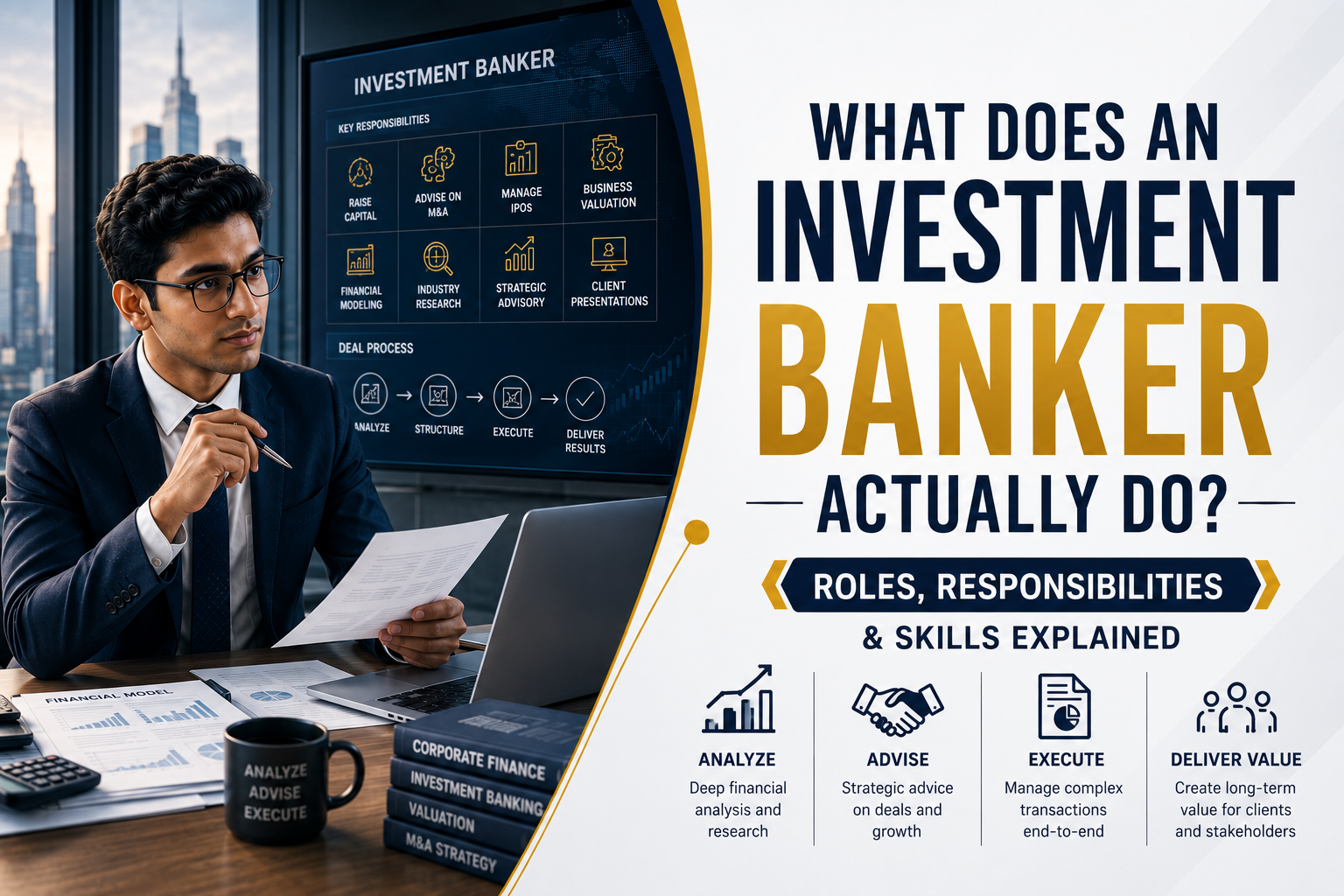
Ask someone outside the finance industry what an investment banker does, and you’ll probably hear one of these answers:
“They trade stocks.”
“They help people invest.”
“They work on Wall Street.”
While investment bankers certainly work in finance, these answers barely scratch the surface.
The reality is much more interesting.
Investment bankers help companies make some of the biggest financial decisions they’ll ever face. Whether it’s raising thousands of crores through an Initial Public Offering (IPO), acquiring another company, restructuring debt or expanding into new markets, investment bankers play a crucial role behind the scenes.
For CA, CMA and commerce students, understanding investment banker roles isn’t just about exploring a prestigious career. It’s about understanding how businesses grow, raise capital and create long-term value.
Let’s take a closer look at what investment bankers actually do—and why this career continues to attract ambitious finance professionals.
Who Is an Investment Banker?
An investment banker is a finance professional who advises companies, governments and institutions on raising capital, managing large financial transactions and making strategic business decisions.
Unlike accountants, who primarily focus on recording and reporting financial information, investment bankers focus on the future.
They answer questions such as:
- How should a company raise funds?
- Is it the right time to go public?
- Should one business acquire another?
- What is this company worth?
- Which financing option is most suitable?
Simply put, investment bankers help businesses make high-value financial decisions.
Why Do Companies Need Investment Bankers?
Large financial transactions involve significant complexity.
Imagine a manufacturing company planning to acquire a competitor worth ₹3,000 crore.
Questions immediately arise:
- Is the acquisition financially viable?
- How should it be funded?
- What risks exist?
- Is the target company fairly valued?
- How should negotiations proceed?
These aren’t decisions companies make alone.
Investment bankers guide them through the entire process.
The Core Roles of an Investment Banker
Investment banking isn’t a single job.
It’s a collection of responsibilities that vary depending on the project.
Here are the primary investment banker roles.
1. Raising Capital for Businesses
One of the most important responsibilities is helping companies raise money.
Businesses require capital to:
- Expand operations
- Launch new products
- Build manufacturing facilities
- Enter international markets
- Invest in technology
- Reduce debt
Investment bankers help determine the most suitable funding option.
This could involve:
- Equity financing
- Debt financing
- Private placements
- Corporate bonds
- Rights issues
Every funding decision affects the company’s future.
2. Managing Initial Public Offerings (IPOs)
When a private company decides to become publicly listed, investment bankers play a leading role.
They help:
- Evaluate company readiness
- Determine valuation
- Prepare offering documents
- Coordinate regulatory approvals
- Market shares to institutional investors
- Support the listing process
Many of India’s largest IPOs have involved investment banking teams working for months before the listing date.
3. Advising on Mergers & Acquisitions (M&A)
Suppose Company A wants to acquire Company B.
Investment bankers help answer several critical questions:
- Is the acquisition financially attractive?
- What is the target company’s value?
- What financing structure should be used?
- How should negotiations proceed?
- What risks exist?
Their objective is to help clients make informed strategic decisions.
4. Business Valuation
Knowing what a company is worth is essential before any transaction.
Investment bankers estimate business value using multiple methods.
Common approaches include:
- Discounted Cash Flow (DCF)
- Comparable Company Analysis
- Precedent Transactions
- Asset-Based Valuation
Valuation combines finance, mathematics and business judgment.
It’s both analytical and practical.
5. Financial Modelling
Investment bankers spend considerable time building financial models.
These Excel-based models help predict future business performance.
Models support decisions related to:
- Investments
- Acquisitions
- IPO pricing
- Business expansion
- Capital raising
Financial modelling is one of the most valuable technical skills in investment banking.
6. Preparing Client Presentations
Numbers alone rarely convince decision-makers.
Investment bankers prepare professional presentations that explain:
- Business opportunities
- Market conditions
- Financial analysis
- Valuation findings
- Strategic recommendations
These presentations often influence multi-crore decisions.
Communication matters as much as technical analysis.
7. Industry Research
Before advising clients, investment bankers study industries carefully.
Research includes:
- Competitor analysis
- Market trends
- Economic outlook
- Industry growth
- Regulatory developments
Understanding the broader business environment helps produce better recommendations.
8. Supporting Corporate Strategy
Investment bankers don’t simply execute transactions.
They often advise companies on long-term growth.
Examples include:
- International expansion
- Strategic partnerships
- Capital restructuring
- New investment opportunities
Their recommendations shape future business direction.
A Day in the Life of an Investment Banker
Every project is different.
Still, a typical day might include:
| Time | Activity |
|---|---|
| Morning | Review market news and financial updates |
| Mid-Morning | Analyse company financial statements |
| Afternoon | Build financial models in Excel |
| Late Afternoon | Prepare presentations for clients |
| Evening | Team discussions and transaction updates |
| Night | Finalise reports before deadlines |
Work schedules can become demanding during active deals.
Skills Every Investment Banker Needs
Success requires more than academic knowledge.
Technical Skills
- Financial Accounting
- Corporate Finance
- Financial Modelling
- Business Valuation
- Excel
- PowerPoint
- Financial Statement Analysis
- Capital Markets
- M&A Concepts
Professional Skills
- Communication
- Business Writing
- Analytical Thinking
- Time Management
- Problem-Solving
- Negotiation
- Attention to Detail
- Team Collaboration
The strongest professionals combine both.
Why CA & CMA Students Are a Strong Fit
CA and CMA students already study subjects directly relevant to investment banking.
Examples include:
- Financial Reporting
- Cost Analysis
- Financial Management
- Taxation
- Corporate Laws
- Strategic Management
This gives them a technical advantage.
Adding skills like financial modelling, valuation and presentation makes them highly competitive.
Investment Banker vs Financial Analyst
Students often confuse these careers.
| Investment Banker | Financial Analyst |
|---|---|
| Advises companies on transactions | Analyses company performance |
| Focuses on capital raising | Focuses on financial analysis |
| Works on IPOs and M&A | Creates financial reports |
| Highly client-facing | Internal or research-focused |
Both careers involve finance but serve different purposes.
Tools Investment Bankers Use
Technology has become essential.
Common tools include:
- Microsoft Excel
- PowerPoint
- Bloomberg Terminal
- Capital IQ
- PitchBook
- Financial databases
- Data visualization software
- AI-powered research tools
Learning Excel remains one of the best investments students can make.
Is Investment Banking Stressful?
Yes.
Investment banking is known for:
- Tight deadlines
- Long hours
- Complex projects
- High client expectations
- Constant learning
However, many professionals enjoy the fast-paced environment because every project presents a new challenge.
It’s demanding—but intellectually rewarding.
Career Growth in Investment Banking
A typical career path looks like this:
| Position | Primary Focus |
|---|---|
| Analyst | Financial analysis and modelling |
| Associate | Transaction execution |
| Vice President | Client management |
| Director | Strategic advisory |
| Managing Director | Business development and leadership |
As professionals gain experience, client interaction and strategic responsibilities increase.
How Students Can Prepare
You don’t need to wait until graduation.
Start today.
Learn Financial Modelling
Practice forecasting revenue, expenses and cash flows.
Study Annual Reports
Read management discussions and financial statements.
Observe how businesses communicate with investors.
Follow Business News
Track:
- IPO announcements
- Mergers
- Acquisitions
- Interest rates
- Corporate earnings
Business awareness develops gradually.
Improve Communication
Investment bankers spend significant time explaining financial ideas.
Presentation and communication skills matter.
Complete Relevant Internships
Practical exposure helps students understand how finance professionals work.
Internships also strengthen resumes.
Common Myths About Investment Bankers
“They only work with the stock market.”
Not true.
Investment bankers primarily advise businesses rather than trade stocks.
“Only MBAs become investment bankers.”
Many firms recruit CAs, CMAs, commerce graduates and finance professionals.
“It’s all mathematics.”
Finance requires analytical thinking.
Communication, judgment and business understanding are equally important.
“Every investment banker becomes rich quickly.”
High salaries exist.
So do demanding workloads and high expectations.
Success requires consistent learning and performance.
Future of Investment Banking
Technology is transforming the profession.
Today’s investment bankers increasingly use:
- Artificial Intelligence
- Automation
- Advanced Analytics
- Data Visualization
- Financial Technology Platforms
Routine work is becoming faster.
Strategic thinking remains irreplaceable.
Businesses will always need professionals who can evaluate complex financial decisions.
Practical Exercise
Choose a listed company.
Now imagine the company plans to acquire a competitor.
Answer these questions:
| Question | Your Analysis |
|---|---|
| Why would the company make this acquisition? | |
| How might it raise funds? | |
| What risks exist? | |
| Would shareholders benefit? | |
| What questions would you ask as an investment banker? |
This exercise develops strategic thinking rather than memorization.
Frequently Asked Questions (FAQs)
What does an investment banker actually do?
Investment bankers advise companies on raising capital, mergers and acquisitions, IPOs, business valuation and strategic financial decisions.
Is investment banking a good career for commerce students?
Yes. Commerce students studying accounting, finance and business management already possess a strong foundation for investment banking careers.
What skills are required for investment banker roles?
Financial modelling, valuation, accounting, Excel, communication, analytical thinking and presentation skills are among the most important investment banker skills.
Can CA students work in investment banking?
Absolutely. Many Chartered Accountants build successful careers in investment banking, corporate finance, private equity and mergers & acquisitions.
Do investment bankers trade stocks?
Not usually. Investment bankers primarily advise businesses on corporate finance transactions rather than actively trading securities.
Is investment banking stressful?
Investment banking can involve long working hours and demanding projects, but it also offers excellent learning opportunities and strong career growth.
