

Blog
Profit and Loss Account Explained with a Practical Business Example

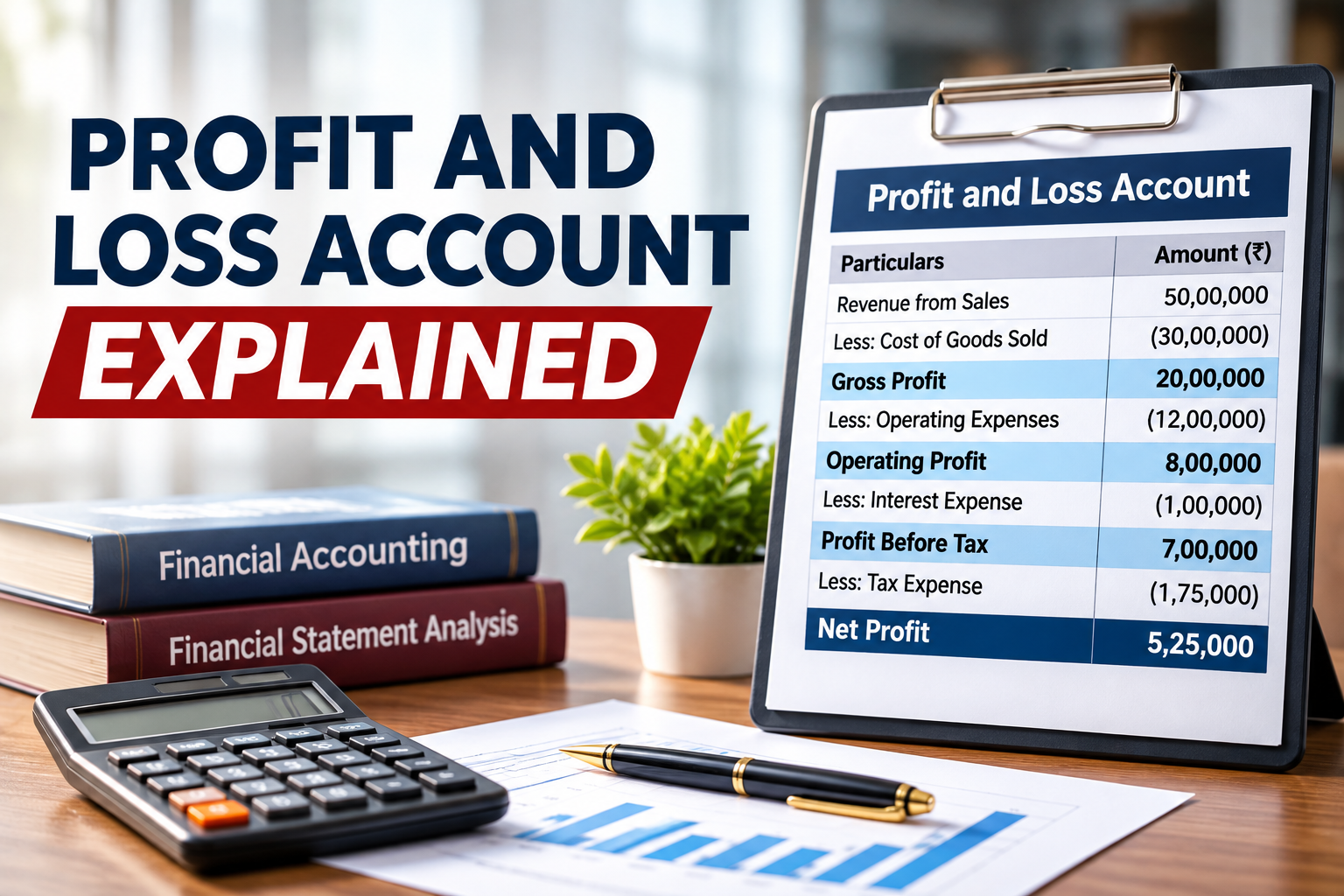
A business may generate lakhs of rupees in sales and still struggle to make a profit. The reason is simple: earning revenue and making a profit are not the same thing.
A profit and loss account shows how much income a business earns, how much it spends, and whether it makes a profit or incurs a loss during a particular accounting period.
If you are looking for a profit and loss account explained with a practical example, the easiest approach is to follow the money from sales revenue to the final profit figure.
For CA, CMA and commerce students, understanding this statement is essential because it connects accounting concepts with real business performance.
What Is a Profit and Loss Account?
A profit and loss account is a financial statement that summarises a business’s income, expenses and resulting profit or loss over a specific period.
It is also commonly called an income statement. In Indian corporate financial reporting, it is generally presented as the Statement of Profit and Loss.
The basic principle is:
Profit = Total Income − Total Expenses
When income exceeds expenses, the business earns a profit. When expenses exceed income, it incurs a loss.
For example, if a business earns ₹10 lakh in income and incurs ₹8 lakh in expenses, its profit is ₹2 lakh.
However, an actual profit and loss statement provides more detail. It separates different types of income and expenses to explain how the final profit was earned.
Why Is a Profit and Loss Account Important?
A profit and loss account helps business owners, accountants, investors and lenders understand financial performance.
It answers several important questions:
- Is the business generating enough revenue?
- How much does it spend on operations?
- Are expenses increasing faster than sales?
- Is the company earning an operating profit?
- How much profit remains after interest and taxes?
Consider two businesses that each generate ₹50 lakh in annual revenue.
One earns ₹8 lakh in profit, while the other earns only ₹2 lakh.
Although their sales are identical, their profitability is very different.
A profit and loss account helps identify the reasons behind that difference.
Main Components of a Profit and Loss Account
Before preparing a profit and loss account, it is important to understand its major components.
| Component | Meaning |
|---|---|
| Revenue | Income earned from the company’s main business activities |
| Other income | Income from activities outside the main operations, such as certain interest receipts |
| Cost of goods sold | Direct cost of goods sold during the period |
| Gross profit | Revenue remaining after deducting cost of goods sold |
| Operating expenses | Expenses incurred to run the business |
| Operating profit | Profit from operations before interest and tax |
| Finance costs | Interest and other applicable borrowing costs |
| Tax expense | Income tax expense recognised for the period |
| Net profit | Profit remaining after all recognised expenses and taxes |
The exact presentation depends on the type of business and applicable accounting requirements.
For example, a trading business may focus on purchases and inventory, while a service company may have substantial employee and professional expenses.
Profit and Loss Account Format with a Practical Example
Let us understand the concept using a fictional business.
Imagine ABC Traders, a company that purchases household appliances from manufacturers and sells them to retailers.
The following figures represent its financial performance for the year ended 31 March 2026.
ABC Traders — Simplified Profit and Loss Account
For the year ended 31 March 2026
| Particulars | Amount (₹) |
|---|---|
| Revenue from sales | 50,00,000 |
| Less: Cost of goods sold | 30,00,000 |
| Gross Profit | 20,00,000 |
| Salaries and wages | 6,00,000 |
| Rent | 2,40,000 |
| Electricity and utilities | 1,20,000 |
| Advertising expenses | 1,00,000 |
| Depreciation | 1,40,000 |
| Total Operating Expenses | 12,00,000 |
| Operating Profit (EBIT) | 8,00,000 |
| Less: Interest expense | 1,00,000 |
| Profit Before Tax | 7,00,000 |
| Less: Income tax expense | 1,75,000 |
| Net Profit After Tax | 5,25,000 |
Note: This is an illustrative, simplified statement prepared for educational purposes. It assumes no other income or expenses. The tax expense is hypothetical and does not represent a prescribed tax rate. A statutory company Statement of Profit and Loss may follow a different presentation.
Now, let us understand how each figure is calculated.
Step 1: Calculate Total Revenue
Revenue represents income earned from the company’s principal business activities.
For ABC Traders, total sales revenue during the year is ₹50 lakh.
Revenue is generally recognised according to applicable accounting principles, not simply when cash is received.
For example, a business may sell goods worth ₹1 lakh on credit. If the relevant revenue recognition conditions are satisfied, the sale is recorded as revenue even though the customer has not yet paid.
This distinction is important because revenue does not necessarily mean cash received.
Step 2: Calculate the Cost of Goods Sold
Cost of goods sold (COGS) represents the cost of inventory sold during the accounting period.
For a trading business, it generally includes the purchase cost of goods sold and other relevant costs attributable to bringing inventory to its present location and condition.
A simplified formula is:
COGS = Opening Inventory + Net Purchases − Closing Inventory
Suppose ABC Traders has:
| Particulars | Amount |
|---|---|
| Opening inventory | ₹5,00,000 |
| Net purchases | ₹35,00,000 |
| Closing inventory | ₹10,00,000 |
| Cost of Goods Sold | ₹30,00,000 |
The company purchased goods worth ₹35 lakh but did not sell all the inventory available during the year.
The unsold inventory remains an asset rather than becoming an expense through cost of goods sold.
This is an important concept in accounting: purchases and the cost of goods sold are not always equal.
Step 3: Calculate Gross Profit
Gross profit is the amount remaining after deducting the cost of goods sold from sales revenue.
Gross Profit = Revenue − Cost of Goods Sold
For ABC Traders:
₹50,00,000 − ₹30,00,000 = ₹20,00,000
The company earns ₹20 lakh in gross profit.
But this is not the final profit.
It still needs to pay salaries, rent, electricity, advertising expenses and other operating costs.
What Does Gross Profit Tell Us?
Gross profit helps assess how much a business earns from selling goods after accounting for their direct cost.
A business with a healthy gross profit may have greater room to cover operating expenses.
However, gross profit alone cannot establish whether the company is financially successful.
Step 4: Deduct Operating Expenses
Operating expenses are costs incurred in running the business.
ABC Traders reports the following expenses:
| Operating Expense | Amount |
|---|---|
| Salaries and wages | ₹6,00,000 |
| Rent | ₹2,40,000 |
| Electricity and utilities | ₹1,20,000 |
| Advertising | ₹1,00,000 |
| Depreciation | ₹1,40,000 |
| Total | ₹12,00,000 |
These expenses are necessary for day-to-day business activities.
Depreciation deserves particular attention.
When a company purchases equipment that qualifies as a depreciable asset, it generally does not recognise the entire purchase price as an expense immediately. Instead, the depreciable amount is allocated over the asset’s useful life.
Depreciation therefore reduces accounting profit even though the depreciation expense itself does not involve a cash payment during the period.
Step 5: Calculate Operating Profit
Operating profit measures earnings from the company’s operations after deducting operating expenses.
In our simplified example:
Operating Profit = Gross Profit − Operating Expenses
₹20,00,000 − ₹12,00,000 = ₹8,00,000
ABC Traders earns ₹8 lakh from its operations before interest and tax.
This measure is useful because it helps separate operating performance from financing costs and income tax.
However, the precise definition of operating profit can vary depending on the reporting presentation and analytical method.
Step 6: Calculate Profit Before Tax
ABC Traders has an interest expense of ₹1 lakh.
Interest is a finance cost arising from borrowings.
Profit Before Tax = Operating Profit − Interest Expense
₹8,00,000 − ₹1,00,000 = ₹7,00,000
The company therefore earns ₹7 lakh before tax.
If the company had other income or non-operating expenses, those amounts would also need to be considered.
Step 7: Calculate Net Profit After Tax
Net profit is the amount remaining after deducting all recognised expenses, including income tax expense.
For ABC Traders:
Net Profit = Profit Before Tax − Tax Expense
₹7,00,000 − ₹1,75,000 = ₹5,25,000
The company’s net profit for the year is ₹5.25 lakh.
This means ABC Traders earned ₹5.25 lakh in accounting profit from ₹50 lakh in sales revenue after accounting for the expenses shown.
It does not mean the company necessarily has ₹5.25 lakh sitting in its bank account.
How to Analyse a Profit and Loss Account?
Preparing the statement is only one part of financial accounting.
The next step is understanding what the numbers reveal.
Three profitability measures are particularly useful.
Gross Profit Margin
Gross profit margin shows the percentage of revenue remaining after deducting the cost of goods sold.
Gross Profit Margin = (Gross Profit ÷ Revenue) × 100
For ABC Traders:
(₹20,00,000 ÷ ₹50,00,000) × 100 = 40%
This means the company retains ₹40 as gross profit from every ₹100 of sales before paying operating expenses.
Operating Profit Margin
Operating profit margin measures the proportion of revenue remaining after operating expenses.
Operating Profit Margin = (Operating Profit ÷ Revenue) × 100
(₹8,00,000 ÷ ₹50,00,000) × 100 = 16%
The company earns ₹16 in operating profit for every ₹100 of sales.
Net Profit Margin
Net profit margin measures the percentage of revenue remaining as final profit.
Net Profit Margin = (Net Profit ÷ Revenue) × 100
(₹5,25,000 ÷ ₹50,00,000) × 100 = 10.5%
ABC Traders earns ₹10.50 in net profit for every ₹100 of sales.
Summary of Profitability Ratios
| Ratio | ABC Traders |
|---|---|
| Gross Profit Margin | 40% |
| Operating Profit Margin | 16% |
| Net Profit Margin | 10.5% |
These figures become more meaningful when compared with previous years and businesses operating in the same industry.
A 10.5% net profit margin may be attractive in one industry but relatively modest in another.
Gross Profit vs Operating Profit vs Net Profit
These three terms are often confused by beginners.
| Gross Profit | Operating Profit | Net Profit |
|---|---|---|
| Revenue minus cost of goods sold | Profit after operating expenses | Final profit after all recognised expenses and tax |
| Focuses on the margin from selling goods | Focuses on operating performance | Measures overall profitability |
| Excludes operating overheads | Excludes interest and tax in our example | Includes interest and tax effects |
A company can have a strong gross profit but a weak net profit if operating expenses and finance costs are too high.
That is why reading only one profit figure can be misleading.
What Happens When Business Expenses Increase?
Let us return to ABC Traders.
Suppose its sales remain ₹50 lakh, but operating expenses increase from ₹12 lakh to ₹15 lakh.
Assume all other figures remain unchanged.
| Particulars | Original | After Expense Increase |
|---|---|---|
| Revenue | ₹50 lakh | ₹50 lakh |
| Gross profit | ₹20 lakh | ₹20 lakh |
| Operating expenses | ₹12 lakh | ₹15 lakh |
| Operating profit | ₹8 lakh | ₹5 lakh |
| Interest expense | ₹1 lakh | ₹1 lakh |
| Profit before tax | ₹7 lakh | ₹4 lakh |
Operating profit falls from ₹8 lakh to ₹5 lakh even though sales have not changed.
This example demonstrates an important business lesson:
Increasing revenue is not the only way to improve profitability. Managing costs also matters.
However, cutting expenses indiscriminately can harm product quality, employee productivity or future growth.
A business must understand which expenses create value and which can be controlled without damaging operations.
Profit and Loss Account vs Balance Sheet
The profit and loss account and balance sheet are closely connected, but they serve different purposes.
| Profit and Loss Account | Balance Sheet |
|---|---|
| Shows financial performance | Shows financial position |
| Covers a period | Reports balances on a particular date |
| Includes income and expenses | Includes assets, liabilities and equity |
| Determines profit or loss | Shows resources and financial obligations |
| Helps assess profitability | Helps assess liquidity and financial structure |
For example, ABC Traders reports ₹5.25 lakh in net profit.
That profit generally affects retained earnings within equity, subject to distributions and other adjustments.
However, the balance sheet is needed to understand the company’s cash, receivables, inventory, borrowings and overall financial position.
Students can also explore how to read a balance sheet to understand the relationship between profitability and financial position.
Common Mistakes When Reading a Profit and Loss Account
Confusing Revenue with Profit
A company generating ₹1 crore in sales is not necessarily more profitable than a company generating ₹50 lakh.
Expenses determine how much profit remains.
Treating Profit as Cash
A company can report profit while facing cash shortages.
This may happen when customers purchase goods on credit but delay payment.
The cash flow statement helps explain the difference between accounting profit and actual cash movements.
Ignoring Depreciation
Depreciation reduces accounting profit, even though it is not a current-period cash outflow.
Ignoring it can give an incomplete picture of operating costs.
Looking at Only One Accounting Period
A single year’s profit does not reveal whether the business is improving or declining.
Compare revenue, expenses and profit margins across multiple periods.
Assuming Higher Profit Always Means Better Performance
A company may report higher profit because of a one-time gain rather than stronger core operations.
Understanding the source of profit is just as important as knowing the final amount.
Why CA and CMA Students Should Understand Profit and Loss Accounts?
The profit and loss account connects several important subjects in commerce education.
For CA students, it provides a foundation for financial accounting, financial reporting, auditing and financial statement analysis.
Understanding how income and expenses are recognised also helps students interpret financial results and identify unusual transactions.
For CMA students, profit and loss analysis is closely connected to cost management, budgeting and business decision-making.
A CMA learner may examine how changes in material costs, labour expenses, production efficiency or selling prices affect profitability.
For commerce graduates entering accounting or finance roles, the ability to explain gross profit, operating profit and net profit is a useful practical skill.
The objective is not simply to calculate the final profit correctly. It is to understand why the business earned that amount and what influenced its performance.
Strengthen Your Financial Accounting Knowledge with Master Minds India
Understanding a profit and loss account is an important step towards learning financial reporting, cost analysis and business finance. Once students understand how revenue and expenses affect profitability, they can approach more advanced accounting concepts with greater confidence.
Master Minds India provides educational resources for students pursuing commerce and professional accounting studies. Explore the Master Minds courses to learn more about the available educational programmes.
