

Blog
Accrual Accounting vs Cash Accounting: Examples and Differences

Imagine a business completes a project worth ₹1 lakh in March but receives payment from the customer in April. Should the income be recorded in March, when the work was completed, or in April, when the money was received?
The answer depends on the accounting method used.
Understanding accrual vs cash accounting is important for CA, CMA and commerce students because these methods determine when businesses recognise income and expenses.
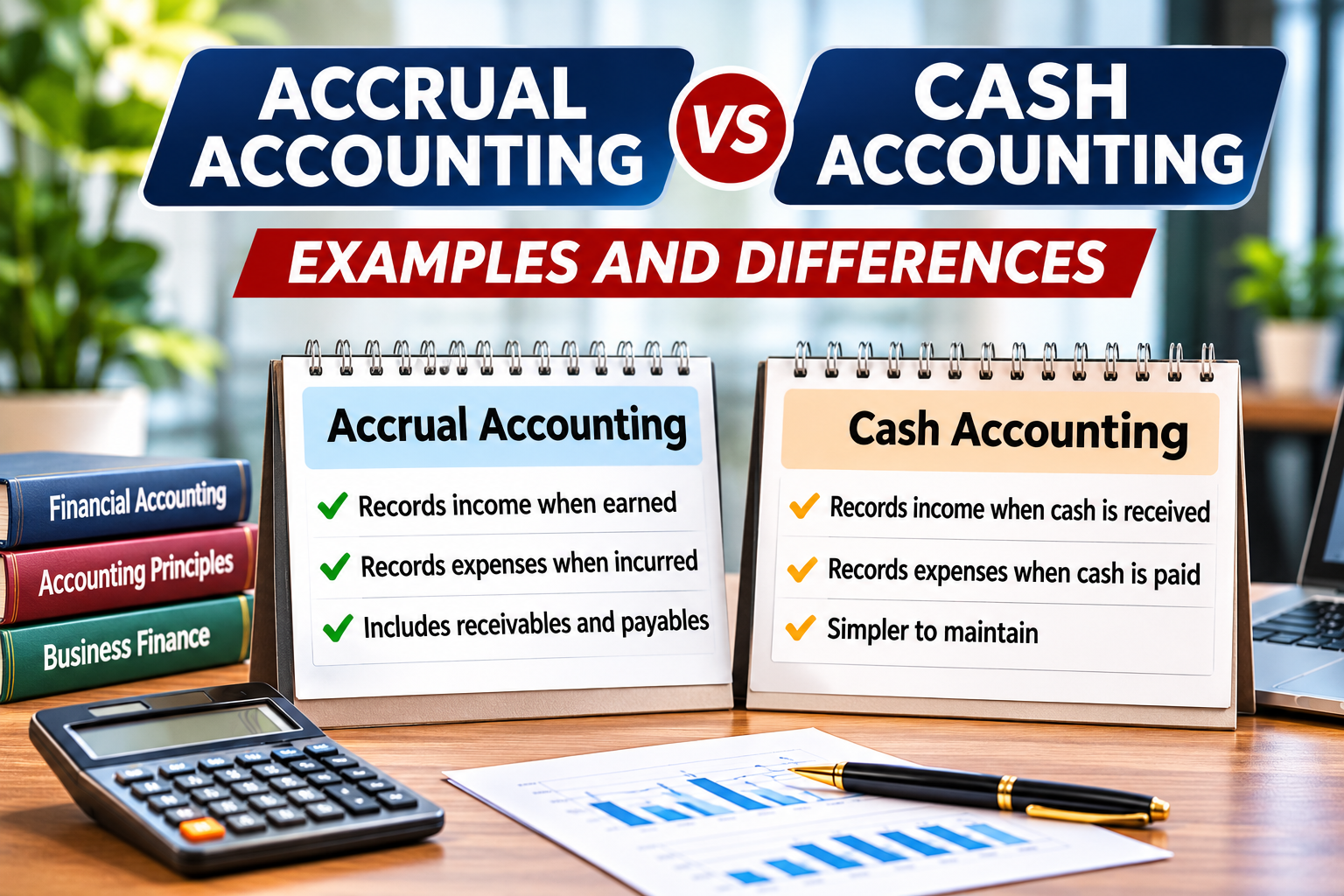
Accrual accounting records transactions when income is earned or expenses are incurred, even if payment happens later. Cash accounting records income and expenses when money is actually received or paid.
Both methods track business activity, but they can produce different profit figures for the same period.
What Is Accrual Accounting?
Accrual accounting is a method of recording income when it is earned and expenses when they are incurred, regardless of when cash is received or paid.
It focuses on the economic activity of the business rather than only its cash transactions.
For example, suppose a consulting company provides services worth ₹80,000 in March and receives payment in April.
Under accrual accounting, the company generally recognises ₹80,000 as revenue in March because that is when the service was provided and the relevant revenue recognition requirements were satisfied.
The unpaid amount is recorded as a receivable.
When the customer pays in April, the company records the receipt of cash and reduces the receivable. It does not recognise the same revenue again.
This method helps businesses measure financial performance during the period in which the underlying activities occur.
Main Features of Accrual Accounting
- Revenue is recognised when earned, subject to applicable recognition requirements.
- Expenses are recognised when incurred according to the relevant accounting principles.
- Credit sales and credit purchases are recorded.
- Outstanding expenses and prepaid expenses are accounted for.
- Receivables and payables appear in the balance sheet.
- Profit may differ from the cash generated during the period.
Accrual accounting is widely used in corporate financial reporting because it provides information about both current transactions and outstanding financial obligations.
What Is Cash Accounting?
Cash accounting is a method of recording income when cash is received and expenses when cash is paid.
It focuses on actual cash movements rather than the timing of the underlying business transactions.
Consider the same consulting company.
It completes services worth ₹80,000 in March but receives payment in April.
Under cash accounting, the ₹80,000 is generally recorded as income in April because that is when the money is received.
Similarly, if the company receives an electricity bill in March but pays it in April, the expense is generally recorded in April under the cash basis.
This approach is relatively straightforward because it follows cash receipts and payments.
However, it may not accurately reflect the economic performance of a business during a particular period.
Main Features of Cash Accounting
- Income is recorded when cash is received.
- Expenses are generally recorded when cash is paid.
- Unpaid customer invoices are not recognised as income until collection.
- Outstanding expenses are generally not recognised before payment.
- Recordkeeping is relatively simple.
- Reported profit can fluctuate because of payment timing.
Cash accounting may be useful for certain simple recordkeeping purposes, but it is not automatically permitted for every business or statutory reporting requirement.
Accrual vs Cash Accounting: Key Differences
The following table explains the major differences between accrual and cash accounting.
| Basis | Accrual Accounting | Cash Accounting |
|---|---|---|
| Meaning | Records income when earned and expenses when incurred | Records income and expenses when cash changes hands |
| Revenue recognition | Based on earning the revenue | Based on receiving payment |
| Expense recognition | Based on incurring the expense | Based on making payment |
| Credit sales | Recognised when relevant revenue conditions are met | Recognised when payment is received |
| Outstanding expenses | Recognised as liabilities | Generally recorded when paid |
| Prepaid expenses | Recognised as assets when applicable | Generally recorded when paid |
| Financial performance | Reflects economic activity during the period | Reflects cash receipts and payments |
| Complexity | Requires more accounting adjustments | Usually simpler |
| Balance sheet information | Includes receivables, payables and accruals | Does not generally recognise those items in the same way |
| Common use | Corporate financial reporting | Certain small-scale or permitted recordkeeping arrangements |
The fundamental difference is the timing of recognition.
Accrual accounting follows when economic activity takes place, while cash accounting follows when money is received or paid.
Accrual Accounting vs Cash Accounting: Practical Business Example
Let us understand the difference using a fictional business.
ABC Digital Services provides website development and digital marketing services to customers.
During March, the company records the following transactions:
- Completes a website project worth ₹1,00,000. The customer will pay in April.
- Receives ₹50,000 for another service completed in March.
- Incurs employee salary expenses of ₹40,000 for March, payable in April.
- Pays ₹15,000 for March office rent.
Assume there are no other income or expense transactions during the month.
Profit Calculation Under Accrual Accounting
Under accrual accounting, revenue is recognised when services are completed and expenses are recognised when incurred.
| Particulars | Amount |
|---|---|
| Website development revenue | ₹1,00,000 |
| Other service revenue | ₹50,000 |
| Total Revenue | ₹1,50,000 |
| Salary expense | ₹40,000 |
| Rent expense | ₹15,000 |
| Total Expenses | ₹55,000 |
| Profit for March | ₹95,000 |
The company reports a profit of ₹95,000 for March.
Even though the website development payment and employee salaries remain outstanding, both transactions are included because the related services and work occurred in March.
Profit Calculation Under Cash Accounting
Under cash accounting, only cash receipts and payments are considered.
| Particulars | Amount |
|---|---|
| Cash received from customers | ₹50,000 |
| Total Income | ₹50,000 |
| Rent paid | ₹15,000 |
| Total Expenses Paid | ₹15,000 |
| Profit for March | ₹35,000 |
The company reports a cash-basis profit of ₹35,000.
The ₹1 lakh website payment and ₹40,000 salary payment are not included because neither was paid during March.
Comparison of Results
| Particulars | Accrual Basis | Cash Basis |
|---|---|---|
| Revenue | ₹1,50,000 | ₹50,000 |
| Expenses | ₹55,000 | ₹15,000 |
| Profit | ₹95,000 | ₹35,000 |
The same business reports two different profit figures for March.
This does not mean either calculation contains an arithmetic mistake.
The difference arises because the two accounting methods recognise transactions at different times.
What Happens When the Payments Are Made in April?
Now assume ABC Digital Services receives the outstanding ₹1 lakh from its customer and pays the ₹40,000 salary in April.
Under accrual accounting, these transactions were already recognised in March.
Receiving the customer payment increases cash and reduces trade receivables. Paying salaries reduces cash and the outstanding salary liability.
Neither transaction creates additional April revenue or salary expense.
Under cash accounting, however, the company records:
- Income received: ₹1,00,000.
- Salary expense paid: ₹40,000.
The resulting cash-basis profit from these two transactions is ₹60,000.
This example shows how the timing of receipts and payments can shift reported profit between accounting periods under the cash method.
Journal Entries Under Accrual Accounting
Accrual accounting requires businesses to recognise transactions even when cash has not changed hands.
Consider the ₹1 lakh website development service completed in March.
When the Service Is Completed
| Account | Debit | Credit |
|---|---|---|
| Trade Receivables A/c | ₹1,00,000 | |
| Service Revenue A/c | ₹1,00,000 |
The company records revenue and the amount receivable from the customer.
When Payment Is Received
| Account | Debit | Credit |
|---|---|---|
| Bank A/c | ₹1,00,000 | |
| Trade Receivables A/c | ₹1,00,000 |
The second entry records collection of the outstanding amount.
No additional revenue is recognised because the income was already recorded when earned.
Entry for Outstanding Salaries
When March salaries of ₹40,000 become payable:
| Account | Debit | Credit |
|---|---|---|
| Salary Expense A/c | ₹40,000 | |
| Salary Payable A/c | ₹40,000 |
When salaries are paid in April:
| Account | Debit | Credit |
|---|---|---|
| Salary Payable A/c | ₹40,000 | |
| Bank A/c | ₹40,000 |
These entries illustrate how accrual accounting separates the recognition of expenses from their actual payment.
How Accrual Accounting Treats Prepaid and Outstanding Expenses?
Two important concepts in accrual accounting are prepaid expenses and outstanding expenses.
Prepaid Expenses
A prepaid expense occurs when a business pays for a benefit that relates to a future accounting period.
For example, suppose a company pays ₹1,20,000 on 1 January for 12 months of insurance coverage.
Assuming the benefit is recognised evenly over the coverage period, the monthly insurance expense is:
₹1,20,000 ÷ 12 = ₹10,000
By 31 March, three months of coverage have been used.
The company recognises:
- Insurance expense: ₹30,000.
- Prepaid insurance asset: ₹90,000.
The remaining amount is recognised as an expense over the subsequent coverage period.
Outstanding Expenses
An outstanding expense is an expense incurred but not yet paid.
For example, if electricity worth ₹12,000 was consumed in March but the bill will be paid in April, the company generally recognises the expense and corresponding liability in March.
These adjustments help ensure that expenses are reflected in the periods to which they relate.
Advantages and Limitations of Accrual Accounting
Accrual accounting offers several benefits.
It provides a more complete picture of financial performance by recognising revenue and expenses in the relevant accounting periods.
It also records receivables, payables and other obligations that help users understand the company’s financial position.
However, accrual accounting requires more detailed records and accounting adjustments.
Another important limitation is that reported profit does not necessarily represent available cash.
A company may recognise substantial revenue from credit sales while waiting several months to collect payment.
This is why accrual-based financial statements should be analysed alongside cash flow information.
Advantages and Limitations of Cash Accounting
Cash accounting is relatively simple because it follows actual receipts and payments.
It can make basic cash recordkeeping easier for businesses with uncomplicated transactions.
However, it may create a misleading picture of financial performance.
For example, a business could receive several months of customer payments in one month and appear unusually profitable.
In another month, it may pay several outstanding bills and report a loss even though its underlying business activity remains stable.
Cash accounting also provides less information about unpaid customer balances and outstanding obligations.
Therefore, simplicity should not be confused with completeness.
Which Accounting Method Is Used in India?
In India, the appropriate accounting method depends on the type of entity and the purpose of reporting.
Companies preparing financial statements under the Companies Act, 2013 generally follow the accrual basis of accounting, subject to applicable accounting standards.
Section 128 of the Companies Act requires companies to maintain books of account on an accrual basis and according to the double-entry system of accounting.
For income-tax purposes, Section 145 of the Income-tax Act, 1961 provides for income chargeable under the relevant business or professional income and other sources heads to be computed using either the cash or mercantile system, regularly employed by the assessee, subject to applicable provisions and standards.
The mercantile system broadly corresponds to accrual accounting.
However, the accounting method used for tax computation does not automatically determine the financial reporting requirements applicable to every entity.
Businesses should follow the laws and accounting standards relevant to their circumstances.
Why Accrual Accounting Matters for Financial Statements?
Accrual accounting affects both the profit and loss account and the balance sheet.
For example, when a company makes a credit sale:
- Revenue is recognised in the profit and loss account when the applicable conditions are satisfied.
- Trade receivables are recognised in the balance sheet.
When the customer pays, cash increases and receivables decrease.
The original revenue is not recorded again.
Similarly, when an expense is incurred but remains unpaid, it affects the profit and loss account and creates a liability in the balance sheet.
This connection helps students understand why financial statements must be studied together.
To explore these concepts further, read How to Read a Company’s Balance Sheet and Profit and Loss Account Explained once those articles are published at the linked addresses.
Common Mistakes Students Make in Accrual and Cash Accounting
Confusing Revenue with Cash Received
Revenue may be recognised before payment is collected under accrual accounting.
A credit sale can therefore increase revenue without immediately increasing cash.
Recording the Same Income Twice
When a credit customer pays an outstanding invoice, the receipt should not create additional revenue under accrual accounting.
The payment settles an existing receivable.
Ignoring Outstanding Expenses
Expenses incurred during an accounting period should be recognised according to applicable accrual accounting principles, even if payment occurs later.
Treating Every Advance Payment as Revenue
Money received from a customer before the related goods or services are provided may create a liability rather than immediate revenue under accrual accounting.
Revenue recognition depends on the applicable accounting requirements.
Assuming Accrual Profit Means Cash Is Available
A business may report a profit while experiencing cash shortages due to delayed customer payments.
Profitability and liquidity are different financial concepts.
Why CA and CMA Students Should Understand Both Methods?
For CA students, accrual accounting is fundamental to financial accounting, financial reporting, auditing and the preparation of financial statements.
Understanding when income and expenses should be recognised helps students analyse transactions and identify accounting errors.
During practical accounting work, students may encounter adjustments for outstanding expenses, prepaid expenses, accrued income and unearned revenue.
For CMA students, the distinction is equally important when studying cost accounting, budgeting, financial management and business performance.
Managers need to understand both accounting profitability and actual cash availability when making decisions.
For commerce students, learning the difference between accrual and cash accounting provides a foundation for understanding how businesses record transactions and measure their results.
The essential distinction is straightforward: accrual accounting records economic activity when it occurs, while cash accounting records transactions when money is received or paid.
Strengthen Your Accounting Fundamentals with Master Minds India
Understanding accrual and cash accounting helps students connect journal entries with financial statements and real business transactions. These concepts form an important foundation for studying financial reporting, auditing, taxation and business finance.
Master Minds India provides educational resources for students pursuing commerce and professional accounting studies. Explore the available Master Minds courses to learn more about the educational programmes.
