

Blog
Venture Capital vs Private Equity: What’s the Difference?

Imagine two companies.
The first is a two-year-old fintech startup founded by three college friends. They have an innovative product, thousands of early users and ambitious plans—but very little revenue.
The second is a profitable manufacturing company that’s been operating for 20 years. It wants to expand internationally by acquiring a competitor.
Both businesses need funding.
But they won’t approach the same type of investor.
The startup is more likely to seek venture capital.
The established company may look for private equity.
At first glance, both industries seem similar. After all, they invest money in businesses.
But that’s where the similarity ends.
The companies they invest in, the risks they take, the strategies they follow and even the careers they offer are quite different.
For commerce students, especially those pursuing CA and CMA, understanding venture capital vs private equity is essential. These two fields sit at the intersection of entrepreneurship, corporate finance, investment banking and business strategy.
Let’s explore how they differ—and why both are shaping the future of finance.
What Is Venture Capital?
Venture Capital (VC) is a type of investment made in early-stage startups that have strong growth potential but limited operating history.
Most startups receiving venture capital have:
- Innovative products or services
- Scalable business models
- Strong founding teams
- High-growth markets
- Limited profits—or sometimes no profits at all
Instead of focusing on today’s earnings, venture capital investors focus on what the company could become over the next five to ten years.
What Is Private Equity?
Private Equity (PE) involves investing in established companies that already have customers, revenue and a proven business model.
Rather than funding an idea, private equity firms invest in businesses that have demonstrated success but still have room to grow.
Their objective is to:
- Improve operations
- Increase profitability
- Expand into new markets
- Strengthen management
- Increase business value
- Exit the investment with attractive returns
Private equity is less about discovering businesses.
It’s more about transforming them.
The Biggest Difference
Here’s the easiest way to remember it.
Venture Capital helps build businesses.
Private Equity helps grow businesses that are already built.
That single idea explains most of the differences between these two investment models.
Venture Capital vs Private Equity: Side-by-Side Comparison
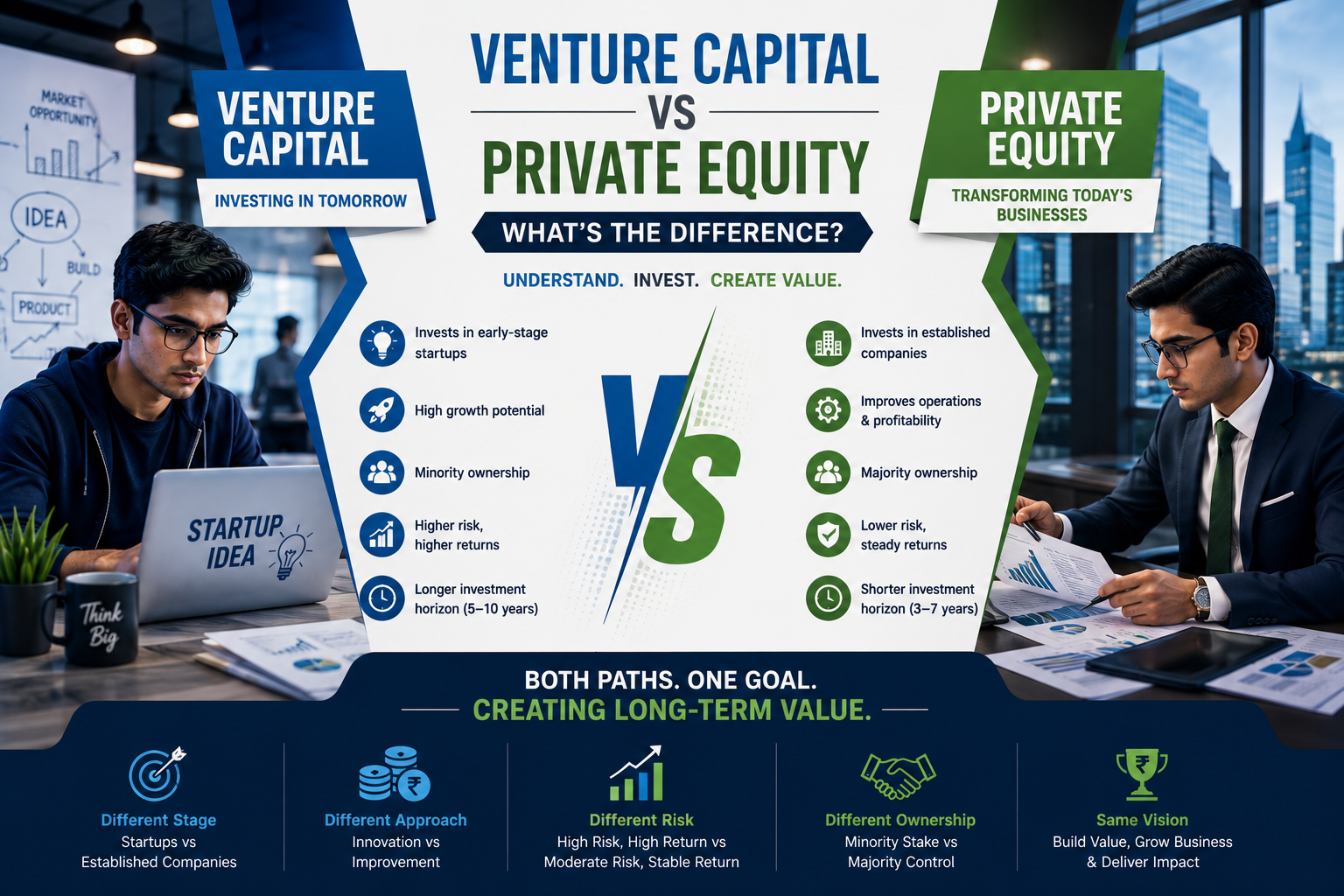
| Venture Capital | Private Equity |
|---|---|
| Invests in startups | Invests in established businesses |
| Higher investment risk | Comparatively lower risk |
| Focuses on innovation | Focuses on operational improvement |
| Usually acquires minority ownership | Often acquires majority ownership |
| Long-term growth | Profit optimisation and expansion |
| Startup founders retain significant control | Investors usually have stronger operational influence |
| Higher failure rate | More predictable performance |
Why Startups Need Venture Capital?
Building a startup requires money long before profits begin.
Founders need funding for:
- Product development
- Technology
- Hiring employees
- Marketing
- Customer acquisition
- Business expansion
Banks often hesitate to finance young companies with limited financial history.
Venture capital fills that gap.
VC investors understand that many startups will fail.
They accept that risk because a few successful investments can generate exceptional returns.
Why Established Companies Choose Private Equity?
Established businesses face different challenges.
Instead of proving an idea, they may want to:
- Expand internationally
- Acquire competitors
- Modernise operations
- Improve profitability
- Reduce debt
- Prepare for an IPO
Private equity firms provide both capital and strategic guidance.
Unlike passive investors, they actively help improve business performance.
How Venture Capital Firms Make Investment Decisions?
When evaluating startups, VC firms often ask:
- Is the problem worth solving?
- Is the market large enough?
- Does the founding team have strong leadership?
- Can the business scale quickly?
- What makes the startup different?
- How competitive is the industry?
Interestingly, early-stage investors sometimes place greater emphasis on founders than financial statements.
Why?
Because startups evolve rapidly.
A strong team can adapt when business conditions change.
How Private Equity Firms Evaluate Businesses?
Private equity firms analyse companies differently.
They focus on:
- Revenue growth
- Profitability
- Cash flow
- Debt levels
- Industry position
- Operational efficiency
- Growth opportunities
- Management quality
Since these businesses already have financial history, investment decisions rely heavily on detailed financial analysis.
Ownership Structure
Ownership is another important difference.
Venture Capital
VC firms usually purchase minority ownership.
Founders continue leading the company while investors provide guidance and strategic support.
Private Equity
Private equity firms frequently acquire majority ownership or even purchase the entire company.
This allows them to make significant operational and strategic changes.
Investment Horizon
Neither VC nor PE is designed for quick profits.
However, their timelines differ slightly.
| Venture Capital | Private Equity |
|---|---|
| Often 5–10 years | Often 3–7 years |
| Waits for startup growth | Focuses on business improvement before exit |
| Exit through IPO or acquisition | Exit through IPO, merger or strategic sale |
Patience is essential in both industries.
Risk and Return
One of the biggest differences lies in risk.
Venture Capital
Many startups fail.
Some never generate meaningful revenue.
Others struggle to find customers.
VC investors accept this because a single successful company can produce extraordinary returns.
Private Equity
Private equity firms invest in companies with proven business models.
The risk is generally lower.
Instead of searching for the next breakthrough idea, they focus on improving existing businesses.
Typical Funding Stages
Understanding funding stages makes the difference clearer.
Venture Capital
Investments commonly occur during:
- Seed Stage
- Pre-Series A
- Series A
- Series B
- Early Growth
Private Equity
Investments usually happen after businesses have:
- Stable operations
- Consistent revenue
- Established customer base
- Experienced leadership
- Expansion opportunities
Skills Required in Venture Capital
VC professionals spend considerable time analysing ideas and entrepreneurs.
Important skills include:
- Startup evaluation
- Market research
- Industry analysis
- Networking
- Financial modelling
- Business strategy
- Communication
- Commercial awareness
Curiosity is a major advantage.
New industries emerge constantly.
Skills Required in Private Equity
Private equity professionals spend more time evaluating financial performance.
Key skills include:
- Financial statement analysis
- Business valuation
- Due diligence
- Excel
- Financial modelling
- Corporate finance
- Mergers & Acquisitions
- Negotiation
Attention to detail is critical.
Small financial assumptions can significantly influence investment decisions.
Why CA & CMA Students Should Learn Both?
Professional commerce courses already teach many relevant concepts.
Students study:
- Accounting
- Corporate Finance
- Cost Management
- Financial Reporting
- Taxation
- Business Strategy
- Auditing
Understanding venture capital and private equity helps students apply classroom knowledge to real-world businesses.
It also opens career opportunities beyond traditional accounting.
Career Opportunities
Knowledge of VC and PE supports several finance careers.
| Career | Relevance |
|---|---|
| Venture Capital Analyst | Startup evaluation |
| Private Equity Associate | Business acquisition analysis |
| Investment Banker | Capital raising and advisory |
| Corporate Finance Manager | Strategic investments |
| Business Valuation Analyst | Company valuation |
| M&A Analyst | Acquisition support |
| Financial Consultant | Strategic advisory |
| Entrepreneur | Startup fundraising |
These careers often overlap.
Many professionals move between investment banking, venture capital and private equity during their careers.
Common Misconceptions
“Venture Capital and Private Equity are the same.”
They both invest in companies—but at very different stages of growth.
“Private Equity only provides money.”
Private equity firms actively improve businesses through operational changes, governance and strategic planning.
“Only MBA graduates work in VC and PE.”
Not true.
Many professionals come from CA, CMA, commerce, finance and investment banking backgrounds.
“Every startup receives venture capital.”
Actually, only a small percentage of startups attract venture capital funding.
Many grow through bootstrapping, bank finance or angel investors.
Future Trends
Both industries continue evolving rapidly.
Current trends include:
- Artificial Intelligence startups
- Climate-tech investments
- FinTech innovation
- Healthcare technology
- ESG investing
- Digital infrastructure
- Cross-border acquisitions
- Data-driven due diligence
Technology is improving decision-making, but business judgment remains essential.
How Commerce Students Can Prepare?
Interested in venture capital or private equity?
Start building these habits today.
- Read startup stories.
- Follow IPO announcements.
- Learn financial modelling.
- Study annual reports.
- Understand business valuation.
- Analyse mergers and acquisitions.
- Improve Excel skills.
- Stay updated on industry trends.
You don’t need investment capital to start learning.
You simply need curiosity and consistency.
Practical Exercise
Choose two companies.
One startup.
One established company.
Now compare them.
| Question | Startup | Established Company |
|---|---|---|
| Revenue | ||
| Business Stage | ||
| Funding Requirement | ||
| Growth Potential | ||
| Higher Investment Risk | ||
| Better Fit for VC or PE? |
This simple exercise helps you think like an investor instead of memorizing definitions.
Frequently Asked Questions (FAQs)
What is the main difference between venture capital and private equity?
Venture capital invests in early-stage startups with high growth potential, while private equity invests in established businesses to improve performance and increase company value.
Which is riskier: venture capital or private equity?
Venture capital generally involves higher risk because startups have limited operating history. Private equity investments are comparatively less risky because they focus on established companies.
Can CA students work in venture capital and private equity?
Yes. Many Chartered Accountants build successful careers in venture capital, private equity, investment banking, business valuation and corporate finance.
Why should commerce students learn venture capital and private equity?
These concepts strengthen knowledge of corporate finance, entrepreneurship, valuation, financial modelling and modern investment careers.
Do venture capital firms own entire companies?
Usually not. Venture capital firms often take minority ownership while founders continue managing the business.
What skills are important for VC and PE careers?
Financial modelling, valuation, accounting, Excel, communication, strategic thinking, due diligence and business analysis are among the most valuable skills.
