

Blog
CA Foundation Maths Tips and Tricks: How to Score High Without Getting Stuck?

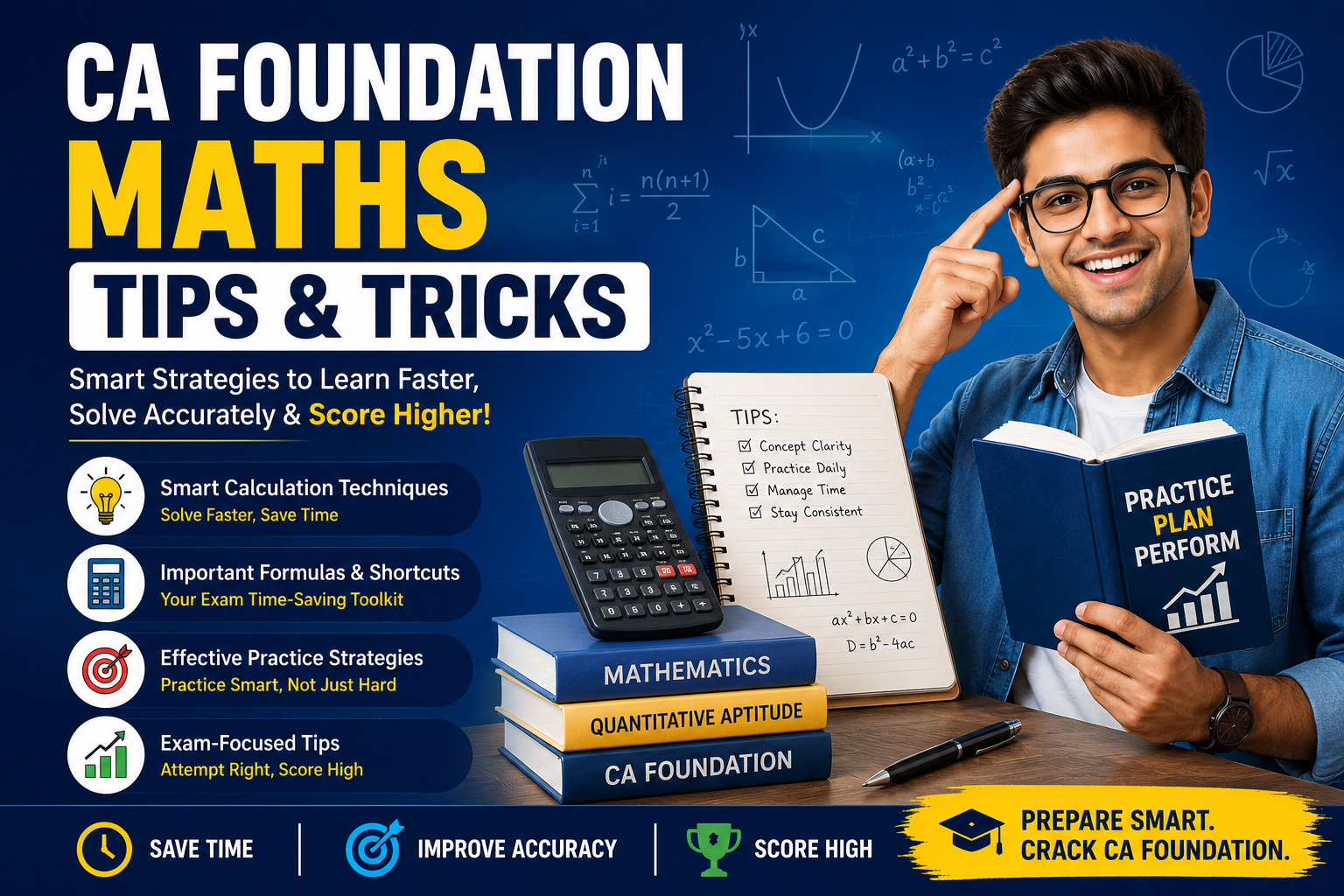
CA Foundation Maths is where many students start feeling the pressure. It’s not just about formulas—it’s about speed, accuracy, and decision-making under time constraints. And honestly, this is where most students either build confidence… or lose it.
If you’ve ever looked at a question and thought “I knew this, but why am I stuck?” — this guide is for you.
Let’s break it down in a practical, no-nonsense way.
Why CA Foundation Maths Feels Difficult? (But Isn’t)
The difficulty isn’t the syllabus. It’s the combination of concepts + time pressure + negative marking.
Here’s what usually goes wrong:
- Students try to solve everything instead of selecting smart questions
- Over-dependence on calculators slows them down
- Weak basics in algebra and ratios
- Panic during exams → careless mistakes
The paper is designed to test application, not just memory. That’s the real game.
Understanding the Exam Pattern (Don’t Skip This)
| Section | Topics | Weightage |
|---|---|---|
| Business Mathematics | Algebra, Linear Equations, Calculus | High |
| Logical Reasoning | Coding-Decoding, Series, Puzzles | Medium |
| Statistics | Mean, Median, Probability | Medium |
Key rule:
You don’t need 100%. You need smart 60–70 marks.
1. Focus on High-Scoring Topics First
Not all chapters deserve equal time. Some give better returns.
Priority Topics:
- Ratio & Proportion
- Time Value of Money
- Linear Inequalities
- Permutations & Combinations
- Probability
- Logical Reasoning (easy scoring if practiced)
Reality check:
Students who clear CA Foundation rarely complete the entire syllabus perfectly. They master selective areas deeply.
2. Speed Matters More Than Perfection
In CA Maths, speed is everything.
Try this:
- Solve 20 questions in a timed setting (say 30 minutes)
- Track accuracy
- Improve both together
Quick Speed Tips:
- Memorize standard formulas (don’t derive in exam)
- Practice mental calculations (especially percentages)
- Avoid long methods—learn shortcuts
Example:
Instead of full calculation, use approximation when options are far apart.
3. Master the Art of Question Selection
This is where toppers differ.
During the exam:
- First 5 minutes → scan the paper
- Mark:
- Easy questions (solve immediately)
- Moderate (come back later)
- Difficult (skip unless needed)
Golden rule:
Never get stuck on one question for more than 2–3 minutes.
4. Avoid Negative Marking Traps
Each wrong answer costs you. And it adds up fast.
When to Skip:
- You’re guessing blindly
- You eliminated only one option
- Calculation is too long and time-consuming
When to Attempt:
- You eliminated 2–3 options confidently
- You’re 70% sure
This single habit can improve your score by 10–15 marks.
5. Build Concept Clarity (Not Just Practice)
Many students solve hundreds of questions but still struggle.
Why? No clarity.
Fix it like this:
- After solving a question, ask: Why this method?
- Understand the logic behind formulas
- Revise mistakes weekly
If you can’t explain a concept in simple terms, you don’t fully understand it yet.
6. Daily Practice Strategy (Simple but Effective)
Consistency beats intensity.
Ideal Daily Plan:
- 1 hour: Concept learning
- 1 hour: Practice questions
- 30 mins: Revision + mistakes
Weekly:
- Take 1 mock test
- Analyze errors (this is more important than the test itself)
7. Calculator Usage – Smart, Not Slow
Your calculator should save time, not waste it.
Common Mistakes:
- Using calculator for simple calculations
- Not knowing memory functions
- Re-checking too much
Pro Tip:
Practice without calculator first. Then use it only when needed.
8. Logical Reasoning = Easy Marks (If Prepared Right)
Many students ignore this section. Big mistake.
It’s often the fastest scoring area.
Focus on:
- Series
- Coding-Decoding
- Direction sense
- Blood relations
With practice, you can solve these in seconds.
9. Mock Tests Are Non-Negotiable
You can’t skip this and expect results.
What mock tests teach you:
- Time management
- Question selection
- Pressure handling
But here’s the catch:
Taking tests is not enough.
Analyzing them is where improvement happens.
10. Common Mistakes to Avoid
- Studying everything but mastering nothing
- Ignoring weak areas
- Last-minute cramming
- Not practicing MCQ-based solving
- Overconfidence in familiar topics
And one more…
Skipping revision. That hurts more than you think.
Practical Study Plan (15-Day Revision Strategy)
| Day Range | Focus |
| Day 1–5 | Strong topics + formula revision |
| Day 6–10 | Weak areas + practice |
| Day 11–13 | Full mock tests |
| Day 14–15 | Light revision + confidence building |
Keep it simple. Don’t try to learn new concepts at the last minute.
Expert Tips That Actually Work
- Solve ICAI study material at least twice
- Focus on accuracy first, then speed
- Keep a mistake notebook
- Revise formulas daily (5–10 mins is enough)
- Stay calm during exam—it directly affects performance
FAQs on CA Foundation Maths
1. Is CA Foundation Maths very difficult?
Not really. It feels difficult due to time pressure and MCQ format, but with practice, it becomes manageable.
2. How many hours should I study Maths daily?
Ideally 2–3 hours with a mix of concepts, practice, and revision.
3. Can I pass without strong Maths basics?
Yes, but you’ll need extra effort in core topics like algebra and ratios.
4. Which is the most scoring topic?
Logical Reasoning and Time Value of Money are often considered high scoring.
5. Is calculator enough for solving questions?
Calculator helps, but speed and concept clarity matter more.
