

Blog
How CA and CMA Knowledge Helps Startup Founders?

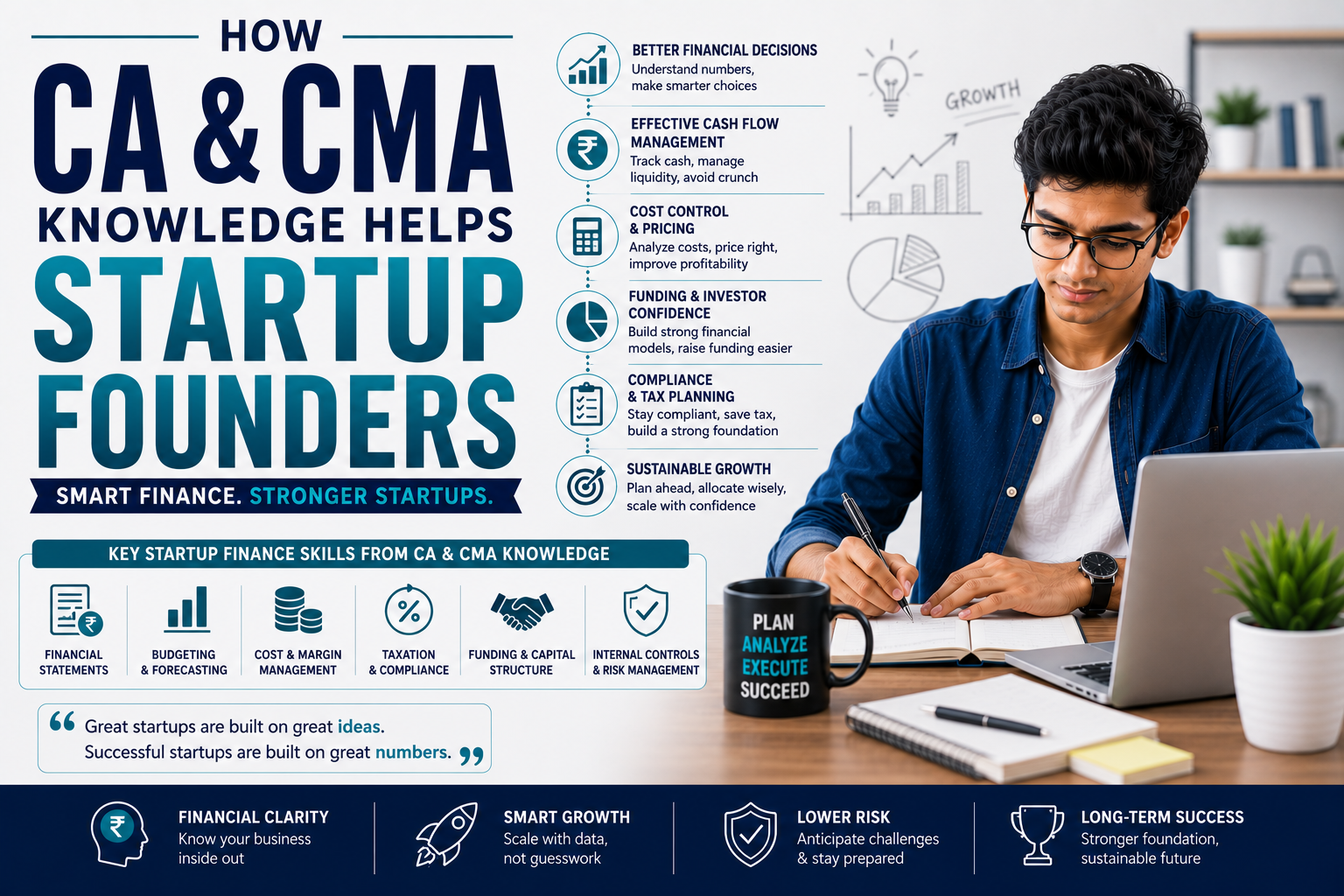
A founder can build a brilliant product and still lose control of the business.
Why?
Sometimes the problem isn’t marketing.
It isn’t technology either.
It’s finance.
The startup may be growing quickly, but cash is running out. Customer numbers are rising, yet every new sale creates another loss. The founder raises funding but has no clear plan for using the capital.
These situations are surprisingly common in young businesses.
This is where knowledge from professional commerce courses becomes extremely valuable.
Chartered Accountancy and Cost and Management Accountancy are usually associated with accounting, taxation, audit and corporate finance careers. But many concepts studied by CA and CMA students are equally useful for entrepreneurs.
Strong startup finance skills help founders understand whether their business is simply growing—or actually becoming financially stronger.
There is a big difference.
Why Startup Founders Need Financial Knowledge?
In the early stages of a startup, founders make dozens of financial decisions.
Should we hire another employee?
Can we increase the marketing budget?
Is our product priced correctly?
Should we take a business loan?
How long will our current cash last?
When should we approach investors?
A founder doesn’t need to become a professional accountant to answer every question alone.
But understanding basic financial logic changes the quality of decisions.
Without financial knowledge, founders often depend completely on accountants, consultants or investors to interpret their own business numbers.
That’s risky.
A founder should at least understand the financial story of the company they are building.
CA and CMA Knowledge Is More Entrepreneurial Than Many Students Realise
Students sometimes study professional subjects only from an examination perspective.
Cost accounting becomes a chapter.
Working capital becomes a formula.
Financial ratios become another practical problem.
Budgeting becomes a question worth eight marks.
Inside a startup, these concepts become real decisions.
| CA & CMA Knowledge | Startup Application |
|---|---|
| Financial Accounting | Understanding business performance |
| Cost Management | Controlling product and operating costs |
| Financial Management | Funding and capital decisions |
| Taxation | Tax planning and compliance |
| Audit | Building financial controls |
| Budgeting | Planning startup expenses |
| Working Capital | Managing short-term cash needs |
| Strategic Management | Connecting finance with growth |
The syllabus may be academic.
The application is very real.
1. Understanding Financial Statements
Many founders watch only one number.
Revenue.
“We crossed ₹1 crore in sales.”
That’s exciting.
But revenue alone cannot tell you whether a startup is financially healthy.
A founder with accounting knowledge will also examine:
- Gross profit
- Operating expenses
- Net profit or loss
- Assets
- Liabilities
- Receivables
- Cash balance
- Debt
The income statement shows how the business performed over a period.
The balance sheet provides a picture of its financial position.
The cash flow statement explains where cash came from and where it went.
CA and CMA students already learn these statements in detail.
For a founder, knowing how to read them is a serious advantage.
2. Managing Cash Flow Before It Becomes a Crisis
Startups rarely fail because founders cannot calculate profit.
Cash is usually the more immediate concern.
Imagine a B2B startup that invoices customers for ₹30 lakh.
The company appears to have strong sales.
But customers pay after 90 days.
Meanwhile, salaries, software subscriptions, rent and vendors must be paid every month.
The startup can look successful and still face a cash shortage.
CA and CMA knowledge helps founders understand concepts such as:
- Working capital
- Receivable days
- Payable days
- Cash conversion cycle
- Operating cash flow
- Short-term financing
A founder who tracks cash early can take action before the bank balance becomes uncomfortable.
That’s much better than discovering the problem two weeks before salary day.
3. Understanding the Real Cost of a Product
Founders are often emotionally attached to their products.
Finance isn’t.
Finance asks a simple question:
Does the business make economic sense?
Suppose a startup sells a product for ₹2,000.
The manufacturing cost is ₹900.
The founder may assume the company earns ₹1,100 per product.
Not so fast.
What about:
- Packaging
- Shipping
- Payment gateway fees
- Returns
- Advertising
- Sales commissions
- Customer support
Once these costs are considered, the actual contribution may be much lower.
CMA knowledge in cost accounting and cost management can be particularly useful here.
Understanding direct costs, indirect costs, fixed costs, variable costs and contribution margins helps founders price products more intelligently.
4. Building Realistic Budgets
Startups usually have more ideas than money.
A founder may want to:
- Hire a sales team
- Build new product features
- Run advertising campaigns
- Open an office
- Attend industry events
All of these activities cost money.
Budgeting forces founders to prioritise.
If a startup has ₹50 lakh available, the question isn’t simply, “What should we spend?”
The better question is:
Where can this ₹50 lakh create the greatest business value?
CA and CMA students learn budgeting, variance analysis and financial planning.
These skills help founders compare planned spending with actual results.
For example, if the marketing budget was ₹5 lakh but actual spending reached ₹8 lakh, the founder should investigate.
Did customer acquisition improve?
Did revenue increase?
Was the additional spending justified?
A budget should guide decisions, not sit untouched in an Excel file.
5. Making Better Pricing Decisions
Pricing is one of the most important startup decisions.
And one of the most misunderstood.
Some founders simply copy competitors.
Others calculate the product cost and add a random margin.
Neither approach is always reliable.
A strong pricing decision may consider:
- Cost structure
- Customer value
- Competitor pricing
- Gross margin
- Customer acquisition cost
- Distribution expenses
- Market positioning
Finance knowledge helps founders understand how even small pricing changes can affect profitability.
Consider a subscription startup charging ₹999 per month.
Increasing the price to ₹1,099 may look like a small change.
But across 10,000 customers, the revenue impact can be significant.
Of course, customers may react to the increase.
That’s why pricing is both a financial and strategic decision.
6. Understanding Break-Even
When will the startup stop losing money?
It’s a question founders should be able to discuss clearly.
Break-even analysis helps estimate the level of sales required to cover fixed and variable costs.
Suppose a company has monthly fixed costs of ₹10 lakh.
If the contribution from each product is ₹1,000, the company may need to sell 1,000 units to cover those fixed costs.
The real calculation can be more complex.
But the principle matters.
Break-even analysis helps founders:
- Set sales targets
- Evaluate pricing
- Plan expansion
- Understand cost pressure
- Measure financial progress
CA and CMA students already encounter these concepts.
Startup founders actually use them.
7. Evaluating Funding Options
Not every startup needs venture capital.
This point is often ignored.
Founders may finance businesses through:
- Personal savings
- Business revenue
- Bank loans
- Angel investors
- Venture capital
- Strategic investors
Each option affects the business differently.
Debt creates repayment obligations.
Equity funding reduces founder ownership.
Bootstrapping may protect control but limit the speed of expansion.
Finance knowledge helps founders compare:
- Cost of capital
- Interest obligations
- Ownership dilution
- Financial risk
- Growth requirements
A founder should never raise money simply because other startups are doing it.
Capital should solve a business need.
8. Talking Confidently with Investors
Investors don’t only want to hear about the idea.
They usually want to understand the economics behind it.
Founders may be asked about:
- Revenue growth
- Gross margins
- Burn rate
- Runway
- Customer acquisition cost
- Customer lifetime value
- Churn
- Cash flow
- Funding requirements
A founder with strong startup finance skills can discuss these numbers confidently.
More importantly, they understand what the numbers mean.
Imagine an investor asking:
“Why did your customer acquisition cost increase by 35%?”
A founder should not need to immediately call the accountant.
Financial literacy improves the quality of investor conversations.
9. Understanding Startup Burn Rate and Runway
Two startup finance terms every founder should know are burn rate and runway.
Burn rate broadly refers to how quickly a startup is using its cash.
Runway estimates how long the company can continue operating with its current cash reserves, assuming the burn pattern continues.
For example:
| Startup Cash | Monthly Net Burn | Approximate Runway |
|---|---|---|
| ₹1 crore | ₹10 lakh | 10 months |
| ₹1 crore | ₹20 lakh | 5 months |
| ₹50 lakh | ₹5 lakh | 10 months |
This is a simplified illustration.
Real businesses may have changing revenue and expenses.
Still, founders should regularly understand their cash position.
A startup with six months of runway makes decisions differently from one with 24 months of runway.
10. Building Better Financial Controls
Startups often begin informally.
One founder handles payments.
Another manages vendors.
Someone maintains a spreadsheet.
This may work when the company is tiny.
It becomes risky as the business grows.
Basic financial controls may include:
- Payment approval processes
- Expense documentation
- Bank reconciliation
- Vendor verification
- Access controls
- Regular financial reporting
CA knowledge in audit and internal controls can help founders understand why these systems matter.
Financial controls aren’t only for large corporations.
Growing startups need them too.
11. Planning Taxes and Compliance Early
Tax and regulatory compliance may not be the most exciting part of entrepreneurship.
Ignoring it can become expensive.
Depending on the nature and structure of the business, founders may need to understand areas involving:
- Income tax
- GST
- TDS
- Payroll obligations
- Corporate filings
- Financial records
The exact requirements depend on applicable Indian laws, regulations and the company’s circumstances.
Professional advice may be necessary.
Still, founders with a basic understanding of taxation and compliance are less likely to treat these responsibilities as last-minute problems.
CA knowledge is obviously valuable here.
12. Connecting Strategy with Numbers
This may be the biggest advantage.
A startup strategy sounds impressive until the financial model is tested.
“We’ll open 20 branches.”
Fine.
How much capital is required?
“We’ll hire 100 employees.”
What happens to monthly cash burn?
“We’ll reduce prices to gain market share.”
How does that affect contribution margin?
“We’ll double advertising.”
What customer acquisition results are expected?
Finance forces strategy to face reality.
CMA students with strategic cost and performance management knowledge, and CA students with financial management expertise, can develop a strong ability to connect business plans with numbers.
CA vs CMA Knowledge for Startup Founders
Both professional pathways offer useful perspectives.
| CA Knowledge | CMA Knowledge |
|---|---|
| Financial reporting | Cost management |
| Taxation | Cost analysis |
| Audit and controls | Budgeting |
| Corporate finance | Performance management |
| Compliance | Strategic cost decisions |
| Financial management | Operational efficiency |
This doesn’t mean founders need both qualifications.
It simply shows how professional commerce knowledge can support entrepreneurship from different angles.
A Simple Startup Example
Imagine three friends launch a food delivery startup.
Sales grow quickly.
Everyone is excited.
But the company loses ₹80 on every order.
The founders decide to increase marketing because they want more customers.
Here’s the problem.
If the economics don’t improve, more orders may create bigger losses.
A financially aware founder may ask:
- What is the contribution per order?
- What is the delivery cost?
- How much are discounts costing us?
- What is the customer acquisition cost?
- How frequently do customers reorder?
- Can pricing be changed?
- Which locations are profitable?
This is where accounting and cost knowledge become business tools.
Growth is useful.
Profitable or financially sustainable growth is better.
Startup Finance Skills CA & CMA Students Should Develop
Professional knowledge creates a strong foundation, but students interested in startups should also develop practical skills.
Focus on:
- Advanced Excel
- Financial modeling
- Cash flow forecasting
- Startup unit economics
- Business valuation
- Budgeting and variance analysis
- Financial dashboards
- Basic fundraising concepts
- Investor metrics
- Business communication
Students can also explore tools such as Microsoft Excel and Microsoft Power BI for financial analysis and reporting.
The goal isn’t to collect software certificates.
Learn how to use tools to answer business questions.
How Students Can Practice Startup Finance?
You don’t need to launch a company tomorrow.
Pick a simple business.
Maybe a café.
An e-commerce brand.
A software startup.
A coaching centre.
Then try to estimate:
- Monthly revenue
- Fixed costs
- Variable costs
- Gross margin
- Break-even sales
- Working capital
- Cash requirement
Create a basic financial model.
Change the assumptions.
What happens if sales fall by 20%?
What if employee costs increase?
What if customers take longer to pay?
This is how financial thinking develops.
Not by memorising one more definition.
By asking better questions.
Frequently Asked Questions
How does CA knowledge help startup founders?
CA knowledge helps founders understand financial statements, taxation, audit, compliance, financial management and internal controls.
How does CMA knowledge help entrepreneurs?
CMA knowledge is valuable for cost management, pricing, budgeting, performance analysis and improving operational efficiency.
What are the most important startup finance skills?
Cash flow management, budgeting, cost analysis, financial forecasting, unit economics, break-even analysis and funding knowledge are important startup finance skills.
Do startup founders need accounting knowledge?
Founders don’t need to become professional accountants, but basic accounting knowledge helps them understand business performance and communicate with finance professionals.
Is CA or CMA useful for entrepreneurship?
Yes. Both qualifications develop financial and analytical knowledge that can help entrepreneurs make more informed business decisions.
What financial metrics should startup founders understand?
Depending on the business model, founders may need to understand revenue growth, gross margin, burn rate, runway, cash flow, customer acquisition cost and customer lifetime value.
Can CA and CMA students work with startups?
Yes. CA and CMA students and professionals can explore opportunities in startup finance, FP&A, financial analysis, business advisory, cost management, controllership and strategic finance.
