

Blog
How Commerce Students Can Enter the World of Business Analytics?

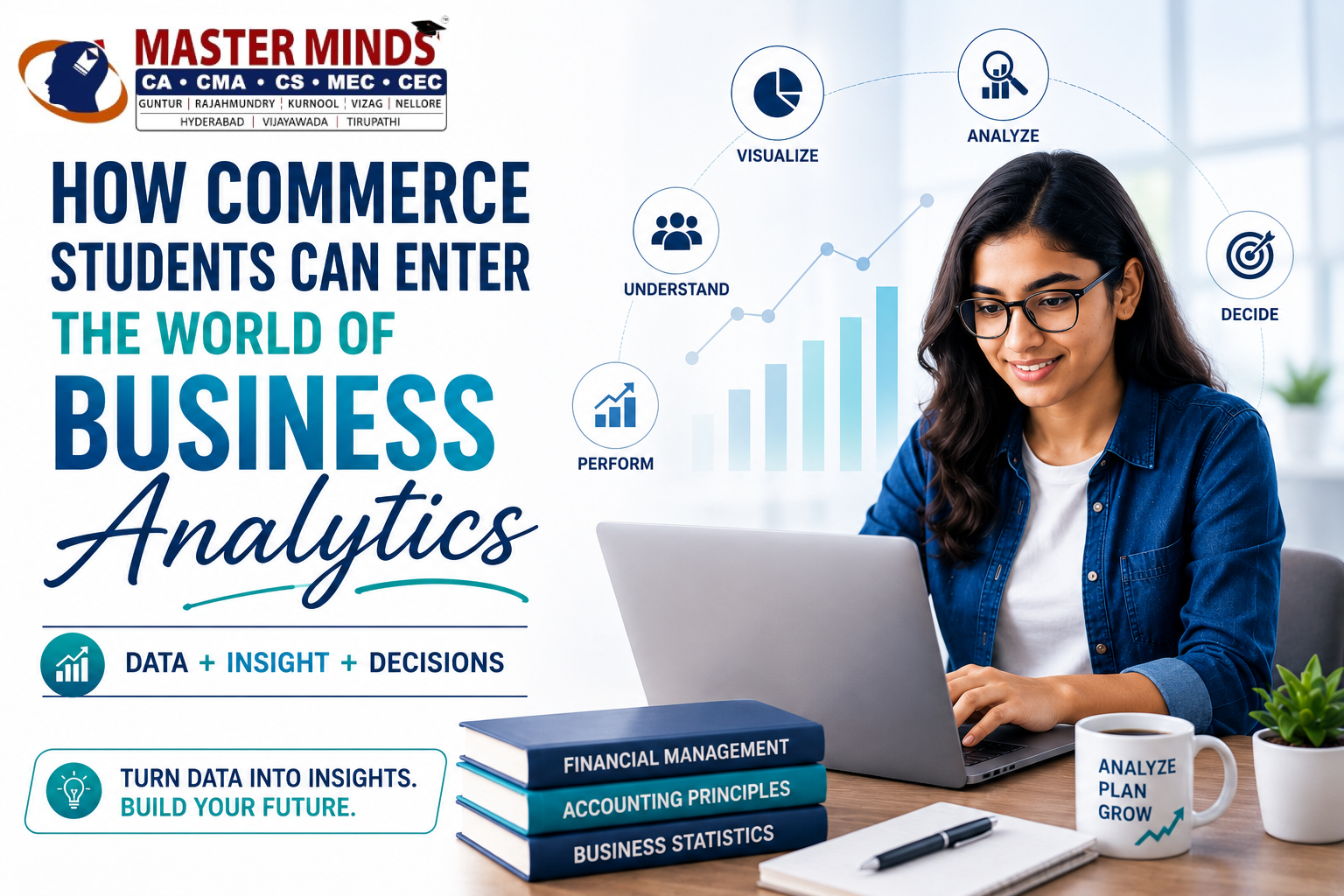
For years, business decisions were largely based on experience, intuition, and market knowledge.
Today, data plays a much bigger role.
Companies want evidence.
They want numbers.
They want insights.
Whether it’s a bank deciding whom to lend money to, an e-commerce company tracking customer behavior, or a startup planning its next expansion, data has become one of the most valuable business assets.
This shift has created massive demand for professionals who can analyze information and turn it into meaningful business decisions.
That’s where business analytics comes in.
The good news?
You don’t need an engineering degree to build a successful career in this field.
In fact, many employers actively seek candidates who understand finance, accounting, economics, business operations, and commercial decision-making.
This creates exciting opportunities in business analytics for commerce students.
What Is Business Analytics?
Business analytics is the process of collecting, analyzing, and interpreting data to improve business decisions.
Think of it as solving business problems using numbers.
A business analyst might help answer questions like:
- Which products generate the highest profit?
- Why are customers leaving?
- Which marketing campaigns deliver the best results?
- How can a company reduce costs?
- What trends are emerging in the market?
The goal isn’t simply to create reports.
The goal is to help businesses make smarter decisions.
Why Commerce Students Have an Advantage
Many students assume analytics is only for programmers.
That’s not entirely true.
Technology is important.
But understanding business is equally important.
Commerce students already learn subjects such as:
- Accounting
- Economics
- Financial Management
- Costing
- Business Studies
- Statistics
These subjects develop analytical thinking and business understanding.
A software expert may understand how data is processed.
A commerce student often understands what the data actually means from a business perspective.
That’s a powerful combination.
Why Business Analytics Is Growing Rapidly?
Every company generates data.
The challenge is knowing what to do with it.
Businesses today track:
- Sales performance
- Customer behavior
- Financial results
- Operational efficiency
- Employee productivity
The amount of available information keeps increasing.
As a result, organizations need professionals who can convert raw data into useful insights.
This demand is creating career opportunities across:
- Banking
- Financial Services
- Insurance
- E-commerce
- Consulting
- Retail
- Healthcare
- FinTech
In short, business analytics is no longer limited to technology companies.
It’s becoming a core function across industries.
Career Opportunities in Business Analytics
One of the biggest advantages of this field is its versatility.
Several roles are suitable for commerce graduates.
| Role | Suitable For | Growth Potential |
|---|---|---|
| Business Analyst | Commerce Graduates | High |
| Data Analyst | Finance & Analytics Students | High |
| Financial Analyst | B.Com, CA, CMA | High |
| Reporting Analyst | Commerce Students | Growing |
| Business Intelligence Analyst | Analytics Professionals | High |
| Risk Analyst | Finance Students | High |
| Operations Analyst | Business Graduates | Growing |
Each role focuses on helping organizations make better decisions using data.
Business Analytics vs Data Analytics
Students often confuse these two fields.
They’re related, but not identical.
Business Analytics
Focuses on:
- Business problems
- Decision-making
- Strategy
- Financial outcomes
Data Analytics
Focuses more on:
- Data processing
- Technical analysis
- Statistical models
- Data structures
A simple way to understand the difference:
Data analysts explain what happened.
Business analysts help determine what should happen next.
Commerce students often find business analytics more aligned with their background.
Skills Commerce Students Should Learn
The good news is that entering this field doesn’t require learning everything at once.
Start with fundamentals.
Essential Skills
- Microsoft Excel
- Business Statistics
- Data Interpretation
- Financial Analysis
- Problem Solving
High-Value Skills
- Power BI
- Tableau
- Financial Modeling
- Dashboard Creation
- Data Visualization
Advanced Skills
- SQL
- Python
- Predictive Analytics
- Machine Learning Basics
Not every role requires advanced technical knowledge.
Many successful analysts begin with Excel and Power BI.
The Role of Excel in Business Analytics
It may not sound exciting.
But Excel remains one of the most important tools in analytics.
Many companies still use Excel for:
- Reporting
- Budgeting
- Forecasting
- Financial analysis
- Dashboard creation
Students often rush toward advanced tools while overlooking Excel.
That’s a mistake.
Strong Excel skills remain highly valued in the job market.
Why Power BI Is Becoming a Must-Have Skill?
If there’s one tool commerce students should seriously consider learning, it’s Power BI.
Organizations increasingly want:
- Interactive dashboards
- Real-time reporting
- Visual business insights
Power BI helps professionals transform complex spreadsheets into meaningful visual reports.
And employers love seeing it on resumes.
A Practical Roadmap for Commerce Students
Students frequently ask:
“Where should I start?”
Here’s a realistic roadmap.
Step 1
Build strong foundations in:
- Accounting
- Finance
- Statistics
- Business concepts
Step 2
Learn Excel thoroughly.
Not basic Excel.
Advanced Excel.
Step 3
Learn Power BI.
Create simple dashboards.
Practice regularly.
Step 4
Work on small projects.
Analyze:
- Stock market data
- Business case studies
- Sales reports
- Public datasets
Step 5
Build a portfolio.
Even 3–4 quality projects can significantly improve interview opportunities.
Common Mistakes Students Make
One mistake appears repeatedly.
Students focus entirely on tools.
Tools matter.
But employers hire problem solvers.
Learning Power BI without understanding business concepts is like owning a calculator without knowing mathematics.
The strongest candidates combine:
- Business knowledge
- Analytical thinking
- Communication skills
- Technical abilities
That combination creates real value.
Does Business Analytics Have a Future?
Absolutely.
If anything, demand is increasing.
Organizations are becoming more data-driven every year.
Artificial Intelligence is also creating more opportunities rather than eliminating them.
Why?
Because businesses still need people who can:
- Understand business problems
- Interpret results
- Communicate insights
- Make decisions
Technology provides information.
Humans provide judgment.
That’s unlikely to change anytime soon.
Why Business Analytics Is a Great Option for Commerce Students
Business analytics sits at the intersection of:
- Business
- Finance
- Technology
Commerce students already possess one-third of that equation.
Adding analytics skills can significantly expand career opportunities.
For students interested in finance, consulting, banking, FinTech, or corporate careers, business analytics can become a valuable career accelerator.
And perhaps that’s the biggest reason to explore it.
The future of business belongs to professionals who can understand both numbers and decisions.
FAQs
Can commerce students become business analysts?
Yes. Commerce students often have strong business and financial knowledge, making them well-suited for business analyst roles.
Is coding required for business analytics?
Not always. Many entry-level business analytics roles focus on Excel, Power BI, reporting, and business analysis rather than programming.
Which tools should commerce students learn for business analytics?
Excel, Power BI, Tableau, Financial Modeling, and SQL are among the most valuable tools for aspiring business analysts.
Is business analytics a good career in 2026?
Yes. Demand for business analytics professionals continues to grow across banking, consulting, finance, e-commerce, healthcare, and technology sectors.
Can CA and CMA students enter business analytics?
Absolutely. CA and CMA students often possess strong analytical and financial skills that are highly relevant to business analytics careers.
