

Blog
Standard Costing and Variance Analysis: A Practical Introduction

A manufacturing company expects to spend ₹500 on materials for each product. At the end of the month, the actual material cost is ₹550 per unit.
Why did the cost increase by ₹50? Did the company pay higher prices for raw materials, use more materials than planned, or experience both problems?
This is where standard costing and variance analysis become useful.
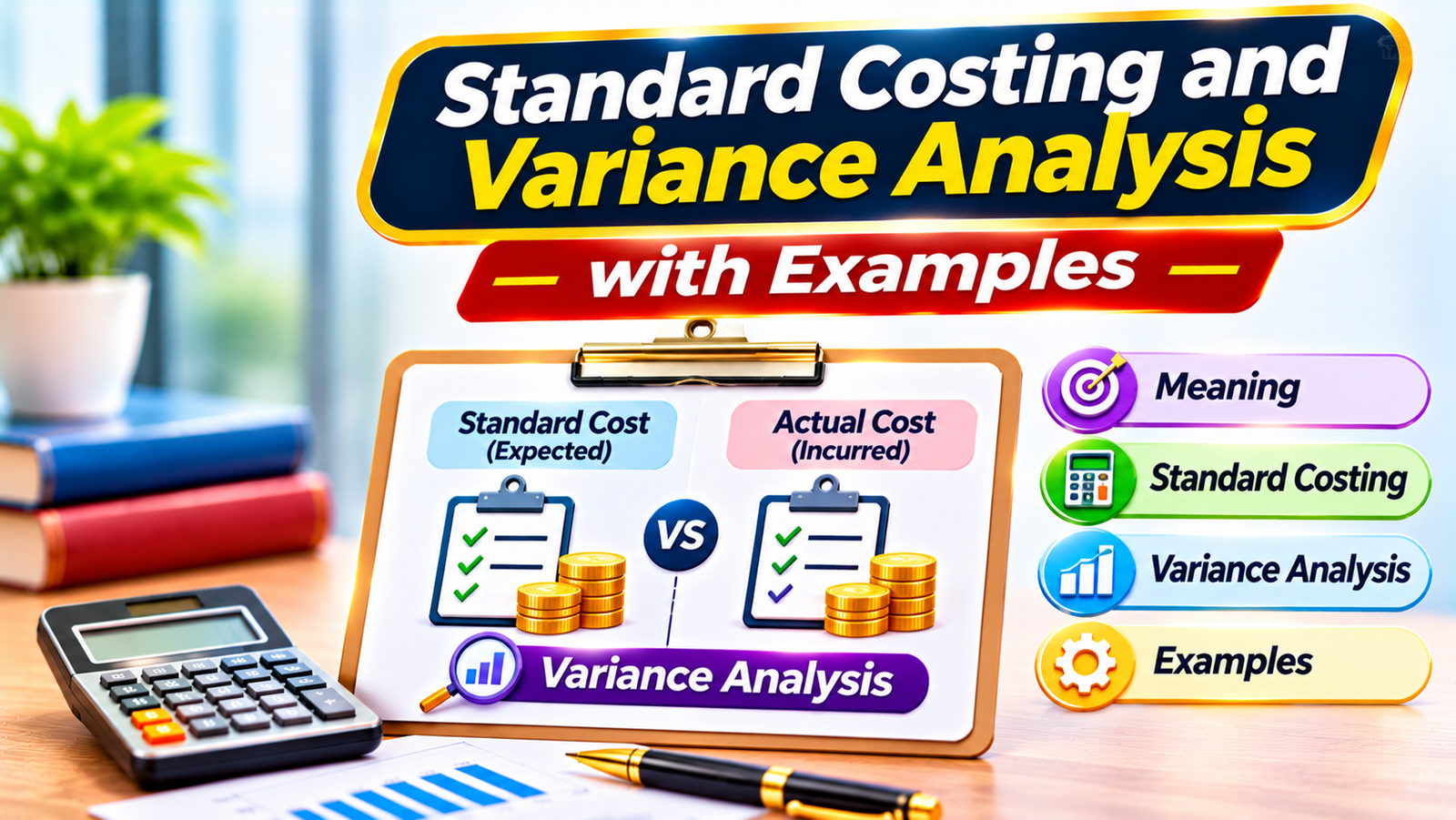
Standard costing establishes expected costs for materials, labour and overheads. Variance analysis compares those standards with actual results to identify differences and understand their causes.
For CA, CMA and commerce students, these concepts are important because they connect cost accounting with budgeting, cost control and business performance.
The purpose is not simply to identify whether actual costs are higher or lower than expected. It is to understand why the difference occurred and whether management needs to take action.
What Is Standard Costing?
Standard costing is a cost accounting technique in which predetermined costs are established for products, services or business activities.
These predetermined costs are called standard costs.
A standard cost represents the expected cost of performing an activity under specified operating conditions.
For example, a company manufacturing wooden tables may establish the following standards for one table:
| Cost Component | Standard Cost |
|---|---|
| Direct materials | ₹800 |
| Direct labour | ₹400 |
| Variable manufacturing overhead | ₹200 |
| Total Standard Variable Production Cost | ₹1,400 |
The company expects to incur ₹1,400 in variable production costs for each table.
If actual costs differ from this amount, management can investigate the reasons.
Standard costs are normally developed using information such as material requirements, labour time estimates, expected prices, production methods and operating capacity.
They should be realistic and reviewed when business conditions change.
What Is Variance Analysis?
Variance analysis is the process of comparing actual results with predetermined standards or budgets.
The difference between the two is called a variance.
In cost accounting, variances help businesses understand whether actual costs or operating performance differ from expectations.
For a basic cost comparison:
Cost Variance = Standard Cost − Actual Cost
Under this convention:
- A positive result is favourable because actual cost is lower than standard cost.
- A negative result is adverse because actual cost exceeds standard cost.
For example, suppose a company expected material costs of ₹2,00,000 but actually spent ₹2,20,000.
Cost variance:
₹2,00,000 − ₹2,20,000 = −₹20,000
The company has an adverse cost variance of ₹20,000.
However, this comparison is meaningful only when the standard cost relates to the actual level of activity. If production volume differs from the original budget, the standard should be adjusted appropriately before evaluating cost efficiency.
Standard Cost vs Actual Cost
The difference between standard cost and actual cost is central to variance analysis.
| Basis | Standard Cost | Actual Cost |
|---|---|---|
| Meaning | Predetermined expected cost | Cost actually incurred |
| Timing | Established before the activity | Determined during or after the activity |
| Basis | Planned prices, quantities and operating conditions | Actual transactions and resource consumption |
| Main purpose | Planning and performance benchmark | Recording and measuring actual performance |
| Use in variance analysis | Provides the comparison standard | Provides the observed result |
For example, if the standard material cost is ₹100 per unit and the actual cost is ₹108 per unit, the company has spent ₹8 more than expected per unit.
Variance analysis helps determine whether this difference came from material prices, material usage or both.
Types of Standards Used in Standard Costing
Businesses may establish different types of cost standards depending on their objectives.
Ideal Standards
Ideal standards assume highly efficient operating conditions with little or no waste, delays or interruptions.
They may be useful for identifying theoretical maximum efficiency, but they can be difficult to achieve consistently.
Attainable Standards
Attainable standards reflect efficient performance under realistic operating conditions.
They allow for normal waste, machine downtime and other expected operating limitations.
These standards are often more useful for practical performance evaluation.
Basic Standards
Basic standards are established for long-term comparison and may remain unchanged for extended periods.
They help businesses study cost trends over time, although they may become less useful for current operational control.
Current Standards
Current standards reflect expected costs under prevailing operating conditions.
They may incorporate current material prices, labour rates and production methods.
For variance analysis to be meaningful, businesses must understand which type of standard is being used.
Standard Costing and Variance Analysis with a Practical Business Example
Consider ABC Furniture Pvt. Ltd., a fictional company manufacturing office chairs.
The company establishes the following direct material standard for each chair:
- Standard material quantity: 4 kg.
- Standard material price: ₹100 per kg.
Therefore:
Standard material cost per chair:
4 × ₹100 = ₹400
During a month, the company produces 1,000 chairs.
Its actual material information is:
| Particulars | Standard | Actual |
|---|---|---|
| Output | 1,000 chairs | 1,000 chairs |
| Material quantity | 4,000 kg | 4,200 kg |
| Material price per kg | ₹100 | ₹110 |
| Total Material Cost | ₹4,00,000 | ₹4,62,000 |
Assume all 4,200 kg of material purchased was used in producing the 1,000 chairs, with no opening or closing material inventory.
Step 1: Calculate Standard Material Cost
Standard quantity for actual output:
1,000 × 4 kg = 4,000 kg
Standard cost:
4,000 × ₹100 = ₹4,00,000
Step 2: Calculate Actual Material Cost
Actual quantity × Actual price
4,200 × ₹110 = ₹4,62,000
Step 3: Calculate Material Cost Variance
Material cost variance:
₹4,00,000 − ₹4,62,000 = −₹62,000
The company has an adverse material cost variance of ₹62,000.
But this figure alone does not explain why material costs increased.
To understand the reasons, management must separate the variance into material price and material usage variances.
Material Price Variance
Material price variance measures the effect of paying a different price from the standard price.
The formula is:
Material Price Variance = Actual Quantity × (Standard Price − Actual Price)
Using the ABC Furniture example:
Actual quantity = 4,200 kg
Standard price = ₹100 per kg
Actual price = ₹110 per kg
Material price variance:
4,200 × (₹100 − ₹110)
= 4,200 × −₹10
= −₹42,000
The company has an adverse material price variance of ₹42,000.
This means it spent ₹42,000 more because the actual purchase price was higher than the standard price.
Possible reasons include higher supplier prices, increased transportation costs, changes in material quality or reduced purchasing discounts.
The calculation identifies the price effect. Further investigation is needed to establish its actual cause.
Material Usage Variance
Material usage variance measures the difference between the standard quantity allowed for actual production and the quantity actually used.
The formula is:
Material Usage Variance = Standard Price × (Standard Quantity − Actual Quantity)
Using the same example:
Standard quantity = 4,000 kg
Actual quantity = 4,200 kg
Standard price = ₹100 per kg
Material usage variance:
₹100 × (4,000 − 4,200)
= ₹100 × −200
= −₹20,000
The company has an adverse material usage variance of ₹20,000.
This means the company used 200 kg more material than the standard quantity allowed for its actual production.
Possible causes include material wastage, defective materials, production errors or inefficient cutting processes.
Reconciliation of Material Variances
| Material Variance | Amount | Result |
|---|---|---|
| Material Price Variance | ₹42,000 | Adverse |
| Material Usage Variance | ₹20,000 | Adverse |
| Total Material Cost Variance | ₹62,000 | Adverse |
Material cost variance equals the sum of material price variance and material usage variance.
₹42,000 + ₹20,000 = ₹62,000 adverse
The reconciliation confirms the calculations.
It also gives management more useful information than the total cost difference alone.
Labour Variance Analysis with an Example
Standard costing can also be used to evaluate labour costs.
Direct labour variances commonly include:
- Labour rate variance.
- Labour efficiency variance.
Consider XYZ Engineering Ltd., a fictional manufacturing company.
For its actual monthly production, the company establishes the following labour standards:
| Particulars | Standard | Actual |
|---|---|---|
| Labour hours | 2,000 hours | 2,200 hours |
| Labour rate | ₹200 per hour | ₹210 per hour |
| Total Labour Cost | ₹4,00,000 | ₹4,62,000 |
Assume the actual hours are all paid direct labour hours and no separate idle-time variance is recognised.
Labour Cost Variance
Labour Cost Variance = Standard Labour Cost − Actual Labour Cost
₹4,00,000 − ₹4,62,000 = −₹62,000
The company has an adverse labour cost variance of ₹62,000.
Labour Rate Variance
Labour rate variance measures the effect of paying a different hourly wage rate.
Labour Rate Variance = Actual Hours × (Standard Rate − Actual Rate)
2,200 × (₹200 − ₹210)
= −₹22,000
Labour rate variance = ₹22,000 adverse.
Labour Efficiency Variance
Labour efficiency variance measures the effect of using more or fewer labour hours than the standard allowed for actual output.
Labour Efficiency Variance = Standard Rate × (Standard Hours − Actual Hours)
₹200 × (2,000 − 2,200)
= −₹40,000
Labour efficiency variance = ₹40,000 adverse.
Reconciliation of Labour Variances
| Labour Variance | Amount | Result |
|---|---|---|
| Labour Rate Variance | ₹22,000 | Adverse |
| Labour Efficiency Variance | ₹40,000 | Adverse |
| Total Labour Cost Variance | ₹62,000 | Adverse |
The company spent ₹22,000 more because of the higher hourly rate and ₹40,000 more, measured at the standard rate, because of additional labour hours.
Possible explanations include overtime premiums, changes in employee skill levels, machine breakdowns or inefficient work processes.
Management should investigate the underlying conditions before assigning responsibility.
Overhead Variance Analysis
Manufacturing overheads include production costs that cannot be directly traced to individual products in the same way as direct materials or direct labour.
Examples include factory electricity, indirect materials, maintenance, factory supervision and machinery depreciation.
Overhead variance analysis compares actual overhead costs with appropriate standard or budgeted amounts.
The analysis is commonly divided into variable overhead and fixed overhead variances.
Variable Overhead Variances
Variable overheads change with production activity.
For example, electricity used by production machinery may vary with machine hours.
Variable overhead variances may include:
- Variable overhead expenditure variance.
- Variable overhead efficiency variance.
The expenditure variance measures differences in overhead spending or rates.
The efficiency variance measures the overhead cost effect of using more or fewer activity hours than the standard allowed for actual output.
Fixed Overhead Variances
Fixed manufacturing overheads generally remain unchanged in total within a relevant activity range.
Examples include factory rent and fixed production supervision costs.
Fixed overhead analysis may include:
- Fixed overhead expenditure variance.
- Fixed overhead volume variance.
The volume variance may be analysed further into capacity, efficiency and calendar components, depending on the costing system.
Unlike direct material and labour variances, fixed overhead volume variance is influenced by the relationship between actual production and the production level used to establish the absorption rate.
Favourable vs Adverse Variance
A variance may be favourable or adverse.
A favourable cost variance generally occurs when actual costs are lower than the standard cost allowed for actual output.
An adverse cost variance generally occurs when actual costs exceed the standard cost.
| Situation | Variance Classification |
|---|---|
| Actual material price is below standard price | Favourable price variance |
| Actual material price is above standard price | Adverse price variance |
| Actual material usage is below standard quantity | Favourable usage variance |
| Actual material usage exceeds standard quantity | Adverse usage variance |
| Actual labour hours are below standard hours | Favourable efficiency variance |
| Actual labour hours exceed standard hours | Adverse efficiency variance |
However, favourable does not always mean good performance.
For example, a company may purchase cheaper raw materials and report a favourable material price variance.
If those materials are of poor quality, they may increase wastage, rework or customer complaints.
Similarly, an adverse labour rate variance may arise because a company employs more skilled workers who complete production more efficiently.
Variances should therefore be interpreted together rather than judged individually.
How Businesses Use Variance Analysis for Cost Control?
Variance analysis helps businesses move from simply recording expenses to understanding operating performance.
Identifying Material Wastage
An adverse material usage variance may indicate that production is consuming more raw materials than expected.
Management can investigate machine settings, material quality, handling procedures and production waste.
Evaluating Supplier Prices
Material price variances help purchasing teams identify differences between expected and actual procurement costs.
However, supplier performance should also be evaluated using quality, reliability and delivery information.
Monitoring Labour Efficiency
Labour efficiency variances can reveal differences between expected and actual production time.
These differences may arise from training requirements, machine breakdowns, product complexity or changes in production methods.
Improving Budgeting
Repeated variances may indicate that standards are outdated.
For example, if raw material prices have permanently increased, management may need to revise its standards rather than repeatedly report the same adverse price variance.
Supporting Management Decisions
Variance analysis helps managers identify where further investigation may be worthwhile.
It can also support decisions involving supplier selection, production methods, employee training and process improvement.
Standard Costing vs Budgetary Control
Standard costing and budgetary control are related, but they are not identical.
Standard costing focuses on predetermined costs and quantities for units of output or activities.
Budgetary control compares actual financial and operating results with planned budgets.
| Basis | Standard Costing | Budgetary Control |
|---|---|---|
| Main focus | Cost per unit or activity | Overall planned operations |
| Benchmark | Standard costs and quantities | Budgets |
| Common application | Manufacturing and operational cost control | Organisation-wide planning and control |
| Analysis | Price, usage, rate and efficiency variances | Budget versus actual performance |
| Level of detail | Often detailed by cost element | May cover departments, revenue and expenditure |
For example, a production budget may estimate that a factory will manufacture 5,000 units.
Standard costing helps determine how much material, labour and overhead should be required for those units.
The two techniques can therefore work together.
Limitations of Standard Costing and Variance Analysis
Although useful, standard costing has several limitations.
Standards Can Become Outdated
Material prices, wage rates and production methods may change.
Standards must be reviewed to remain relevant.
Not Every Variance Indicates Poor Performance
An adverse variance may arise from factors outside the control of the department being evaluated.
For example, sudden supplier price increases may affect material costs.
Excessive Focus on Costs Can Affect Quality
Employees may attempt to reduce costs or production time in ways that affect product quality or workplace safety.
Cost performance should be considered alongside quality and operational measures.
Standard Costing May Be Less Suitable for Highly Variable Work
Businesses producing customised products or performing non-repetitive services may find it difficult to establish reliable standards for every activity.
Investigation Requires Time and Resources
Analysing every small variance may be inefficient.
Management should focus on material, recurring or unusual differences that justify further investigation.
Common Mistakes Students Make in Variance Calculations
Using Budgeted Output Instead of Actual Output
Standard quantities and hours should generally be calculated for the actual output achieved when measuring material usage and labour efficiency variances.
Using the original budgeted output may produce misleading results.
Confusing Standard Quantity with Actual Quantity
Material price variance uses actual quantity in the conventional formula demonstrated above.
Material usage variance compares standard quantity for actual output with actual quantity.
Mixing Standard and Actual Rates
Labour rate variance uses actual hours and the difference between standard and actual rates.
Labour efficiency variance uses the standard rate and the difference between standard and actual hours.
Forgetting the Variance Convention
In this article, cost variances are calculated as standard cost minus actual cost.
Under this convention, positive cost variances are favourable and negative cost variances are adverse.
Some textbooks present variances using a different sign convention. Students should identify the convention used before interpreting the result.
Failing to Reconcile Variances
The total material cost variance should reconcile with its price and usage components when calculated consistently.
Similarly, the total labour cost variance should reconcile with its rate and efficiency components under the stated assumptions.
Reconciliation is a useful way to identify calculation errors.
Why Standard Costing and Variance Analysis Matter for CA and CMA Students?
Standard costing and variance analysis help students understand how businesses plan costs, measure operating performance and investigate differences between expected and actual results.
For CA students, these concepts strengthen their understanding of cost accounting, management accounting and financial decision-making.
Students should learn not only the formulas but also how to interpret the results.
For CMA students, variance analysis is particularly relevant to cost management, budgeting, performance evaluation and management reporting.
Management accountants may use variance reports to help production managers, purchasing teams and other departments understand cost differences.
Commerce students can also benefit from learning how standard costs are established and why actual results may differ from expectations.
The central principle is that variance analysis is useful only when the differences identified lead to meaningful interpretation and better business decisions.
Build Stronger Cost Accounting Skills with Master Minds India
Standard costing and variance analysis help students move beyond recording costs to understanding how businesses measure efficiency and control expenses. Learning material, labour and overhead variances develops the analytical skills needed for cost accounting and management accounting.
Master Minds India provides educational resources for commerce students and aspiring CA and CMA professionals. Students can also explore the available Master Minds courses to learn more about the educational programmes.
